|
August 21, 2009
Mark C. Taylor, The Moment of Complexity: Emerging Network Culture explores the well known shift from the ‘grid’ to the ‘network’ that has being taking place since the 1960s.
He says that the grid is the figure of modernism and it finds its most cogent early expression in the ideas of Le Corbusier, whose attachment to the rectilinear, the straight and the machine-like was exemplary of the rationalizing, formalizing and standardizing drive of industrial Modernism, as evinced by the scientific management principles of Frederick Winslow Taylor and the production methods of Henry Ford. For Taylor, Mies van der Rohe is the greatest architectural devotee of the grid. His work for the Illinois Institute of Technology (IIT) eschews ornament and is so pristine and simple that it is the expression of the analytic simplicity and rational organisation of modern industrial society.
His interpretation of Robert Venturi, Denise Scott Brown and Steven Izenour 's Learning from Las Vegas, a text that is popularly supposed to have defined and initiated architectural postmodernism that engaged with the complexities of a world dominated by mass media and a concomitant endless play of signs, stood for embellishing standard Modernist rectangular boxes with eclectic significatory elements. The apogee of this approach is Philip Johnson’s famous AT&Tbuilding, which is a Modernist block surmounted by the shape of a
Chippendale highboy.
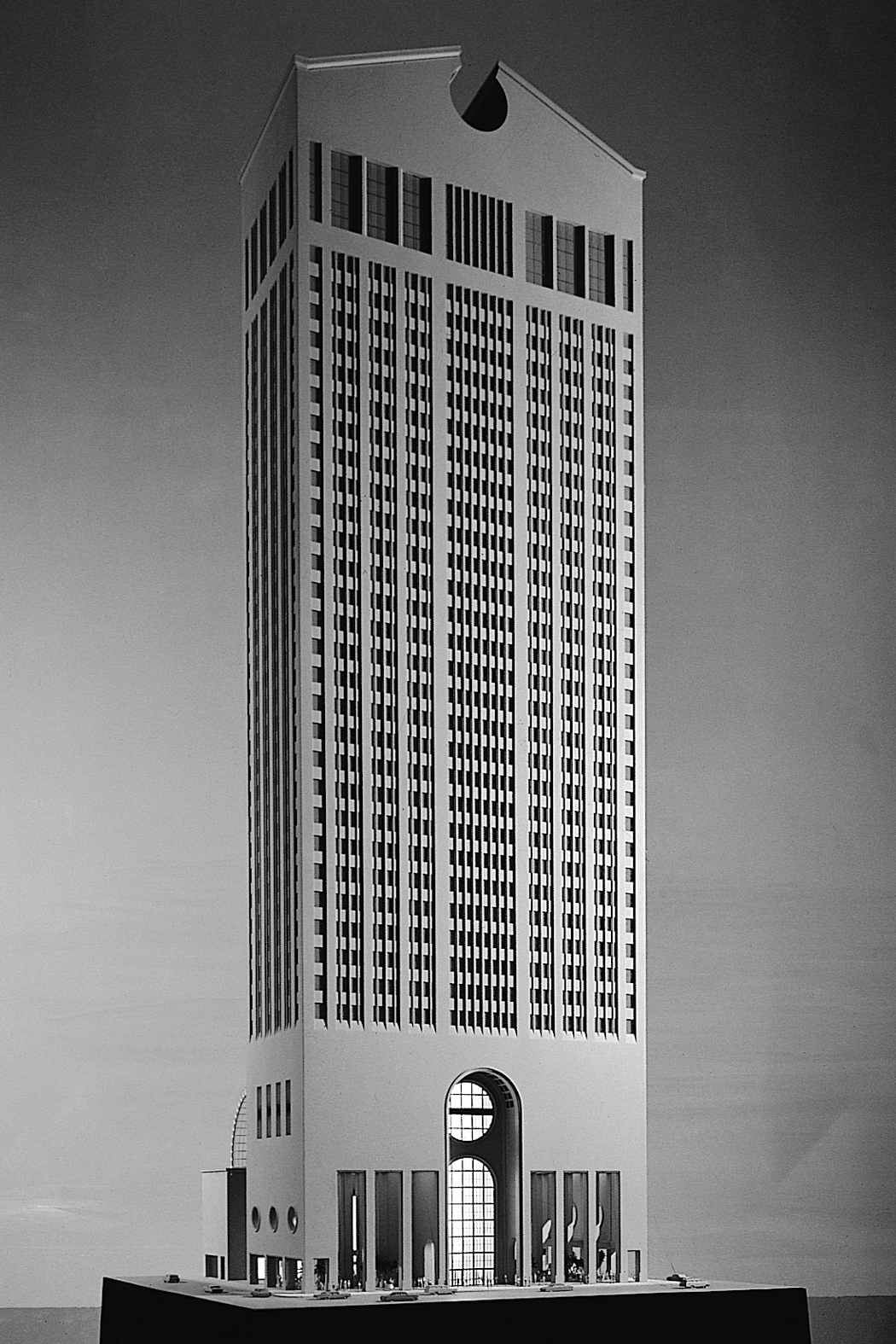
Postmodernism looks back to Modernism by embellishing modern blocks and boxes and so falls short of being able truly to express the emerging world of information communications technologies.
Taylor puts it thus:
The failure of classical postmodern architects to develop alternative forms and structures reflects a society that is no longer industrial, but not yet postindustrial. By creating an architecture around the automobile, Venturi, Johnson, and others remain stuck along the industrial highway and do not venture into the world created by the information superhighway. Their complexities are not complex enough. In network culture, not only surfaces but structures that once seemed simple become irreducibly complex. (p. 40 emphasis in original)
Taylor's text is structured in terms of a move from the grids of modernism to the networks of complexity via the critical perturbations of postmodernism.
|


