|
August 20, 2009
The Tate Modern has an exhibition on Russian Constructivism--- they were part of the Russian avant garde in the early 20th century that rejected all ideas of illusory representation.
Constructivist art is committed to complete abstraction with a devotion to modernity, where themes are often geometric, experimental and rarely emotional. Rodchenko focused on the physical qualities of the painting: the use of different paints and different textures, and how these related to other elements such as the painting surface, or the choice of colour.
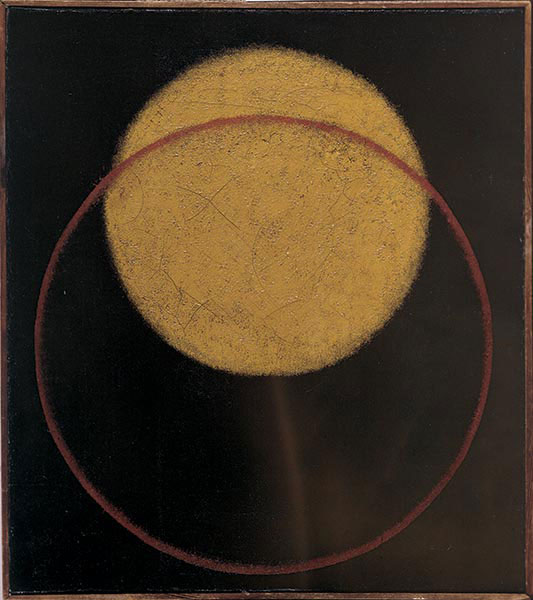 Alexander Rodchenko, Composition no 61, (from the series 'Concentration of Colour'), 1918
Artists like Rodchenko did not believe in abstract ideas per se; rather they tried to link art with concrete and tangible ideas. Early modern movements around WWI were idealistic, seeking a new order in art and architecture that dealt with social and economic problems. They wanted to renew the idea that the apex of artwork does not revolve around "fine art", but rather emphasized that artwork can often be discovered in the nuances of "practical art" and through portraying man and mechanization into one aesthetic program.
Rodchenko rejected ideas of 'Composition' – a subjective approach to art that expressed the personality of the artist, guided by ideas of taste and emotions – in favour of 'Construction', a more impersonal method dictated by the materials at hand and stripped of anything decorative or unnecessary. The painting is presented as a single physical object, with raw colour as its essential material:
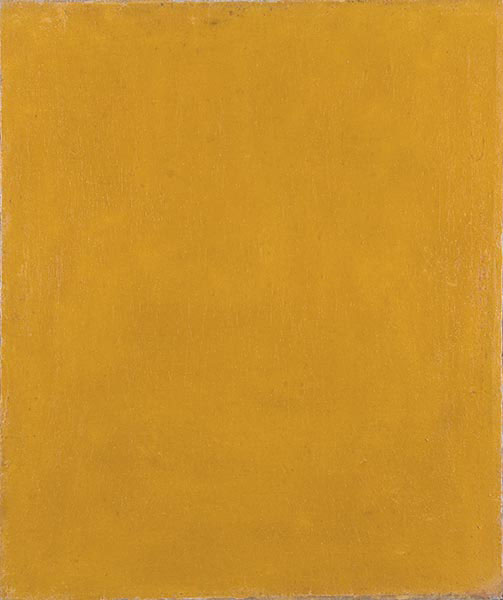 Alexander Rodchenko, Pure Yellow Colour, 1921
This is pretty much the Russian version of modernism. The principles of constructivism theory were derived from three main movements that evolved in the early part of the 20th century: Suprematism in Russia, De Stijl (Neo Plasticism) in Holland and the Bauhaus in Germany.
|


