|
August 11, 2009
Mirjam Wittman in Time, extended: Hiroshi Sugimoto with Gilles Deleuze” in Image and Narrative is concerned with time in photography. There is an earlier post on Hiroshi Sugimoto in which brief mention was made about photography and time. There mention was made of how photography is traditionally attached to the moment of time at which the image came into existence.
In 1980 Sugimoto began working on an ongoing series of photographs of the sea and its horizon in locations all over the world, using an old-fashioned large-format camera to make exposures of varying duration. These seascapes are often interpreted as being as much about the nature of photography as nature itself; and that in negating the horizon, Sugimoto’s photographs reassert or perserve it all the same.
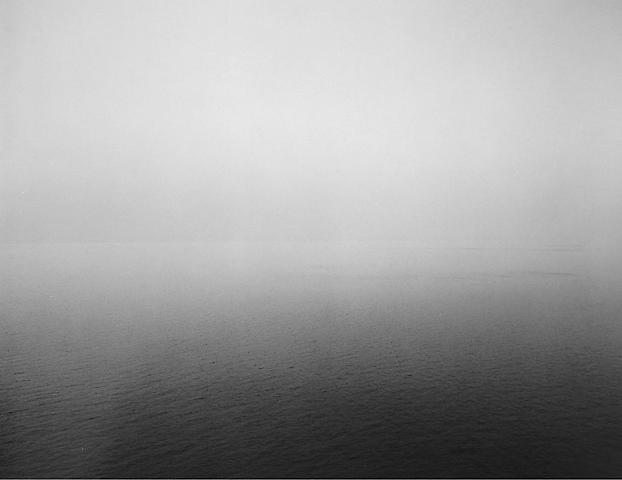 Hiroshi Sugimoto, 'Ionian Sea Santa Cesarea' (1990)
They fall into several basic types: clear dayscapes with crisp, absolute horizons dividing bright, blank skies from dark water; foggy dayscapes where sky and sea merge atmospherically; nightscapes, in which sky, water, waves, and horizon register as so many degrees of black; and dawnscapes shot deliberately out of focus, where sunpaths spill from misty horizons, rendering the candor of photographic vision as pure impressionism.
Wittman is more concerned with time as becoming or growing time and Deleuze's idea of an image of time in his film thinking as a series of simultaneous paths of bifurcations between the “actual” and the “virtual”. Deleuze calls this time-image-one that fluctuates constantly between actual and virtual and records memory-- or a crystal-image. The terms expresses his idea of an image outside of traditional verbal denotation. Does Deleuze’s ‘crystal-image’ of time have much in common with Benjamin’s ‘dialectical image’ of historical time as ‘petrified unrest’?
Wittman interprets Sugimoto's seascapes as time floating around, moving both in a linear timeline, through the moments captured in each single frame, and horizontally, across different images- until the series as a whole could be read as a movie in which all events registered simultaneously.
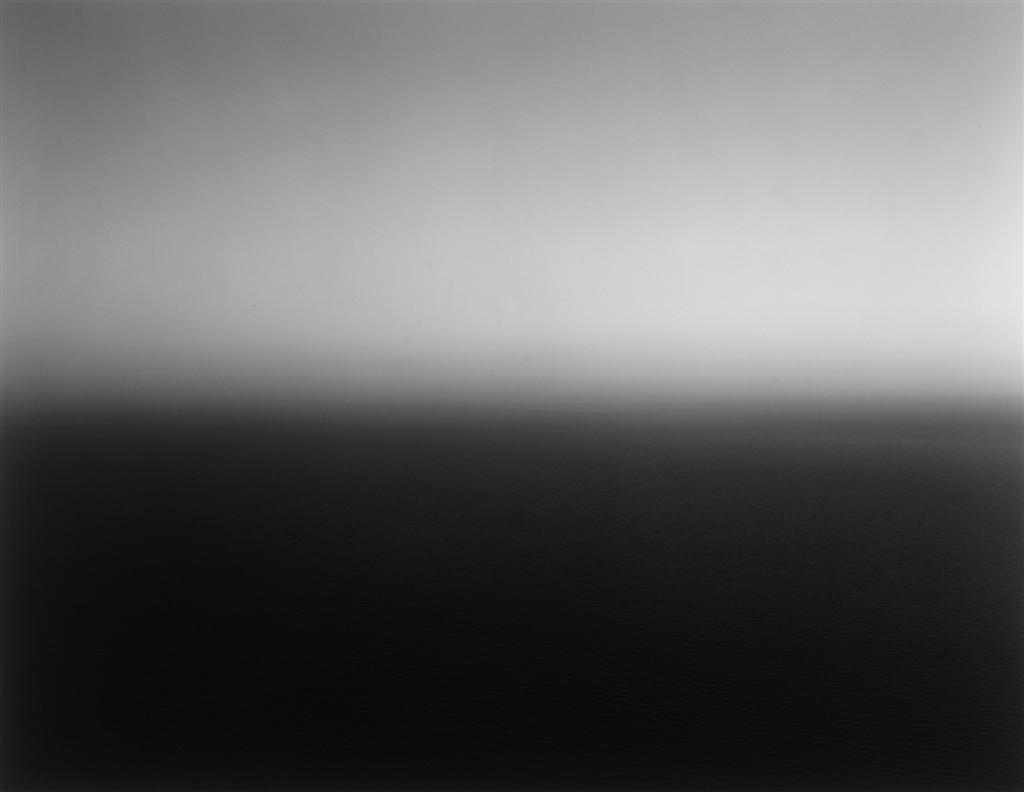 Hiroshi Sugimoto, Mediterranean sea, circa 1990
Hiroshi Sugimoto evokes a sense of time that is floating constantly between reception and production and provokes an understanding of time as event, thereby undermining the notion of the photograph as a frozen moment of time. Although a photograph captures a single moment of time and fixes it on paper, Sugimoto reinforces time as duration and and makes you feel as if time stands still and moves on at the same time.
|


