|
August 12, 2009
Takaaki Chikamori in a review of The Media City: Media, Architecture and Urban Space by Scott McQuire in Media Culture and Society (July 2009, Volume 26, No. 4) says that while Benjamin’s prominent figure of the flâneur has been mentioned in many literatures on urban modernity, the understanding of the figure seems to have been relatively limited.
This is important as I have adopted the figure of the flâneur as a model for my urban photography.
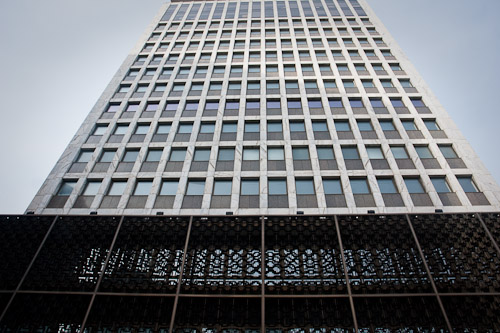 Gary Sauer-Thompson, State Administration, Adelaide, 2009
Chikamori says:
Gary Sauer-Thompson, State Administration, Adelaide, 2009
Chikamori says:
Usually, the flâneur is described as an aimless stroller who enjoys a panoramic view of urban space, or as a detective who holds behind his apparently indifferent attitude a keen attention to the details of people on the street. In each case, a certain position seems to be assigned to the flâneur: a position as a privileged observer who is somewhat detached from the bustling street life. However, when considering Benjamin’s original urban writings, the flâneur sometimes appears as the one who falls out of this assumed detached position. Instead of being aloof on the street, the flâneur can get lost, intoxicated like a hashish-eater, seized by some kind of attractive object and dragged around for a long time almost unconsciously.
The practice of flânerie can, then, be seen as a unique technique for getting lost in the city, which is how I understand it.
Chikamori says that the important thing here is that to lose oneself in the city, in the case of flânerie, does not simply mean a situation such as one’s sense of direction getting temporarily confused, or the configuration of streets being too complicated to comprehend. It rather refers to a situation in which one’s system of perception, or the whole system of subjectivity, undergoes a radical transformation. The faculty of mimesis, in which the world is perceived as full of similarities, correspondences and analogies, enables this transformation.
The practice of flânerie is not just about the visual experience, but about the transformation of the whole perception system which is the very condition of the visual experience. Instead of standing as a self-confident subject opposing things and people in urban settings as objective reality, the flâneur begins to lose his distinctive
contours and dissolves into the other kind of reality of the city. Urban memory traces cannot be read by a detached observer, but for an intoxicated flâneur, with his recovered mimetic faculty, the traces can be read as meaningful indexes of the past.
|


