|
August 9, 2009
This sample copy of The Journal of Aesthetics and Art Criticism is concerned with narrative. I am interested in narrative because some of my photographic projects --eg., Murray River and Port Adelaide--assume a kind of narrative. They are visual narratives in that a number of the photos as representations are connected in some way.
But what sort of narrative? Stories through images? Narrative is usually meant to refer to telling a story about a series of events connected in a certain way. This story involves a character in some sort of goal-directed action. But my photos are not about events nor do they involve the action of a character. Nor are they a memory around which I construct and reconstruct a life story.
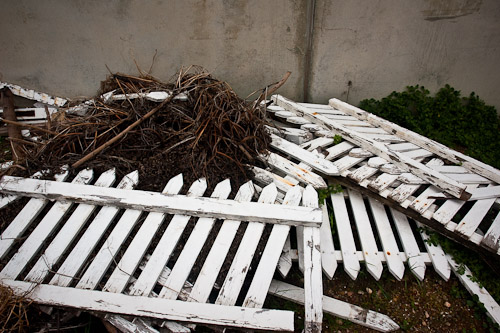 Gary Sauer-Thompson, rubbish, Port Adelaide, 2009
These pictures are more representations of states of affairs than anything else. Can the articles in the Journal of Aesthetics and Art Criticism help to explore what is meant by visual narratives?
In the Introduction to the issue Noel Carroll says that:
as the use of and the discussion of narrative become more common in the culture at large, philosophers are more apt to take notice of it and to start to analyze it, since one of philosophy's charges is to examine the conceptual network of our ideas and categories. Therefore, as the concept of narrative looms larger in our practices, we should expect philosophers to become occupied with it more... one route to the presently awakened philosophical concern with narrative has to do with a renewed interest in aesthetics with particular art forms, specifically narrative ones.
Specifically narrative ones refers to literary narratives and this standardly does not pay too much attention to nonliterary narratives. The assumption is for a narrative, we need at least two events, connected in a certain way.
In Narrative Pictures Bence Nanay argues that:
A naive conception of narrative would be a text or picture where something happens. And something happening usually takes the form of someone doing something. Further, narrative pictures very often, maybe even almost always, represent actions. ...If we want to build an account of narrative around the notion of action, a simple, and not very convincing, way of drawing the distinction between narrative and nonnarrative pictures would be to say that a nonnarrative picture, such as a still life or a portrait, usually represents a state of affairs, whereas narrative paintings represent actions.
Nanay adds that this way of drawing the distinction will not do, as there are portraits that represent the sitter as performing an action. There are narrative paintings where no one performs any action. David's The Death of Marat (1793) is a narrative painting, but Marat does not perform any action in it, as he is represented as dead.
|


