|
April 27, 2008
The German romantics had a profound influence on the way the Australian landscape was first imagined. as exemplified in the work of Eugene Von Guerard. Von Guerard's painting below of a NZ alpine landscape invokes the sublime through the vastness and otherness of the wilderness.
It can be contrasted with with naturalistic French landscape settings, or neo classical paintings that reflect nostalgia for humanity as an enduring presence manifested in traces of antiquity, or the intensely occupied pastoral landscapes of Constable and Courbet.
 Eugene Von Guerard, Milford Sound, New Zealand 1877-79, Oil on canvas
Milford Sound is one of New Zealand's most recognizable images and it continues to attract painters. This work by Von Guerard informs, and is a part of, the NZ landscape tradition. It evokes the Yosemite Valley paintings of Alfred Bierstadt:
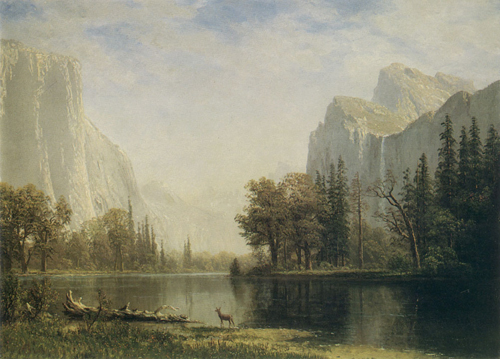 Alfred Bierstadt, Yosemite Valley, 1865, Oil on Canvas
Bierstadt and the earlier Hudson River painters set about to heed Emerson's call "to ignore the courtly Muses of Europe" and define a distinct vision for American art. Their roots were in European Romanticism and their work can be referenced back to that of Caspar David Friedrich in Germany.
I do not know the history of romanticism in New Zealand visual art or the tradition's different interpretations of nature. The tradition in general conceptualized nature as a mysterious and enigmatic force before which the artist must humble himself if he were to learn nature's secrets.The best place to become part of the underlying rhythms of the landscape was in the wild landscapes that stretched the 18th-century idea of the "picturesque" beyond breaking point.
JMW Turner was the English lodestone: wild nature, the interests in the classics and in literature, the interests in storms, in medieval architecture, in mountains, in atmospheric effects, in the dramatic portrayal of light, and in the truthful and yet poetic rendering of a locality. Turner was undoubtedly the most representative of all the English romantic landscape artists. If the European natural world was increasingly subject to an alarming erosion: its outlines have begun to blur, its forms to dissolve, and it becomes ruined, then NZ's South Island stands for wilderness untamed.
|


