|
April 7, 2008
Though indigenous people make up less than three percent of the population, their art in recent years reportedly accounts for about half of the total dollar value of all art sold in Australia. It has a high international profile, even if sales are slow for some regional art centres trying to crack the international art maket Indigenous artists are able to work as professional painters instead of sitting their local communities amongst the violence getting busted up.
An example is the work of Samantha Hobson. The image below is entitled 'Today Life' (2008, synthetic polymer paint , pigment and glaze on canvas) and it is from her 'Growing Up With Country exhibition at the Vivien Anderson Gallery in Melbourne:
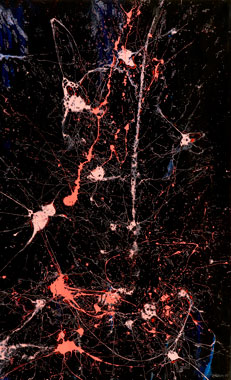 For a western audience this work's style resonates with the drip painting of Jackson Pollock. That is our immediate reference point. We automatically file it under abstract expressionism category, and accept the art history frame which states that Abstract art is an expansive term that is generally associated with all non-representational art. For a western audience this work's style resonates with the drip painting of Jackson Pollock. That is our immediate reference point. We automatically file it under abstract expressionism category, and accept the art history frame which states that Abstract art is an expansive term that is generally associated with all non-representational art.
In doing so, we tacilty locate it within the modernist movement of abstraction, whose origin lies with the diversw works of Wassily Kandinsky as an Expressionist artist, Pablo Picasso the cubist, and Kasmir Malevich a Russian Constructivist.
We understand that the style of this urban work is influenced, and being shaped by, by the international art market, even though we appreciate that it often expresses the beauty of life on the coast of the Great Barrier Reef and the blood, bruising and emotional distress realities of remote community life for Aboriginal people.
Painting, for professional artists such as Samantha Hobson, is their way of dealing with what goes wrong in a an indigenous community where unemployment and alcoholism have a death-grip on people’s hope for the future.
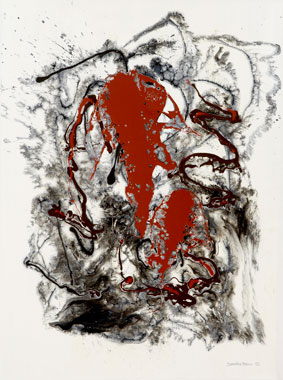 Samantha Hobson's Ol’man Hide 2008, (synthetic polymer paint, pigment and glaze on canvas) is another example of adopting formal considerations from a western perspective, coupled with a strong cultural and aesthetic connection with the land to evelove into a rich source of abstraction. Samantha Hobson's Ol’man Hide 2008, (synthetic polymer paint, pigment and glaze on canvas) is another example of adopting formal considerations from a western perspective, coupled with a strong cultural and aesthetic connection with the land to evelove into a rich source of abstraction.
This indicates the possibility of a number of stylistic developments within the conventions of abstraction and it suggests that we should become critical of the way Aboriginal Art is marketed from the Western Art aesthetic to which is attached an Aboriginal 'Spirituality'. This selling of spirituality consigns the art to ethnography.
The ethnography refers to the stories previously only painted during rituals as sand mosaics or body art. Stories of a creation epoch they call the ‘Dreamtime’; stories that carried traditional laws, philosophies and desert survival skills—the cultural bloodline of the oldest society on earth.
It is more honest to interpret the work of professional indigenous painters, such as Samantha Hobson, as contemporary examples of abstract expressionism.
|


Gary,
Very interesting post. It's an issue that is impossible to resolve with different opinions all over the world.
Kind regards,
David