|
April 12, 2008
We watched John Ford's classic Stagecoach, the movie that put the western on the cinematic map.
I expected the gender stereotypes---men are men and women are (sexless) women--- and the representation of Native Americans as a kind of subhuman species, and the brightly colored black-and-white world, since this was a fil about 'the winning of the West'. I was a rather taken back by the comic set pieces, the trashy phoney dialogue, the rigid, one dimensional acting styles as well as the racism, Indian hating, violence and mawkish celebration of white settler society. This was undercut by the darkness and pathology of the character of the embittered Ethan Edwards, an ex-Confederate soldier who did not really belong anywhere in the post-Civil War era; and who, as a hero trapped in a monomaniacal quest for vengeance, is at odds with the society he is expected to protect:
I read this film about the society being forged, in violence, by the settlers as a pastiche---as fidgeted-together that is open to interpretation.
Aesthetically, The Searchers presents a vast, sophisticated panaroma of the American West - the imagery of buttes and spires of Monument Valley, Utah, with its rockscapes and sweeping vistas, that is often called mythic. This transcended the awkwardness and corniness of life in settler society
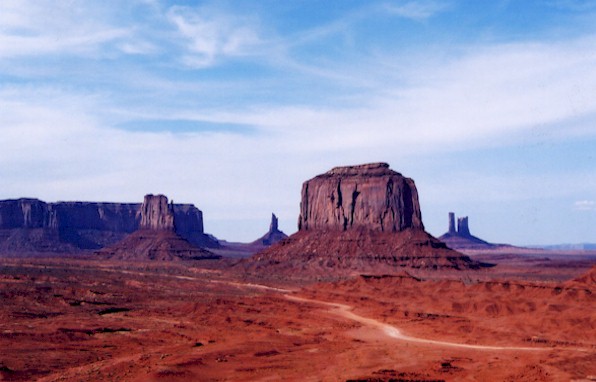 Monument Valley, Utah
We have the hint of closing of the frontier, the establishment of order in wild places beyond the border of civilization, the heart of darkness on the other side of the border, American machismo and justice transforming into where vengeance.
 Monument Valley, Utah
The representation of the landscape and the people by Winton C. Hoch is where this film is visually masterful, especially the frame within the frame shots from a domestic space into the wilderness and barbarism. What is also masterful is the way that the triumph of settler civilization over barbarism is founded on a necessary lie, and that underneath its polished procedures, myths and high-minded institutions is the buried legacy and truth of violence and bloodshed.
Therein lies the core of the western---a man standing framed in a doorway, alone looking out at desolate expanse. The doorway is the line or border that separates the wilderness and the garden. Theboder signifies the cost of violence, which is the moment at which settler's society's foundations are laid over blood and sand.
|


Gary,
It's an enormously influential film. A few films inspired by The Searchers were: Scorsese’s Taxi Driver, Who’s That Knocking at My Door? and Mean Streets, Lucas’ Star Wars, Spielberg’s Close Encounters of the Third Kind, Sergio Leone’s Once Upon a Time in the West, Schrader’s Hardcore, and Wenders’ Paris, Texas (1984). Sam Peckinpah also referenced The Searchers several times in Major Dundee, The Wild Bunch, and Pat Garrett and Billy the Kid.
The counterpoint to Ford's The Searchers is Jim Jarmusch's short, black & white film called Dead Man. Here the Western eats its own tail.