Thought-Factory.net Philosophical Conversations Public Opinion philosophy.com Junk for code

Mandy Martin, Puritjarra 2, 2005. For further information on MANDY MARTIN, refer here: http://www.mandy-martin.com/
If there are diverse kinds of knowledge and ways of knowing place, then we need to learn to value the different ways each of us sees a single place that is significant, but differently so, for each perspective.
RECENT ENTRIES
SEARCH
ARCHIVES
Library
Thinkers/Critics/etc
WEBLOGS
Australian Weblogs
Critical commentary
Visual blogs
CULTURE
ART
PHOTOGRAPHY
DESIGN/STREET ART
ARCHITECTURE/CITY
Film
MUSIC
Sexuality
FOOD & WiNE
Other
www.thought-factory.net
looking for something firm in a world of chaotic flux

the heart of politics is...? « Previous | |Next »
September 13, 2007

The earlier, companion cartoon is here at public opinion. It shows the plotters moving in for the kill. That's the real heart of politics some say.
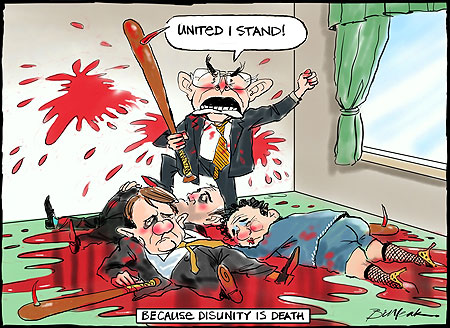
LeakHowardfights.jpg
Bill Leak

It is hard to escape the hothouse politics in Canberra at the moment. It dominates the media and the chatter over pre-dinner drinks or coffee. Is Howard wounded? Who will win the election? Have the Libs self-destructed?

I will be glad to be in Brisbane for a day --in Beatties' cosmopolitan, modern Brisbane known as the smart state --not the old rural Queensland of Labor that refused steadfastly industrialization. I remember the sense of space of space and light --as well as the heat---that pointed to another heart of politics.

Update
I never knew the older literary Brisbane of the 1960s and 1970s that grew up in conservative authoritarian Queensland of the Bjelke Peterson regime. I presume the writers grew up in isolation as opposed to being part of a literary tradition. What I know and enjoy is the lively Brisbane of today, with its own confident style despite the standardized glass towers and Harry Seidler's Riverside in the CBD.
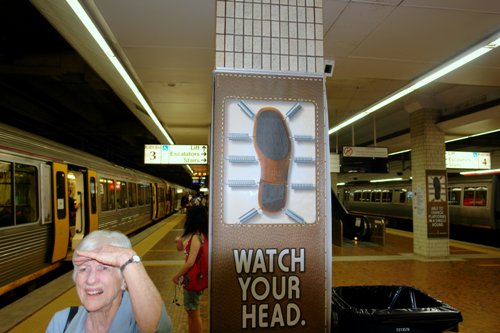
BrisbanerailwayStation.jpg
Gary Sauer-Thompson, Brisbane Railway Station, 2007

So another heart of politics is the development of an urban way of life built around a lively civil society. A decade of Beattie has bequeathed that to Brisbane. The spaces in Brisbane are democratic.

Update
Hell, I even had a soft spot for Seidler's austere, modernist Riverside Centre:
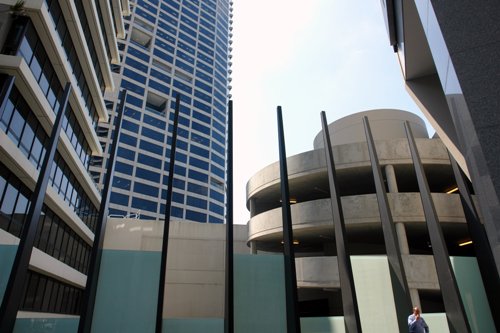
BrisbaneRiverside.jpg
Gary Sauer-Thompson, at Seidler's Riverside Centre, Brisbane, 2007

The plaza or public space has opened up the river's edge and made it accessible to the people in the city. I guess that for all his modernist dismissal of Australia as a nineteenth century backwater that had to be junked Seidler had a point. I enjoyed my moment relaxing in the plaza.

| Posted by Gary Sauer-Thompson at 06:12 AM | | Comments (6)
Comments

Comments

I like the watch your head pic.
Beattie? Who's that?

Les,
dunno.The 'watch your head poster, was everywhere on the platforms.There were some posters about 'watch your feet.' And plenty of Workchoices advertisments. I kinda like the Central Railway Station in Brisbane.

There was plenty of graffiti on the walls along both sides of the railway line out to Wilston.

Gary,
David Malouf has written about the literary Brisbane. He says that he grew up in an Australia that was impoverished and that Brisbane was really the capital of poor white Australia. He talks in terms of the long depression which in some ways lasted from the end of the 1890s right through almost to the outbreak of the war in 1945.

Pam,
the Malouf article that I read, that had been cut out of the Weekend Australian, talked about the difference of Brisbane in terms of the moisture in the air, the quality of light, life under the house, the storms in the afternoon, and rain on the tin roof at night.

Gary
David Malouf’s novel Johnno is full of images from 1940s and 50s Brisbane, like the tramways, brothels and gardens. Malouf sees Brisbane as exotic and it is Dante in Johnno who lamented that Brisbane was a place "where poetry could never occur".

His view of the city is telescoped into a landscape which with its ramshackle inner city dwellings, muddy, mangroves and its ‘ordinary’ life that seemed the apotheosis of life in exotic foreign locales. This impression is cemented by the fact that much of early Qld architecture aped that of Europe, and so echoed those distant vistas without ever feeling able to present the ‘real thing’.

Malouf has written some evocative descriptions of this place eg ‘Brisbane is so sleepy, so slatternly,
so sprawlingly unlovely… It is simply the most ordinary place in the world’ (p 72). And he has Dante deliver a fierce diatribe against this Brisbane: ‘It was so shabby and makeshift … a place where poetry could never occur.’

Pam
I recall reading somewhere that Malouf reframed the vastness of the bush and questioned the way that it had been reframed as an vast, empty, unforgiving, barely explored expanse .

He said that once upon a time --(the 19th century?) Australians found that emptiness to be very frightening, and there was that emptiness as nothingness or deadness that was emptiness, and that it represented an emptiness in us as well.

Malouf's reframing says that we feel that emptiness anymore, as he doesn't see any reason why one should be anything but positive about Australia. Australians I have created a society in which we've learnt to live together in very complex circumstances and that everything in our past would tell us that we have developed the resources for facing crisis and getting over them really quite well.

Was that in the Boyer lectures in 1998?

 
Post a comment

(If you haven't left a comment here before, you may need to be approved by the site owner before your comment will appear. Until then, it won't appear on the entry. Thanks for waiting.)

Name:
Email Address:
URL:
Remember personal info?
Comments: (you may use HTML tags for style)