|
January 10, 2008
I caught the tram into the business part of the city this morning in order to pick up a new wireless modem for the home office from Internode---my ISP provider. This mode of transport makes it easier to move around the city. The tram was packed, as it has been every time I have used it in the last month or so.
However, I noticed that at the City South stop there was no shelter from the weather (it was going to be a 40+ degree day), no seats and no timetables. It is an indication that the shift to making the city a people friendly one has a long way to to go. Poor marks for quality of life in a public space I thought.
Was Adelaide on the way to becoming a place as opposed to a space of different flows? I wandered around the public spaces of the CBD taking some photos about Adelaide's identity or brand in a globalized world:
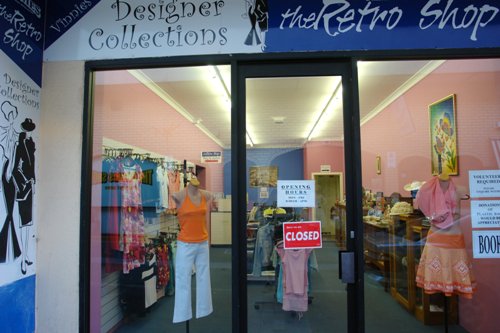 Gary Sauer-Thompson, retro fashion, Adelaide, 2008
What was surprising was the change in the city towards more the pleasant open air coffee shops that provided a space that linked the street to the shop. It gave people public space so they could have their privacy and yet interact publicly. The public space was more inclusive.
Was the uptight, aggressive, boorish Adelaide a part of the industrial city?
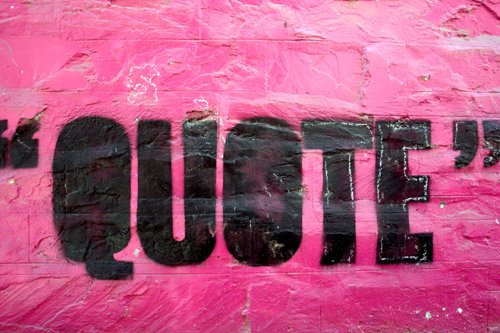 Gary Sauer-Thompson, quote, Adelaide CBD, 2008
The city was no longer a space with buildings, retail and cars, as there was a tacit recognition that the city is a place for people to be in, rather than just a space to work or shop; a space for economic flows. Is this an indication of a post-industrial Adelaide?
The prominence of Adam Internet and Internode in the CBD are an indication of this. I posted an image I'd taken on my laptop in a free wireless cafe, and whilst I was waiting at Internode for the shiny new modem, I made some comments to my weblogs on their public computer.
Is this another indication of the shift from industrial (manufacturing) cities towards cultural, creative and knowledge-based urban environments?
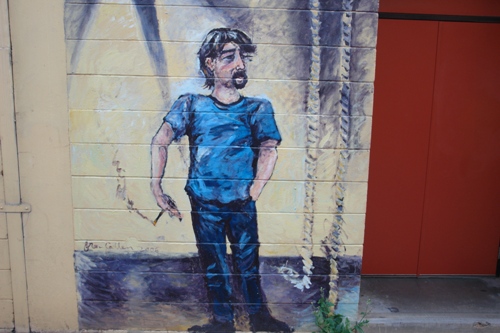 Gary Sauer-Thompson, mural, Adelaide CBD, 2007
The discernible shift I've noticed in the quality of life in the ‘new information economy’ that is transforming Adelaide discloses how the city has a special role to play, since face-to-face interaction, networking and trading, are vital for a quality of life.
If Adelaide has a long way to go in terms of the quality of the public space of urban life, then the ‘network society’ is here.
|


Gary,
there are no free wireless cafes in Victor Harbor. There should be given that it has become a tourist town that is based on the shift from subsistence to ‘making sense’ through seeking ever more stimulating experiences.