Thought-Factory.net Philosophical Conversations Public Opinion philosophy.com Junk for code

Mandy Martin, Puritjarra 2, 2005. For further information on MANDY MARTIN, refer here: http://www.mandy-martin.com/
If there are diverse kinds of knowledge and ways of knowing place, then we need to learn to value the different ways each of us sees a single place that is significant, but differently so, for each perspective.
RECENT ENTRIES
SEARCH
ARCHIVES
Library
Thinkers/Critics/etc
WEBLOGS
Australian Weblogs
Critical commentary
Visual blogs
CULTURE
ART
PHOTOGRAPHY
DESIGN/STREET ART
ARCHITECTURE/CITY
Film
MUSIC
Sexuality
FOOD & WiNE
Other
www.thought-factory.net
looking for something firm in a world of chaotic flux

bad public art in SA « Previous | |Next »
January 13, 2008

Lazy Aussies' Worst of Perth occasionally makes exploratory forays outside Perth, but these forms of kitsch are only allowed if they can challenge one of Perth's own. An example offered is public sculpture and some have risen to the challenge as that post shows.

This giganticism, shot from a car window on the way to Wilsons Promontory would, I suggest, offer a good challenge to the Morley walrus. A tourist icon:
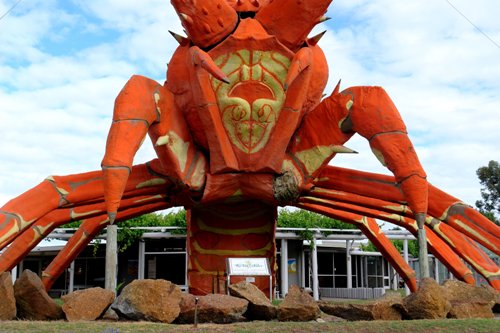
KingstonCray.jpg Gary Sauer-Thompson, Big Lobster, Kingston, SA, 2008

I do not know who designed or constructed the giant lobster on the Princess Highway. The same person who does the Big Pineapple? But I gather that the locals understand this form of public art(called Larry apparently) to be an expression and interpretation of their community, and one that contributes to a sense of pride and place to Kingston.

We were just passing through as 'cultural tourists' and we saw ourselves as visiting. We bought a drink, took some photos and travelled on to Port Fairy.

Update: 14 Jan
I guess that the Big Lobster sculpture was an early attempt to try and put a plain and unattractive Kingston on the national tourist map by signifying that Kingston was the home port of the lobster (crayfish) fishing industry. Kingston, as the 'Gateway to the South East', is overshadowed by the more attractive town of Robe, and so it needed a big tourist icon. The tourism industry was to be the extra engine that enabled development----boost growth in business and employment opportunities--rather than offer a kitsch tourist experience. I

| Posted by Gary Sauer-Thompson at 1:03 PM | | Comments (12)
Comments

Comments

http://www.wilmap.com.au/bigstuff/default.htm

There certainly is a few big things out there. One day there will be a Big Turnip! Boy wont that be great!

I wonder what sort of medication people are being deprived of when it occurs to them that a gigantic lobster is a good idea. At least they've stylised it - the front end of a real lobster is an obscene thing and would frighten kiddies.

There's a big bull in Rockhampton that's brought the council no end of grief. Apparently after a night on the turps the locals love nothing more than depriving the big bull of his masculinity, to put it delicately. They keep having to replace the scrotum due to public demand. Pool rooms and backyards all over Rockhampton must be home to giant fibreglass bull goolies, so much does the Rockhampton public love its public sculpture.

Yes the big prawn was closed last time I was in Ballina where you look out through the head because of repeated vandalism. The gift shop was still open though and doing a good trade. I'm heading down there on wednesday on my way to Evans Head so I will pop in. Being inside a giant prawn has a strange attraction for me. Perhaps its some sort of Mobydickian Syndrome.

Santa Madonna! I suppose that in the Walruses "favour" is that it is genuinely supposed to be good with poetic dedications etc, but this was always meant to be bad right?

WOP,
I once met someone--a nice person-- who worked as a metal technician in the sculpture department of an art school, who built the big things --as Les calls it--- as a way to creat a career as an artist. He considered what he was doing was good not bad.

So I'm not sure that 'intention' has much to do with the interpretation of a visual object or making an aesthetic judgment of 'the worst of'.

Well,
I did interpret the Big Lobster on my road trip in good old modernist terms as kitsch, or as artistic trash. I understood the Big Lobster (built around 1979) to be the work of the culture industry (the tourism industry).

South Australia is home to six big icons:---Kingston’s Big Lobster, Gumeracha’s Big
Rocking Horse, a Big Winch at Coober Pedy, the
Riverland’s Big Orange, a Big Clock at Murray
Bridge and an 8 m-high Big Galah on the Eyre
highway in Kimba.

There is some suggestion that the sculpture was created by the town's sculptor in residence, a South Australian artist named Silvio Apponyi working on the Maria Creek beautification. -Apponyi the Big Marino.

Now I know that it is rather difficult to say what kitsch is--- but sugary trash dished up by the culture industry is my working definition.

It is more than art compromising itself or art becoming sentimental rubbish. It has to do with artistic vulgarity of low art that is usually associated with the working class, or those whom the modernists called 'the masses'.

All of this is tricky stuff as it is loaded by the modernist's high culture (social privilege)/low culture (class domination) view of things. So the vulgar is loaded with the marks of repression.

Gary,
there is a history, perhaps even a tradition, of the 'artist traveller'. Artists have consistently travelled and explored the world. Their sketchbooks and journals have been integral to the imagery and constructions of history, culture and geography. Such works have also been integral to bringing the world closer to home--eg., Europe or Australia to Britain.

The new technology of the 'artist traveller' is the digital camera, laptop, broadband and Flickr. The photographers are tourists, yet they are also participants. They are cultural tourists (eg., cultural consumers), yet they are also cultural producers (producing 'tourist art') whose work will exist online, in a book, or in an art gallery, or tour to regional venues.

Pam,
I see. Of course. So I am unwittingly drawing on a history of those artist travellers, who have put themselves in the picture and identified their own points of view, positioning themselves spatially and contextually. We can be both participants and observers in ways that only tourists can be. They saw themselves seeing.

I'm not sure that I was doing that. Nothing so self-conscious.

For my purposes I would draw a big divide between kitch attempted and achieved and art attempted and failed. The kitch producer can always fall back on that. The walrus carver has no position to fall back on.

WOP,
okay, kitsch is usually poorly designed and cheaply made, and palettes often contain clashing colours that don't work well together. Interiors of Chinese restaurants are kitsch.

Its different from retro, which refers to a specific time period--1950s or 1970s.

The Big Pineapple was designed by the Brisbane architect - Peter Devenport. The internally climbable structure is a most interesting one that opens into a 360˚viewing platform. The pineapple scales must be a first also in the way they were designed and fabricated. Not too sure by it appeared back in the early 1970's from memory. (Rhana Davenport's dad) . . .

Malcolm,
now why would a Brisbane architect embrace kitsch? Wasn't the 1970s modernist? Or was Brisbane different?