Thought-Factory.net Philosophical Conversations Public Opinion philosophy.com Junk for code

Mandy Martin, Puritjarra 2, 2005. For further information on MANDY MARTIN, refer here: http://www.mandy-martin.com/
If there are diverse kinds of knowledge and ways of knowing place, then we need to learn to value the different ways each of us sees a single place that is significant, but differently so, for each perspective.
RECENT ENTRIES
SEARCH
ARCHIVES
Library
Thinkers/Critics/etc
WEBLOGS
Australian Weblogs
Critical commentary
Visual blogs
CULTURE
ART
PHOTOGRAPHY
DESIGN/STREET ART
ARCHITECTURE/CITY
Film
MUSIC
Sexuality
FOOD & WiNE
Other
www.thought-factory.net
looking for something firm in a world of chaotic flux

Gold Coast: vulnerability « Previous | |Next »
January 1, 2008

Lyn had an interesting post on community authoritarianism in the suburban heartland on the Gold Coast over at Public Opinion. References have been made about the effects of global warming on this city, which is the most popular location for tourism in Queensland.

The likely effects on this 'Development or Frontier City' are rising sea levels, more intense storms and cyclones and reduced water availability. I'm not sure about more heat waves. That means the Gold Coast needs to address the issue of sustainability. Will this new urban formations be able to do so?

Gold Coast.jpg Gold Coast, source: Wikepedia

As a coastal region the Gold Coast is vulnerable to considerable damage to low-lying coastal settlements and infrastructure, as it is a space where populations, tourism and capital investment are large and growing.The beaches have a history of severe erosion and the tidal waterways, canal and estuarine systems are subject to intense flooding from king tides and extreme storm sequences.
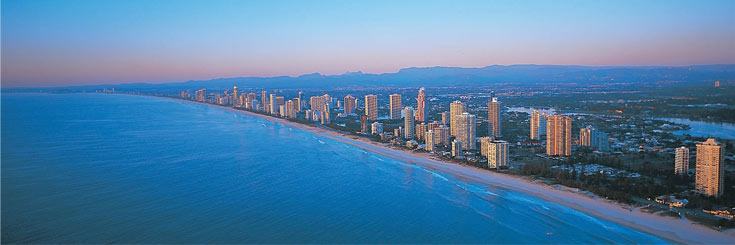
Gold Coast1.jpg Gold Coast, looking south west, ( Courtesy Gold Coast City Council).

The suburban heartland of the Gold Coast is vulnerable to the effects of global warming because the heavily developed coastal strip sits on a narrow barrier sandbar between the waterways.and the sea. Much of the land between the coastal strip and the hinterland was once wetlands drained by the Nerang River, but the swamps have been converted into man-made waterways and artificial islands covered in upmarket homes in a resort-style residential real estate development. The area is 90 sq km in area and contains nearly 60, 000 dwellings, 40% of which are flood prone. Hence the need for flood mitigation projects.
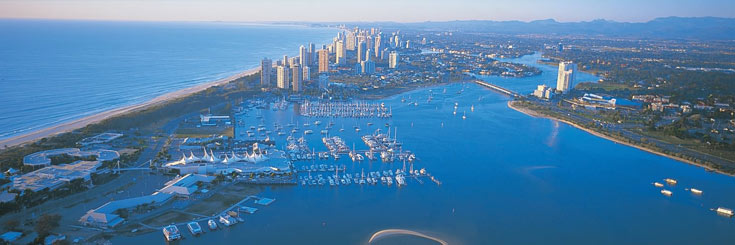
Gold coast2.jpg Gold Coast, looking south ( Courtesy Gold Coast City Council).

It is unlikely that the Gold Coast will become an ecological city-- a city in balance with nature. It will adapt to the effects of climate change.What does 'adapt. mean apart structural flood mitigation projects? it looks to mean a desalination plant powered by electricity from coal-fired power stations that produce greenhouse emissions to address water shortages?

So what will happen during the next big flood?


| Posted by Gary Sauer-Thompson at 8:21 AM | | Comments (9)
Comments

Comments

Gary,
The Gold Coast is the sign of the newly ascendant ‘culture of the beach’ that has ended the old city-bush contest with its anti-urban ethos by establishing itself as the real Australian dream. The seachange narrative is a 'from the billabong to the beach'one. The City on the beach is the 21st century Australia.I don't know the Gold Coast, but I presume that it has the simultaneous rise of new poverty concentrations (working poor) and gated bastions of affluence (retirees?) .

The coastal strip reflects the Gold Coast’s evolution as a tourism city and, from what I gather from friends, tourism is a major source of revenue for the Gold Coast. My friends know the Gold Coast as the commercialism of Surfers Paradise from their shortstay holiday accommodation.

Gary,

I looked about for a pic of the coast that shows how vulnerable it is, but didn't find anything quite like this shot.

You can see how vulnerable the whole place is to anything the sea decides to do from the north during a king tide. You can't really see the Seaway in that shot, which is a thin band curving toward the mainland from the northern tip of the Spit, the undeveloped land north of the high rise strip.

There's a constant squabble between developers and conservationists over building on the Spit.

The canal estate towards the top is called Millionaire's Row, for good reason. The island to the south of that is called Chevron Island, where prices are booming while basements flood.

The vertically layered balcony culture grows with every new high rise, and there are new ones being built all the time. The new one, Soul, http://www.soul.com.au/ (it's worth sitting through the ad to see how we are represented to ourselves here) is being built where Raptis Plaza used to be. It featured an indoor, giant reproduction of Michaelangelo's David, with fig leaf. Never let it be said we're a cultural desert.

Lyn
I've added a couple more images. The one that I had in my head---a very narrow strip ---is the one I cannot find.

Pam,
in comments elsewhere Lyn has pointed out the urban and cultural trajectories on the Gold Coast, which I understand as a 'new frontier city', are marked more by impermanence than continuities.This urban form of the city on the beach is constantly self-renewing-- or producing-- itself with little sense of any limits on its development. I presume that there is a very real conflict between the suburban canal settlements and the natural function of floodplains and river systems, since the new resort style developments are going ahead on the floodplains.

Presumably, flooding is deemed to be acceptable risk that can be managed by developers, residents and the Gold Coast Council.

Gary,

That's what I had in mind too. I think the aerial shots I recall must have been taken years ago. The coast is now continuous, into NSW and there's not a lot of vacant land left between the GC and Brisbane.

These shots are good for illustrating the vulnerability, and also the way the place is sold as a waterfront glitterstrip.

Lyn,
I watched the Soul promo----they are thinking of the Gold Coast as another Florida; ie., one without the Cuban exiles.

Lyn,
I guess that climate change is a factor that people are aware of in deciding where to live, and that they will continue to balance the impacts against the glitterstrip factors that continue to make the Gold Coast so attractive.

However, it is also possible that they are often unaware of current and potential impacts; or that they are simply hoping that the worst predictions won't eventuate.

I have no idea which is which.From all accounts the Gold Coast City Council is pretty stong on coastal management re the rising sea level and flooding scenario. They have it under control. Deputy mayor David Power says:

We started thinking about the impact of climate change about 10 years ago...Of course, we have special reasons to do so -- the beach is a key asset to us. But the coastline is not the only part of the council area. About 70 per cent of our territory is the rural hinterland. A large part of the area is essentially flood plain. We see it as a matter of survival to address these issues.When it comes to zoning and permission for new construction, we have long had measures in place, in anticipation of a one-in-100-year flooding event, such as a combination of extensive rainfall, storm surge, and a king tide," he says. "It requires that floor levels be built a certain height above average sea level, and that has been increased to take account of climate change. We have also developed disaster management strategies, and we are constantly reviewing them in light of climate change projections.

The problem according to Power is the Greens. He says that:
many of the measures we have proposed, including another artificial reef further along the coast, have been opposed by green groups and self-styled environmental activists. They have also attacked our proposed desalination plant, even though we hope to have it powered by sustainable energy sources within 10 years. You would think that these groups would be the first to applaud our efforts, but in fact they oppose everything we put up.

These activists and stirrers must be dark green since the Gold Coast Council is green.

I was out today taking pics of the beach from Currumbin to Surfers.
If you look at the pic that shows the vulnerability I was in the center of the high rise cluster. The tide was very high today due to the rough seas. I estimated that for the water to rise enough to flow down caville mall it would need to rise at least another 4 mtrs.
There are parts that are lower so they go under first. Miami and Mermaid do seem to get flooded out a lot when we have large rains.

Lyn,
The foam down at Elephant rock is marvelous to look at.

Pam,
You would enjoy looking at the Ephraim Is development.
http://www.ephraimisland.com.au/welcome.html

Pam,
Yes. We don't like exiles around here. They make the place look messy. Actually I think they're going for a Florida/Las Vegas combo.

Gary,
I don't think the residents think about climate change at all in relation to their homes. Griffith does a lot of research that relates back to beach erosion which is well supported by the surfing and tourist industries. Qld has been good overall at dealing with water shortages, considering strong local opposition to both desalination and recycling. Apparently the infrastructure for managing flooding from inland sources around the dam is almost finished. I didn't think it had even started yet, but as part of the pipeline between Gold Coast and Brisbane, the political and media focus has been on fresh water supply, rather than flood prevention.

The political stand off between the council and the dark greens around here is ridiculous, but it's the result of bad planning white shoe brigade style. In typically pollie fashion Power mentions the reef but not proposals for developing the spit. He mentions power sources for the desalination plant but not the near absence of public transport that's resulted in traffic congestion and air pollution. 10 years ago you could look up at night and see stars. If the horizon wasn't blue it meant there was a fire somewhere. Not any more.

The dark greens talk up protection of sanctuary areas, but omit to mention that a single frog species with help from the NSW government held up an important bypass by a good decade and multiplied the cost to the public by numbers with lots of zeros. NSW wouldn't contribute even though it shared the benefit, and the thing had to be re-routed to save the frog.

There's actually a healthy frog breeding program here. The local primary school is part of it. They have a small area set aside adjoining the library where they breed frogs, educate the kids on how to breed their own and supply tadpoles to anyone wanting to take part. The kids are trained to gently peel the frogs off the books in the library and return them to the ponds. Yet a frog species cost Qld several million that could have gone into reading programs and school library books.

A well thought out reef could reduce the threat from big swells, benefit fish, the diving and sport fishing industries, and use up an awful lot of old tyres as WA and I believe SA have both done with great success. With some very complex water movement after years of human interference with the coastal and waterways configurations, we've got an impressive body of research to rely on for something like placement of a reef.

On the other hand, the decimation of mangroves for development purposes has reduced fish nursery areas and proportionately increased an already substantial mosquito problem. Ultimately, the developers walk away with buckets of money and the rest of us pay rates so the council can spray us with poison to kill the mozzies. And deal with erosion exacerbated by the unneccesarily gigantic cruise and game fishing boats that tear through the waterways.

All sides are quite insane.