Thought-Factory.net Philosophical Conversations Public Opinion philosophy.com Junk for code

Mandy Martin, Puritjarra 2, 2005. For further information on MANDY MARTIN, refer here: http://www.mandy-martin.com/
If there are diverse kinds of knowledge and ways of knowing place, then we need to learn to value the different ways each of us sees a single place that is significant, but differently so, for each perspective.
RECENT ENTRIES
SEARCH
ARCHIVES
Library
Thinkers/Critics/etc
WEBLOGS
Australian Weblogs
Critical commentary
Visual blogs
CULTURE
ART
PHOTOGRAPHY
DESIGN/STREET ART
ARCHITECTURE/CITY
Film
MUSIC
Sexuality
FOOD & WiNE
Other
www.thought-factory.net
looking for something firm in a world of chaotic flux

Port Elliot--beach culture « Previous | |Next »
January 28, 2008

Yesterday afternoon we hung out at Horseshoe Bay near the Flying Fish Cafe (lots of photos by Mandi Whitten ) at Port Elliot. We were a little group amongst thousands of others having fun on the Australia Day weekend by being at the beach.
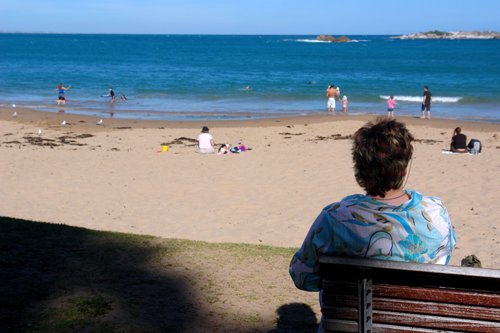
WomanHorseShoebay.jpg Gary Sauer-Thompson, Horseshoe Bay, Port Elliot, Fleurieu Peninsula, 2008

It was an outing as Monday was going to be spent working on the weekender.I tried to do some photography of beach culture---to question the prevailing notions of Australians as a people who look inward to the 'bush' or the continental centre as their primary reservoir of national identity-----but the harsh glaring light made things rather difficult.
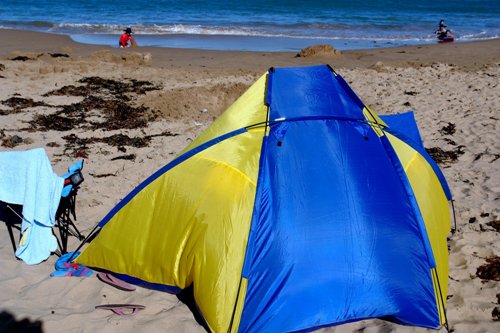
BeachTent.jpg Gary Sauer-Thompson, beach tent, Horseshoe Bay, Port Elliot, Fleurieu Peninsula, 2008

Australia Day means having fun at the beach. If all the flag waving means love of country--rather than one white nation, then love of country includes love of the beach. It's the body, icecream, chips, beach cricket and volleyball, surfing, sunbaking, building sandcastles as well as gourmet food and wine. It is where surf clubs have changed from male bastions into family and community institutions.
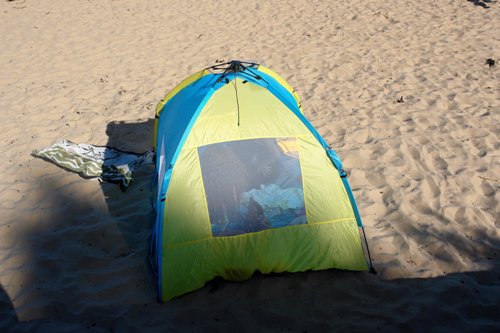
Beachtent1.jpg Gary Sauer-Thompson, beach tent Horseshoe Bay, Port Elliot, Fleurieu Peninsula, 2008

What I had in my mind was Phillip Drew's The Coast Dwellers: Australians Living on the Edge (1994), where he argued a thesis of Australians as 'verandah people' who derive their identity from their place at the physical margin of the island-continent. He argued for a view of Australians as continental fringe dwellers, who gaze out across their beachscapes in search of their place in the world.

Any thesis about the Australian identity being shaped by the beach would defeated by the complexity of meaning and experience arising from the diverse ways Australians use their beaches.

| Posted by Gary Sauer-Thompson at 12:19 PM | | Comments (9)
Comments

Comments

Gary,
I agree with you on identity and beach cultures.

The thing I found interesting about Coast Dwellers was that while we're gazing outward, we also have our backs to something. If the whole nation walked backwards until we collided would we all end up at Uluru?

Lyn,
it's the hills, or the ranges. You have to cross them to get to the desert or centre.

Pam,
What are the cultural differences between Americans and Australians that made American pioneers climb every hill or range they found to settle on the other side until the west coast stopped them, while Australians kind of shrugged their shoulders, said 'too hard' and went to the beach?

I'm glad we did, but find it interesting that while we were building the 'defeated by the interior' mythology, the Americans were building Las Vegas.

Port Elliot is great place for a lunchtime stop which we have done many times. After 4 years in Katherine we yearned to live by the sea so when we looked for a community school Maningrida was a great choice. There was even a tiny view of the water from our back verandah which turned into multiple views after Cyclone Monica in 2006.
Our current home Broome has two special places among many. The vast expanses of Cable Beach and the more intimate Town Beach. The Dampier Peninsula has many extraordinary beachscapes such as Middle Lagoon which is a little known gem.
Yet the coast is only a small part of our identity. I was shocked a few years ago when my neices and newphews had never heard of the Birdsville track. Deserts and horse racing must be quintessentially Australian.

Gary,
Of course, manifest destiny. Due to strong religious cultural roots and systematic rejection of the old world.

aah manifest destiny. America’s “goodness,” is the ultimate hope of mankind, America is the last best hope of Earth etc, etc.

There is a conflation of religion and patriotism here that makes me very uneasy. Ronald Reagan flirted with it in his biblically informed vision of America as a “city on a hill” providentially established by God as example to the nations.

It is a troubling that vision as it leads to interventionist foreign policies, which are grounded in national greatness, and point to saturation-bombing most of Asia into righteousness, freedom, and democracy. They worship their nation in language that should be reserved for God.

Yuk! I'd rather go for the old dead or heart image of Australia than manifest destiny. It's more humble than all that stuff about America's greatness backed by God.

We are coastal fringe dwellers who have found their place at the physical margin of the island-continent. We no longer gaze out across our beachscapes in search of our place in the world. We have found it. We've moved on from Phillip Drew's The Coast Dwellers: Australians Living on the Edge (1994).

Gary,
have a look at Glenn Fuller's
Ockers post at his Event Mechanics weblog. In an earlier post called Fodder out of Opportunities we have an older post draft that relates to our conversation. In it Fuller quotes Noel Pearson from this speech. Pearson says:

Obviously, we’ve got to deal with defensiveness about people’s heritage. Many white Australians, of conservative and traditional bearing, are defensive. Many ordinary Australians are defensive about their own heritage, and if we continue to cast a politics that disregards the understandable and natural defensiveness of people about their own identity, about their own history, and about their own self-feeling, then we’re going to continue to galvanise people into a denialist position. Of course the culture wars have made great fodder out of the opportunities here to turn acknowledgement and empathy into an accusation to the politically correct seeking to impose black-armbands on everyone.

If 'we' are defensive about our settler society and farming in regional Australia, then we ordinary coastal dwellers are not defensive about our beach heritage.

Kevin,
we treat Port Elliot that way to ----we go for a walk, have a drink,or visit the beach.

Re Bromme --lucky you--its ages since I've been there. Suzanne was there a year or so ago for a week and just loved it.