Thought-Factory.net Philosophical Conversations Public Opinion philosophy.com Junk for code

Mandy Martin, Puritjarra 2, 2005. For further information on MANDY MARTIN, refer here: http://www.mandy-martin.com/
If there are diverse kinds of knowledge and ways of knowing place, then we need to learn to value the different ways each of us sees a single place that is significant, but differently so, for each perspective.
RECENT ENTRIES
SEARCH
ARCHIVES
Library
Thinkers/Critics/etc
WEBLOGS
Australian Weblogs
Critical commentary
Visual blogs
CULTURE
ART
PHOTOGRAPHY
DESIGN/STREET ART
ARCHITECTURE/CITY
Film
MUSIC
Sexuality
FOOD & WiNE
Other
www.thought-factory.net
looking for something firm in a world of chaotic flux

Adelaide modern « Previous | |Next »
January 21, 2008

Having missed out so badly on making contact with 'the rush', which according to the publicity machine of the major events crowd, is surging through Adelaide to the rest of the world like a tidal wave, I decided to poke around the laneways of the CBD in the late afternoon.

I had a destination in mind-- the street art in Imperial Place done by Adelaide street artists Benzo, Store and Jules. I'd check it out, then I'd aimlessly wander home like a good situationist should. I'd given up on meeting up with 'the flowing rush'. Maybe it would find me, or I'd stumble upon it whilst doing something else ---acting like a tourist in my hometown:
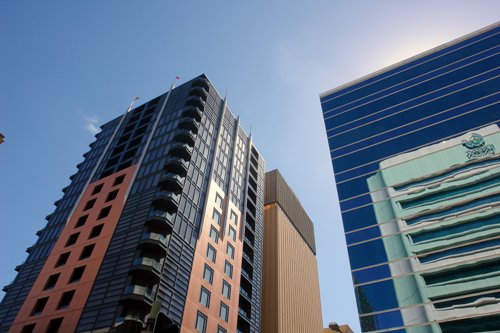
WaymouthSt.jpg Gary Sauer-Thompson, Waymouth Street, Adelaide CBD, 2008

The day had cleared. It was bright and sunny. In the morning I had read about the seachangers going to the Gold Coast looking for the dream of a beachfront lifestyle in the sun at Noosa that was just a short trip to the cosmopolitan Brisbane were returning home bitterly disappointed. Their dream was to be ageing surfies drifting into retirement. They sold up, only to end up in the back blocks of a tacky suburbia, missing family and friends, unable to network, and struggling with the lack of infrastructure.

So why not view Adelaide through the eyes of the seachange bounce back people. They would see their old city anew after their experience, would they not?
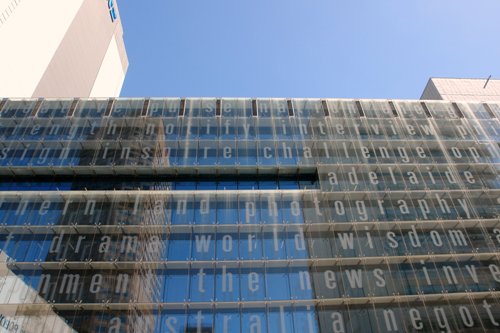
Advertiser.jpg Gary Sauer-Thompson, Murdoch's Advertiser, Adelaide CBD, 2008

They would see how modern it was becoming whilst retaining its nineteenth century buildings and how this was so different to the development ethos of Gold and Sunshine Coasts. What is disclosed is the regional differences within the nation state; regional differences becoming ever more marked as the effect of globalization becomes deeper and more substantial.

| Posted by Gary Sauer-Thompson at 5:18 AM | | Comments (10)
Comments

Comments

Gary,
they don't realize just how expensive Noosa is. The Gold Coast has left Canberra way behind in terms of population numbers, and it has overtaken the population of all of Tasmania.

If you live in Noosa, you would have to get up at 3am to drive to Brisbane to catch the early morning flight to Sydney or Melbourne to do business, then get home around 8 or 9 pm. That is not 'easing into retirement'.

Gary,
I am staring to think that the last time you came to the Gold Coast you were bitten by a dog.

Globalisation seems to have effected different regions in different ways. Capital cities are becoming more internationalised (if that's a word)and more cosmopolitan. The Gold and Sunshine Coasts haven't tapped into the same processes. As tourist meccas they recruit the liminal tourist experience which stays distinct from the local. The local stays parochial. And increasingly defensive. People who've lived here less than 10 years still count as tourists.

Unfortunately for us we're not as interesting as, say, highlanders in New Guinea. We don't count as a unique spectacle for tourist consumption. Tourists don't wander places remote from the tourist hub in search of the authentic experience with the natives, although they can book a canal cruise and look at the homes of millionaires.

Lyn,
Adelaide is beginning to shift from its parochial and defensive response to globalization as it moves away from being a rustbelt state.

I'm surprised by your statement:

As tourist meccas they [Gold and Sunshine Coasts] recruit the liminal tourist experience which stays distinct from the local. The local stays parochial. And increasingly defensive. People who've lived here less than 10 years still count as tourists.

There are a thousand new peopel arriving every week from southern Australia---that's what ex-Premiere Beattie used to tell the rest of the nation. In 1976 there were 100,000 people on the Gold Coast. Today there are 500,000.

How can they be parochical and defensive re globalization? What is going on?

Les,
I'm working off articles in the AFR --'seachange bounceback' is a well known phenomenon. Many who leave from Sydney to downsize return after a couple of years or so.

Gary,
"How can they be parochical and defensive re globalization? What is going on?"

Bearing in mind that dividing people into 'types' is problematic, the Gold Coast is the last place your globalised, urbane types are going to migrate to. The Sunshine Coast is a bit different, a bit more Byron Bay yuppyish. A bit.

The people who move up here tend to be of the battler variety or what Centrelink staff call the warm poor. If they stay it's mostly because they can't afford to go back.

It's very hard to fit in here and very hard to find a first job unless you know someone. One of the reasons is a suspicion of outsiders, but employers are reluctant to take on recent arrivals who might not stay, or who might be tourists posing as permanent. That also means it's hard to establish social networks through workmates. Estate agents tend to be suspicious of prospective tenants for the same reasons.

Retirees come here to get away from the global and relax a bit. The only flows they're interested in are the ones that carry lures past the noses of flathead, or through the garden hoses that carry water to their roses.

For arguments' sake, divide the population into natives, recently arrived battlers and retirees. Battlers want a warm, insulated place with cheap housing and sensible local newspapers. Retirees want to shut the world out. Natives have seen too much change too fast and a lot are resentful of the tourists they depend on for their income.

If you want globalisation you go to Brisbane which, like Adelaide, is shifting.

There is no denying that the air on the Gold coast is less polluted than other places. One whiff will tell you that. This attracts people. Perhaps there is something in this positive and negative ions thing that makes people sea change.
I am not sure of the official stats but I would guess that only 10% of the residents are born here. People move,sometimes it doesn't work out and they move back or somewhere else. Such is life.

Lyn,
I disagree that retirees come here to shut the world out. I say that most would be the opposite.
Retirement villages, bowls clubs and lots of other clubs are a hive of activity with lots of people engaging more of the world than they have ever done.

Les,
I agree that retirees are socially active. You mentioned lawn bowls - I get a real kick out of seeing the young folk and the oldies mixing it on barefoot days.

Lyn,
sounds like the Gold Coast is very place bound --not that much different from Victor Harbor, despite the huge increase in population numbers, and the far greater penetration of the "space of flows" of the tourist economy.

In Victor Harbor there is a deep immersion in the particularities of place and locality despite the mobile phone and the internet.

Gary,
Yes, place bound describes it well. The flows are there, but they don't change the place bound worldview, even though they change everything from the built environment to the economy.