Thought-Factory.net Philosophical Conversations Public Opinion philosophy.com Junk for code

Mandy Martin, Puritjarra 2, 2005. For further information on MANDY MARTIN, refer here: http://www.mandy-martin.com/
If there are diverse kinds of knowledge and ways of knowing place, then we need to learn to value the different ways each of us sees a single place that is significant, but differently so, for each perspective.
RECENT ENTRIES
SEARCH
ARCHIVES
Library
Thinkers/Critics/etc
WEBLOGS
Australian Weblogs
Critical commentary
Visual blogs
CULTURE
ART
PHOTOGRAPHY
DESIGN/STREET ART
ARCHITECTURE/CITY
Film
MUSIC
Sexuality
FOOD & WiNE
Other
www.thought-factory.net
looking for something firm in a world of chaotic flux

cricket gets interesting « Previous | |Next »
January 8, 2008

So the cricket between Australia and India is to be decided off the field, given the bad blood arising from very poor umpiring with India copping the brunt of it, sledging and taunts, lack of sportsmanship, a racist row, biased Channel 9 commentators and Australian arrogance (the champions claiming grounded catches and appealing for nicks when there were not any).

Why isn't simple technology like video slow motion replays being routinely employed to assist more fair judgements by umpires? What aren't bad umpires stood down? Why did not the ICC fine Harbhajan Singh instead of a giving him 3 match suspension? Or better still, why not say that, as there were no independent witnesses, no verdict could be reached and then given both teams final warnings regarding their behaviour around sledging and racist slurs.
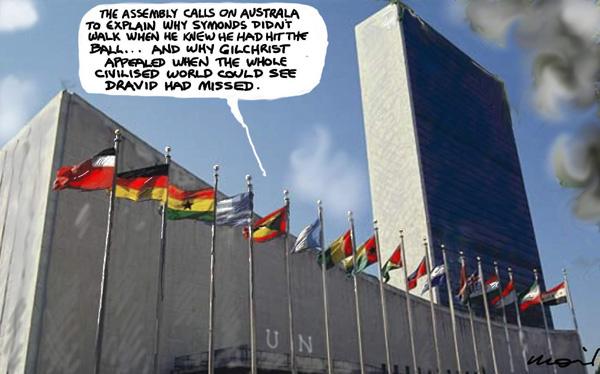
cricket.jpg Alan Moir

An unhappy India is now exercising its muscle off the field. India has given the International Cricket Council (ICC) 24 hours to deal with its protests over the recently completed second Test in Sydney, or risk having the tour of Australia abandoned. The Board of Control for Cricket in India (BCCI) wants the racism charge against spinner Harbhajan Singh withdrawn and umpire Steve Bucknor sacked from the third Test in Perth.

The ICC in Dubai has already rejected the latter demand outright, putting the governing body on a collision course with the powerful Indian board. So the cultural divide between the Indian and Australian cricket teams deepens and Australian cricket continues to develop a tainted side---the national team wins games (a great team winning 16 tests on the bounce) but it develops a tattered reputation for the way it does so.

The cultural context is that the Indians were slow to investigate claims that sections of their crowds racially abused Symonds during the 2007 one-day series in India; and that someone has decided that enough is enough, and dished out some of their own sledging taunts to the Australian team.

| Posted by Gary Sauer-Thompson at 6:16 AM | | Comments (19)
Comments

Comments

Gary,
The Australian approach is one “winning at any cost” and that involves a strategy of sledging, and then saying its just playing hard and tough with a corporate smile. There was a touch of vengeance in the Australian's performance and celebration. Not one Australian player so much as thought about shaking hands with the defeated Indians and departing, despite the Indians playing very well in their first innings.

What's happened to the great Aussie mantra of "what's said on the field stays on the field"?

The Australian officials are now in the situation of trying to broker a peace deal to save the tour.With millions of dollars in revenue at stake, Cricket Australia needs to negotiate a truce so the remaining two Tests can proceed.

Pam
I'm assuming that Harbhajan fell for the Aussie trap and in loosing his cool, called Symonds a monkey (if that is the word used). Then the Australians seized upon the word, and had him in the dock.

Couldn't this have been dealt with on the field--eg., using a sin bin mechanism? Why allow it to be taken off the field?

Gary,
though the Australians are known to be the worst sledges in international cricket (they call it tough and uncompromising way) they seize the high moral sporting ground. Yet they played in a manner that betrayed that spirit---appealing for something when they know a batsman is not out. They then go run after the 2nd test saying that they always go out there and try and play fairly and squarely, always try and play tough competitive cricket and that is the competitive spirit.

Hence the hypocrisy charge.It's warranted. It's also just a bit hard to stomach this new-found holier-than-thou attitude in the Australians, when they have a history of using racist language when routinely sledging Sri Lankans and West Indians. Presumably other teams are becoming more than a little tired of the Australians confrontational, "professional" win-at-all-cost style.

So it's little wonder that India has made a counter-claim against Brad Hogg, suggesting he called Indian captain Anil Kumble and his deputy Mahendra Dhoni bastards while they were batting. Insulting someone's mother might be as culturally offensive as insulting that person's race.

Maybe a zero-tolerance approach will put a stop to the sledging.

The ICC has stated that it will not tolerate racist on field comments.
A racist sounding comment was made.
It was the captains job to report it.
The officials acted on that complaint.
While calling someone in normal life monkey may not be regarded as racist this must be looked at in context of Symonds recent tour and the well publicized monkey calling.
The person who used the word had full knowledge of what had gone before so he used it in a manner to offend.

But in saying that I think the 3 match ban should of been a warning.

The game bores me to death, but the cultural and political aspects of this are amazing.

Polls are suggesting Australian fans have their tall poppy cutters out for Ponting. Given that sport is the only domain exempt from tall poppy rules, that's pretty dire for him.

Also, somebody is going to have to back down and lose face, or lose authority.

Les
the punishment does not warrant the offense in this case.

All there is the word of the Australians against the word of the Indians. The umpires heard nothing. There is no video or sound evidence. The evidence is too thin for people to be persuaded that procedural justice has been done. The Indian appeal is justified.

It is also ironic that the first case of the ICC penalizing racist remarks is against a Indian man sledging a black man; when the history of racism in cricket is that of white men against black men.

The ICC have not handled the politics of this very well. White men no longer rule the cricket world as they once did.

Lyn,
Mike Coward in The Australian expresses the core issue well

Indian cricket captain Anil Kumble's denunciation of the way Australia plays cricket will be widely supported throughout the international cricket community....Ponting and his charges may not like it, but this is a commonly held view of many people in this country and beyond. While they consider themselves fair if hardnosed and aggressive professionals, a growing number of observers see them as exceptional cricketers given to boorish, arrogant and ungracious behaviour.

They have become the ugly Australians. Coward goes on to say that:
Ponting's team is not the first required to defend its reputation and reject the tag of ugly Australians. Indeed, to the despair of the game's governors in this country, many Australian teams have been so branded over the past 40 years. Certainly, Australian teams have long been renowned as the game's worst sledgers, a technique or tactic now covered by the euphemism mental disintegration.

He says that the Indians to a man are convinced the Australians have breached the acceptable standard and they want their protests heard.This protest is about sporting professionalism.

Lyn,
in the same Coward article in The Australian that Pam refers to, Coward gives an account as why sporting achievement means a great deal to Australia:


Cricket, the one true national sport, has helped forge the country's international identity. The first Australian cricket team won against England 24 years before Federation and Ponting and his men wear a baggy green cap bearing the pre-Federation coat of arms.

It's about the politics of nationality and what it means to be an Australian in a global world. Ponting's crew are not the beloved Anzacs of conservative mythology,in spite of all the attempts by Howard to make it appear to be so.

Capitalism has blown that mythology away by turning it into entertainment. The culture industry now rules and its vulgar culture (eg., Warne) has penetrated test cricket.

Cricket needs controversy to survive in a world of much more interesting sports. There is such a culture of controversy that Cricket would see this as good press.

On a humorous note the cartoon by Mann in my local paper seems to have found the solution. Every country needs to train monkeys to play and we'll all just watch.

Pam,

I have the impression that it's about more than professionalism. The 'boorish, arrogant and ungracious behaviour' Australians have been indulging in since, I am told, Border was captain apparently combined a hard attitude towards both the game and traditions of civility. Jardine and Larwood suffered horribly for the same thing. Technically they did nothing wrong, but culturally they blew their noses at the dinner table.

Gary,

Recently I read a paper on why cricket didn't become huge in Canada and the US the way it did everywhere else the British went. It concluded that the refusal of cricket playing gentlemen to have anything to do with crass commercialisation of their sport doomed it as hopelessly elitist in capitalist but not (overtly) class conscious Canada and the US. All Australians were interested in was giving the Brits a pounding.

"Capitalism has blown that mythology away by turning it into entertainment. The culture industry now rules and its vulgar culture (eg., Warne) has penetrated test cricket." That seems to be true. The spirit of the game is incompatible with the requirements of commercialisation and media demands. For example, the authority of the umpire is eroded by 12 million camera angles and demands that technology be used to satisfy the ad-watching crowd's opinion on decisions.

In a similar vein the Australian mythology requires the larrikin Aussie boys to out-fart and out-spit the world while playing superbly. So this larrikinism on the world stage is in as much peril as the gentlemanly civility of the spirit of cricket.

Lyn
Waleed Aly in The Age makes some good points about the events

looming over much of this discontent is a suspicion that arrogance is an Australian trait informed by a barely concealed racism.....This suggests an identity politics might be at play here. In this context, cricket is more than a game, and the anger is about more than cricket. On the sub-continent especially, it is an expression of post-colonial independence: the forum in which colonial masters could be defeated — a dimension well illustrated by the Bollywood film Lagann.

An expression of post-colonial independence means national identity--Indianness---and respect for Indians.

Les,
yes you are right. Ponting did the right thing by tackling the monkey racial slur/taunt by Indian spinner Harbhajan Singh by officially reporting it and making it public. It is the captain's responsibility to immediately report any form of racism from either the crowd or on the field.

The problem is the way the match referee--Mike Proctor--dealt with the issue. It wasn't handled in a good legal way.

I think you will find that the match referee dealt with it with in the parameters of the the rules.
The rules of cricket are separate from the rules of an Australian court.
The important thing for people to realize is that the rules of cricket apply to this situation.
Indian cricket has the right of appeal as does the umpire that was stood aside.
The rules of cricket are very well documented.

As I said before the match referee should of looked to the minimum penalty but because he didn't doesn't mean that he erred.

I commented in the Nationality + Cricket post before I saw this one and stated that I thought the "monkey" comment was just gamesmanship, but having read Les' comment, I've changed my mind.

Gary, why do you think that the insult should have been made public? Could the issue not have remained in-house and resolved with a round-table discussion and apologies from all involved? Has any good been served by its revelation, or is it a matter of principle?

I'm still surprised by how many people have become excited and disappointed in the behavior of the Aust. Cricket side.

Kez,
I initially thought that it should be kept on the field because of the tension between Australia and India--the nationality politics. I changed my mind after reading Les's comments.

Racist slurs ought to be confronted because the pre-match behind the scenes deal didn't hold.

It's not the best place to confront racism given the history of the Australia's use of it to sledge their opponent. But you have to start somewhere.

I think we are past the stage as a nation that an issue like this would pose a threat between India and Aus politically. The press may beat it up to look that way but really its just hitting a ball with a stick at the end of the day and both countries have far greater issues to resolve.
Sledging is a part of sport. What you hear in cricket is probably a lot milder than what is said on the rugby field or the Afl. Cycling is very bad for sledging also.
It is done to put people off their game and I completely doubt it will be removed from sport.

Les,
It's not just a press beatup.

The Indians are claiming that Symonds broke his non-sledging agreement made in Mumbai with Harbhajan Singh---that the pair would not sledge each other. They say that the Queensland all-rounder Symonds renewed hostilities with the spinner last Friday during the second Test at the SCG.

It's a stand off.The Indian argument goes like this: monkey is not offensive, bastard is. The Australian argument goes like this: bastard is not offensive, monkey is. So we have some cultural misunderstanding. That's not a press beatup.

And then there is the larger issue of the match referee not believing Sachin Tendulkar’s account of the monkey slur, but believed the Australian account.

And then we have the Australian cricketers exposed and labelled as cheats.

The Australians and their media friends are trying to close it all down with we did nothing wrong; we did the right thing; sport is like that etc etc. But there are issues involved here that affect the future of the game such as poor umpiring decisions that create big tensions between playing camps. The need for higher standards of umpiring is no press beatup.

Les,
John Buchanan makes some good points on the ABC's Unleashed:

So what are the issues at play?Malcolm Speed at his press conference outlined three issues, which he believed were principal - the Test match itself; the umpires; and the ICC Code of Conduct. He stressed that the ICC wanted to move forward as quickly as possible; wanted to carefully uphold the spirit of the game; reiterated the ICC zero tolerance policy to racism; but wanted to keep everything in perspective and not over-react.But it is my view that the ICC with their approach and decisions has failed to show the leadership that world cricket requires. Through their actions or inactions, they are threatening the future of the game.

Pam,
Thats the thing with sport. The people who enjoy it are barrackers. Barrackers all have opinions about most decisions that are made by the umpires (and include the administrators as umpires) and it is normal for one side to cheer a close decision while the other boos. So no surprises theres a differing of opinion out there.

The only other thing I can add at this point is that I feel if the Indians had of drawn the second test or even won it the commentators would be talking more about the series and not the monkey comment.
The Indians are up against Australia a B grade side at present. The selectors need to have a good think.