|
January 15, 2008
The Big Lobster is similar to the Sunshine Coast's Big Pineapple and Coffs Harbour's Big Banana in that they function as tourist icons in a time of mass tourism as well as being bad art.
If these icons can be viewed as the part of the bad art or junk that make up popular culture, then they are also part of an economy of signs. We have well and truly shifted away from the high modernist view of high art is good, low art is bad, since as a cultural object created by the tourism industry, these big things along with tourist adverts have become ladened with cultural meaning about Australianness, national identity and subjectivity. On the Gold Coast the economy of signs include a palm tree, a girl in a bikini, a beach, a shining sun, a high-rise apartment building. These signify the Gold Coast lifestyle and holiday culture.
So what then of the tourist photographer in an economy of signs where reality becomes code-intensive?
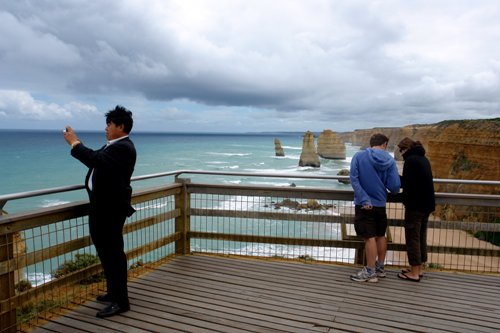 Gary Sauer-Thompson, Port Campbell, Victoria, 2008
The photographer is not just the observer who gazes on the world as through a window; the photographer inhabits this world of tourist images. My perception of the world's appeal and attraction ---ie., what captures my attention---is inseparable from my own interest in it. The photographer then produces more tourist signs that circulate through the economy of signs.
The big things like the Big Lobster are iconic nationalistic landscape objects and they suggest that the tourist/consumer gaze is complicit with the settler gaze, and that in some places, such as Kingston, the two function as one. The absurdly grand and the embarrassingly awful which come together in patriotic tourist iconography is built around the prosperity dream of the idealized and empty landscape.
These icons help to construct our subjectivities---part of the process by which subjectivities are formed--- of the people living in areas like Kingston; and so they interconnect with their desires and pleasures, hopes, fears, memories, and their likes and tastes. Often though the constellation of memory, tourism, consumerism and kitsch offers prepackaged emotion at the expense of critical thought and contains alternative politics.
Australians today, in responding to the trauma of globalization through consumerism, kitsch, and sentimental tourist icons, are revealing a tenacious investment in the idea of Australia's innocence: we have a nativism that needs to be defended from the negative effects of the global market.
|


Has anybody been to the Modern Britain exhibition at the N.G of Victoria?