Thought-Factory.net Philosophical Conversations Public Opinion philosophy.com Junk for code

Mandy Martin, Puritjarra 2, 2005. For further information on MANDY MARTIN, refer here: http://www.mandy-martin.com/
If there are diverse kinds of knowledge and ways of knowing place, then we need to learn to value the different ways each of us sees a single place that is significant, but differently so, for each perspective.
RECENT ENTRIES
SEARCH
ARCHIVES
Library
Thinkers/Critics/etc
WEBLOGS
Australian Weblogs
Critical commentary
Visual blogs
CULTURE
ART
PHOTOGRAPHY
DESIGN/STREET ART
ARCHITECTURE/CITY
Film
MUSIC
Sexuality
FOOD & WiNE
Other
www.thought-factory.net
looking for something firm in a world of chaotic flux

the local in the global « Previous | |Next »
January 17, 2008

I'm sitting at the blue table on the balcony at Victor Harbor testing the wireless broadband with my PC laptop, looking at photographs to include in my coastal neighbourhood, exploring Myla Kent's delightful photoblog, reading Amanda's Gilligan's Mockingbird and listening to BBC Radio World service. It's called multi-tasking in the global village I suppose.

The internet means that the local is no longer the closed provincial looking inward. I find it comforting to be immersed in the 24 hours news cycle that endlessly repeats itself with enthusiasm. The momentary content is a story on the global credit crisis and the declining values of the London property market. Just a blip is the message from the suits. What global credit crisis? The Chinese, Russians and Indians are not experiencing a credit crunch in their countries.

The suits' account is that there are always ups and downs in price---that's how the market works. That is what happened in Canary Wharf in the 1990s. Some win some lose. But the property fundamentals today are sound. Look at the success of Canary Wharf. The developers usually get it---value---right in the long run.

It's all a long way from my little coastal neighbourhood with its rocks and beaches and the modest development of weekenders, resorts and marinas.
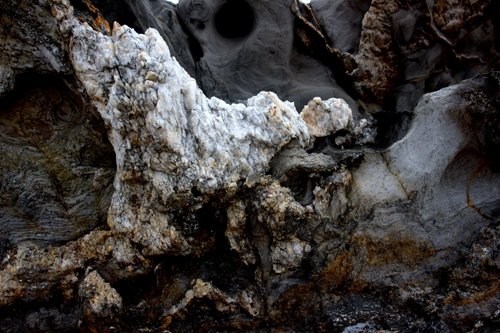
PetrelCoverocks.jpg Gary Sauer-Thompson, rocks near Petrel Cove, Victor Harbor, 2008

Nobody mentions the Pelicans who made the area their home due to being feed fish by the returning recreational fishermen. What will the Pelicans do? Make do? Look for the human touch? Why cannot we have development and sanctuaries?

beachHaborough.jpg Gary Sauer-Thompson, beach, Hayborough, Victor Harbor, 2007

If our roots are the local and the ariel is the global, then I feel like a broken butterfly in a storm. A storm is approaching for sure----its called global warming . Who will fix the broken butterflies' dreaming about the glory days? Or will they too dance in the dark?
AgtetEncounterBay.jpg Gary Sauer-Thompson, Agtet, Encounter Bay, Victor Harbor, 2007

It is no long a case of regionalism in opposition to globalization is it? That much loved beach may no longer be there in ten years, if the Antarctic ice sheet continues to melt the way it currently is doing. All I see is the ice sheet melting faster than initially expected.

| Posted by Gary Sauer-Thompson at 6:19 PM | | Comments (15)
Comments

Comments

The River Murray has already gone as a river. I 'm finding that I just need someone to hang onto. I play Bruce Springsteen. He's comforting. i don't mind dancing in the dark. Adelaide is no longer the lucky town. It's full of lonely spaces.

Yeah I feel myself fading away. I'm no longer recognizable to myself. What ever happened to the promised land? All I see are the ghosts of the pioneering past.

Having just re-read Wark I'm currently in an optimistic place about my country and its people, but the sense of loss and alienation you're both describing is familiar. I feel we are going somewhere, that something is changing, but I don't know where or what.

It's very hard to work. I force myself but produce crap. And it feels like a pointless exercise anyway.

You two seem to be describing a loss of place and personal identity. I have a loss of purpose.

Lyn,
and which Wark text would that be?

Gary---your question: Why cannot we have development and sanctuaries?

One of the housing developments in Victor Harbor is based around a constructed wetland utilizing run off from the estate.The development at the Whalers end of Encounter Bay (the resort end) should be include a Pelican, bird and seal sanctuary. The boaties would not mind.

So far all the talk in the local paper is about boat ramps, dredging channels, and car parks. More and more people are turning up at Whalers for coffee and cake in the morning, lunch, and drinks before dinner. The beaches and footpaths need a facelift.

Lyn,
yes things are changing. I had the plumbers in yesterday. Its no longer taps and drains. We are talking about ways to capture and store the grey water and then re use it on the garden.

It's not just me. The plumber is considering how he is going to do this in his own house as well.This is over and above installing rainwater tanks.

Lyn,
the loss of purpose is part of the process of doing a PhD. It's a process of acquiring skills ---a glorified trade qualification--through self-education, but it is so difficult that it becomes all consuming. It's called character training and the process shapes you into a specific kind of person---Foucault and all that. Traditionally Australian universities have been very poor at nourishing this.

You do need to link this work into something else as you do it, given the long lead times of a doctorate. A suggestion. Just mention the books you are reading on philosophical conversations ---(the name is going to be changed to 'conversations' and it is about our intellectual culture). You could drop a bit of draft writing into it. Think in terms of different bits of writing for different audiences. Mention the ideas that you are grappling with to others.

Here's a model of where things could go (not the content as TPM is all politics) for Thought-Factory.net Links to Facebook and Flicker will be added soon and a photoblog (Rhizomes0) is under construction. Once that's up and running and paid for the next step is the conversations side of Thought-Factory.net

It's the academic/public side of things that needs to developed in Australia, and that can only be done by tossing in ideas, people, books, writing, links that starts a conversation about the ideas that mean something to us, and help us deal with the rapid changes that are happening all around, and through, us. The image is that of digital cafe of bar where people talk about our intellectual life. Anyone in your academic neck of the woods interested in being a part of doing this?

As Andrew Murphy points out in an early issue of Fibreculture, though commercial academic publishing is in trouble, it is also a very exciting time for publishing.

Just as a revolution in music publishing and online distribution has changed the nature of music, new technologies have meant new modes of delivery and new forms of distribution are currently changing the way we engage with ideas. Perhaps most exciting is that it is suddenly much easier for new voices to find publication outside of the established academic presses, and to find new communities that are prepared to give these voices a context.

Fibreculture sure looks interesting. They are doing what I'm groping towards. This is polished academic work-that is referred--we need explore the rougher stuff, the notes, the picking over ideas----what used to be called work in progress.

Gary, it's actually been a Wark/Horne/Graeme Turner convergence.
Horne's The Public Culture, Wark's The Virtual Republic and Celebs, Culture and Cyberspace. Turner on celebrity and what he calls the demotic turn.

Pam, I fantasize about a day when the Water Tank In Use signs on houses are joined by Solar Panels In Use signs as badges of pride.

Gary, since the first day I stepped on campus I've resisted that shaping. One of my supervisors who knows I'm a Bourdieu fan told me to avoid reading Homo Academicus, knowing full well I probably would just because he told me not to. I didn't, but I did read about it. It's the logical conclusion to B's train of thought and homo academicus is not something I want to be.

I find it difficult to hold conversations with ordinary people. I complicate everything and use big words. I want to be ordinary but I'm already something else, which is a something I used to find intimidating before I became one. But I'm not a proper academic either and don't want to be if it means I have to be that shape.

I suspect that's exacerbated by living on the Gold Coast and not belonging here in a cultural sense. Yet when I go back to Sydney I'm not of that place anymore either.

On your suggestion, I've been meaning to email you on a couple of thoughts but for the time being I've managed to comment myself into a horrible headspace.

Lyn,
I do not know Donald Horne's The Public Culture.What is he saying? Is it about public intellectuals? Is he arguing for the creation and development of an informed, critical "public culture" in Australia?

I know some of Wark's work---this extract from Celebrities, Culture and Cyberspace in the Australian Humanities Review makes sense eg.,

The subtle shift from a modern world experienced via people, politics and pop, to a postmodern world experienced via celebrity, culture and cyberspace is an effect of changes in the means of communication, but also in the accumulated techniques available in everyday life for reading what is communicated. Moving from pop to cyberspace, Australians start to see their collective and individual identities differently.

That makes sense to me. As does this:
The emerging vectors of cyberspace are what made it possible in the 90s for there to be 'public things' in a world that long ago outgrew the space of the town hall or market square. The development of cyberspace is what made it possible to partially bypass the limitations of television as a substitute space for the public square.

I read Celebrities, Culture and Cyberspace several years ago. I floated through it.

What is the Turner text that deals with the demotic turn?

Pam,
In the Public Culture Horne is playing the critic role, looking at the way it represents various groups differently or not at all.

Wark's Virtual Republic and Celebs Culture and Cyberspace are both online through this portal.

I just posted something on the demotic turn on Conversations. The text is Understanding Celebrity, which I just got out of the library today. As far as I can tell Australian scholarship on this stuff, public culture and celebrity, is way ahead of American or British. Or maybe Australian society is doing things differently.

Lyn,
re your comment:

... since the first day I stepped on campus I've resisted that shaping. One of my supervisors who knows I'm a Bourdieu fan told me to avoid reading Homo Academicus, knowing full well I probably would just because he told me not to. I didn't, but I did read about it. It's the logical conclusion to B's train of thought and homo academicus is not something I want to be.

To be credentialled with a doctorate you need to become a Homo Academicus.However, you have the option to create the content----you can refuse to be a modernist Homo Academicus and be a postmodern one.

I do agree that Homo Academicus comes ladened with lots of historical baggage. Once I got my doctorate I was happy to leave after a few years of teaching. The political life was much more interesting and enjoyable, even if all my academic friends refused to have anything to do with me!

Pam,
from memory Donald Horne in The Public Culture takes the nation out of the nation state.

Gary,
"To be credentialled with a doctorate you need to become a Homo Academicus" Then I'm in deep poo.

"Once I got my doctorate I was happy to leave after a few years of teaching." If teaching was all there was to it I'd be overjoyed. The look on a student's face when they have a lightbulb moment, a penny drop, is the whole reason I'm doing this.

"you have the option to create the content----you can refuse to be a modernist Homo Academicus and be a postmodern one." That's why I'm trying to bridge a gap between sociology and cultural studies. Apparently I'm a cultural sociologist, which means I can't be a postmodernist because postmodernism is old fashioned. I'll have to figure out how to be an undercover postmodernist. Now there's a challenge I could enjoy.