|
July 13, 2010
I'm still recovering from the shock of what Apple's Mac Pro tower computer and Cinema HD computer screen for Encounter Studio is going to cost me. The prices have gone up in Australia, not gone down as they have in the US.
I was thinking of a $5000 outlay maximum. I'm actually looking at $A7000 for machinery that has a short lifespan. No money has been spent on high end software for post production yet. (eg., Adobe Creative Suite) I'm shell shocked after my experience of the aestheticisation of commodities. Going pro sure is expensive.
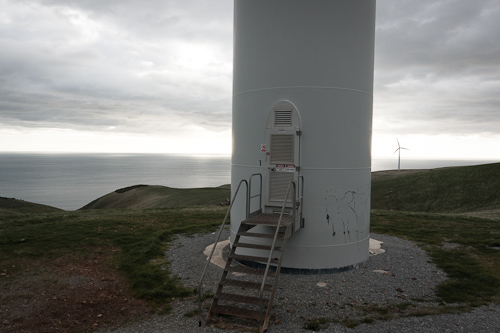 Gary Sauer-Thompson, Starfish Hill, South Australia, 2010
I recognize the way that Apple exploits the productive capacity of representation itself; by which their commodities gain added value by virtue of their mode of appearance. Advertising is the mythicisation of commodities, their transformation into a fetish that openly parades its fetishism and incessantly work to bewitch us. And we are--and so the habit of borrowing and buying becomes an addiction.
There is something strange about being immersed in the mystifying consumer world of the branded factory produced technology, in which the gleaming fetishized objects on display are almost indecipherable. This is a strangeness in the sense of cultural amnesia; a kind of structural forgetting; a destruction of the past. What matters is the latest gleaming whiz bang machine on display. This is celebrated whilst the past is devalued as old and forgotten. The focus is on the future, which somehow resides in the present, shaping it for us.
If the future is always better than the past in this world technology, then it is hard to remember what has been in this glossy world of consumerism, in which buying objects for consumption and so participating in commodity exchange, appears to be disconnected from everything else.
My sense is that what is being, or has been, forgotten in this bewitching commodity form in a world of information-intensive technologies is profound. But what has been lost in this form of cultural forgetting? Our natural roots? Place? Ecological processes?
The classic Marxist answer is human labour. As Paul Connerton says in How Modernity Forgets:
when we speak of a place such as Chicago, or the countryside, or France, we are always in danger of forgetting that these are places created in long processes of labour. Their identity is always, and always has been, in process of formation. The identity of place is always embedded in the histories which people tell of them, and, most fundamentally, in the way in which those histories were originally constituted in processes of labour. Whenever we talk about places, what is at issue, whether we acknowledge it or not, are competing versions of the histories in the process of which the present of those places came into being. Whenever we speak about the identity of a place, therefore, we run the danger of imputing to that place a false ‘essence’, by abstracting it from the history of the place itself.
This abstraction from the history of place, he says, flows from our perception of place being filtered through a spatial mapping, which in turn, entangles us even more in a process of forgetting. Yet place is never a fixed spatial entity but always a social process in transformation that become the locus of institutionalised power and culturally specific perception.
|


whats a trade price for that? email steve@coremac.com.au
cheers from mal E (+ Bh