
Mandy Martin, Puritjarra 2, 2005. For further information on MANDY MARTIN, refer here: http://www.mandy-martin.com/
If there are diverse kinds of knowledge and ways of knowing place, then we need to learn to value the different ways each of us sees a single place that is significant, but differently so, for each perspective.
|
|
looking for something firm in a world of chaotic flux
|
|
|
the cultural landscape
« Previous |
|Next »
|
|
|
July 20, 2010
In The cultural landscape at The Philosopher's Magazine David E. Copper spells out the idea of the cultural landscape.
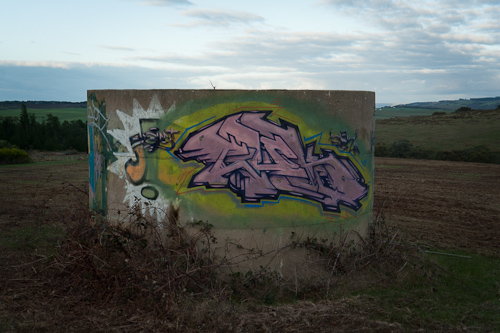 Gary Sauer-Thompson, water tank+ graffiti, Fleurieu Peninsula, 2010
For me attention to the cultural landscape enables insights into the way we do and might behave in our environments, but also provides us access to an understanding of our environments that includes us as part of the landscape.
Cooper says that:
The concept of cultural (or human) landscape has circulated among geographers for a century, but its welcome prominence in philosophical discussions is a very recent development – the result, in large part, of the enthusiasms of several Scandinavian philosophers. Actually, these writers use the expression in two ways. For some, it refers to landscapes – even virgin jungles and mountain wildernesses – that are invested with cultural significance. For most writers, including me, it refers, however, to landscapes that saliently bear the mark of human intervention and control – to farmland, parks and gardens, managed woods, climbed hills, and swum off beaches: to places that, typically, are cultivated as well as culturally imbued.
He adds that if aesthetics is to free itself from the influence of the art versus craft divide, then cultural landscapes, alongside other objects of everyday engagement, must come under its remit.
Copper adds that:
The older environmental ethics presupposed a sharp distinction between nature (“wilderness”) and the human domain – a distinction that has also plagued philosophical anthropology’s attempt to locate the human in relation to the natural. Views have tended to swing between a picture of experience of the world as a Promethean human construct, and a conception of it as, essentially, the passive effect of objective natural processes. Attention to cultural or “hybrid” landscapes can provide a sharp reminder of the implausibility of separating, even notionally, the possibility of human creative practice and a way of experiencing the natural world. The historically and philosophically alert landscape designer and farmer know that the goals they pursue could not have been envisaged except against a background experience of nature that has itself been shaped and enabled by traditions of human practice.
The idea of a cultural landscape helps us to understand the natural environment not only as something apart from us which our modernization has exploited furiously, but also as a series of processes of which we are part, and within which we have had a long history.
|
|
|
|
|
|
|
|
|
|
|


Gary,
you should get yourself some spray cans and a hoody and have a go at it. Write junk for code somewhere. Would be a laugh.