|
July 22, 2010
Andrew Blum, a correspondent for Wired and a contributing editor at Metropolis, has an article on Jane Jacobs and local urban neighbourhoods.
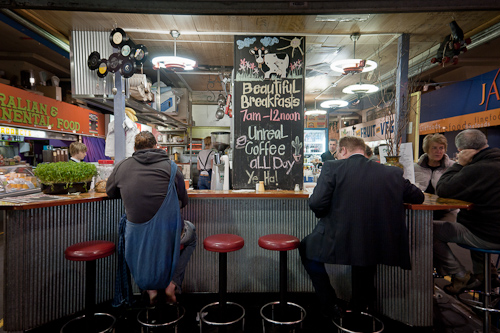 Gary Sauer-Thompson, Central Market, Adelaide, 2010
The preservation of local urban neighbourhoods is a hot issue in Adelaide as people slowly return to the CBD to live. It is mixed use area with low income housing in the south west corner that used to be rejected as a slum. Even though the urban renewal developers have not been really interested there is still a battle for a neighbourhood to help prevent the city from becoming more desolate than it already is. They are not seen as bloggy neighbourhoods.
However, what has been accepted is the idea of lots of people living in diverse, city neighbourhoods. This stands in opposition to the town planning that thins down cities and disperses them over the countryside ie. the Garden City idea that the city just wasn’t any good and that we basically had to replace it with the country. And so we have the fiasco of suburbia.
Blum says that Jane Jacobs:
fought modernist urban planning’s “dishonest mask of pretended order,” and what concerns me today about cities is a corollary: Call it the dishonest mask of pretended localism. Thanks in great part to Jacobs, we talk a lot about preserving neighborhoods, which most often means keeping them the way they are. But for me, preserving an urban community—not merely its architecture, its open space, or its independently owned stores—now means recognizing what the local is made of, the warp and weft of all its pieces, wherever they come from, near or far. And that requires recognizing the global community behind it—for better or worse, in the face of both nostalgia and change.
The conflict for those who live in the inner city is high rise living in the form of a tower of apartments arising from the destruction of some old block. The old must be preserved at the expense of the new is what is often argued by the heritage movement. So we have revival of old-fashioned working class neighborhoods that later have become gentrified.
What is being fought for is a city that is alive. This is an innercity of people in which streets are teeming with people, multitudes of them actually live in the city center in apartment buildings and houses, the footpaths are jammed, in some places until late at night, and the public realm, where the buildings meet the footpath, is activated.
Blum's argument is that the Jacobsean conundrum (and the unspoken subtext of every NIMBY argument) is that the environmental preservation of the future may require the destruction of pieces of the past. But if we can recognize the beauty in its benefit, it won't be a bitter pill. We may be able to reap the global environmental benefit of high-density living without sacrificing the local ties of a medium-density neighborhood.
|


the problem is one of urban form---the car-centric model that has proved so disastrous. Australian cities have yet to innovate to provide city dwellers with a friendly, stimulating environment to replace the old model of urban design that was essentially created for cars.The result has been an explosion in the number of cars, un-crossable streets, a complete lack of pedestrian pathways and few public plazas.