|
July 31, 2010
Today’s digital camera is essentially a computer with a sensor and a lens. It opens up the possibility of what Wired Magazine calls computational rephotography. The rephotography refers to the photos taken from the exact same viewpoint as an old photograph there by highlighting the differences of a place over time. This brings history to life.
The computational bit refers to the software that compares the scene in front of the camera with a historical photograph. It then works out the difference between the two and gives the photographer instructions along the lines of “up a bit, left a bit more.”
At the moment the software runs on a laptop linked to a digital camera. The software compares the camera's view to a preloaded historical scene and provides instructions to adjust the camera's position and zoom to best match the scene.The laptop is a temporary measure as it is envisioned the software running directly on the camera.
Another possibility is bringing history into the present. This is explored by the Russian photographer Sergey Larenkov:
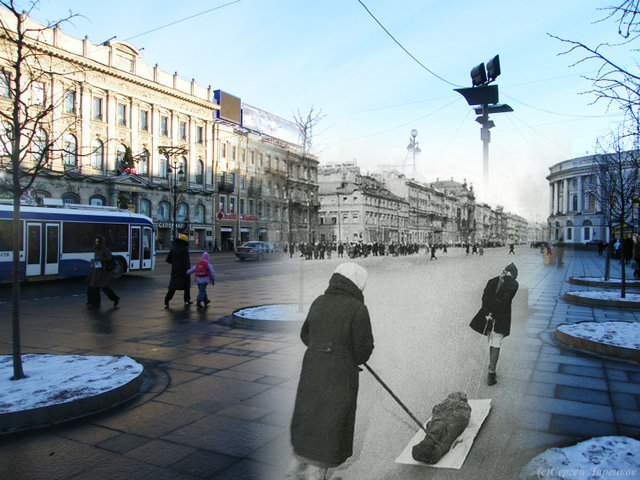 Sergey Larenkov, untitled
Larenkov brings WWII into the present---in this instance the Siege of Leningrad (now St Petersburg). The siege lasted from September 9, 1941, to January 27, 1944 with the estimates of death toll for the 900 day siege ranges from 632,000 to nearer 1 million.
Larenkov takes some pieces of those old photos made during those days and overlays them onto the modern city views, respecting the place and angle of view.
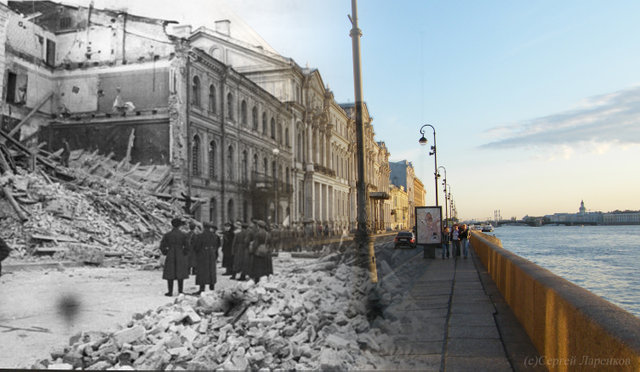 Sergey Larenkov, Palace Embankment
Larenkov's work is essentially a Photoshop-mask-heavy collection of World War II-era prints overlaid on modern snaps. The mergers are jarring in their contrasts, but that's the point.
|


