|
July 25, 2010
The images below are by Lauren Hewitt, a Canberra -based photographer who was trained at the ANU School of Art, is from a series on suburbia in Canberra, entitled Familiar Fable; a series about the ordinary places of the urban landscape that draws on the traditions of film noir. Film noir arose from the collision of German expressionism with documentary realism, paralleling the emergence of "the city" as a character.
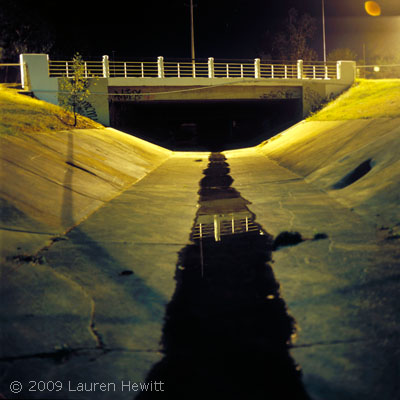 Lauren Hewitt, away from view, from Familiar Fable, 2009
The work was shown at the Huw Davis Gallery at the Manuka Arts Centre in Canberra in August 2009. Cinematic film noir (1940s-50s) is often identified with a visual style that emphasizes low-key lighting and unbalanced compositions, an atmospherics or mood, of small towns or suburbia.
The conventions are dark', downbeat and black and the films express fear, mistrust, bleakness, loss of innocence, despair and paranoia. The primary moods of classic film noir were melancholy, alienation, bleakness, disillusionment, disenchantment, pessimism, ambiguity, moral corruption, evil, guilt, desperation and paranoia. Hewitt says:
This body of work attempts to explore the way the local landscape is represented in the imagination. Capturing locations where sometimes something has occurred, an event, or where there is a hint of a happening, and locations that harbour that potential. Drawing from the traditions of film noir, the familiar scene becomes the unfamiliar. Suburbia, seen from the car window, what we see everyday passes through our awareness, becoming swiftly invisible and unnoticed. Yet glimpses of these shadowed corners can spark the imagination for a fleeting moment, causing the birth of a brief fable, shortly lived, yet lingering.
Film noir films were marked visually by expressionistic lighting, deep-focus or depth of field camera work, disorienting visual schemes, jarring editing or juxtaposition of elements, ominous shadows, skewed camera angles (usually vertical or diagonal rather than horizontal), circling cigarette smoke, existential sensibilities, and unbalanced or moody compositions. Settings were often interiors with low-key (or single-source) lighting, venetian-blinded windows and rooms, and dark, claustrophobic, gloomy appearances.
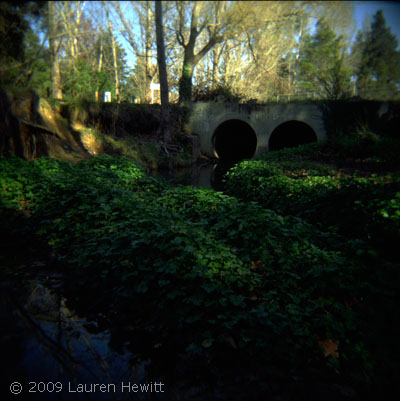 Lauren Hewitt, and here was perfect, from Familiar Fable, 2009
Exteriors were often urban night scenes with deep shadows, wet asphalt, dark alleyways, rain-slicked or mean streets, flashing neon lights, and low key lighting. Story locations were often in murky and dark streets, dimly-lit and low-rent apartments and hotel rooms of big cities, or abandoned warehouses.
Noir is primarily psychological, favoring atmosphere over action.
|
|


The visual or photographic conventions of film noir are subjective camera angles, dark shadowing and deep focus, and low-angled shots.