|
February 29, 2004
I'm on the road--as I have a plane to catch to Canberra.
In the tenth part of the Stephen David Ross interview conducted by Rick over at Artrift Ross says:
"A moving impetus behind The Gift of Beauty [GB] was to be able to think about art and aesthetics beyond the boundaries of art, yet not from another bounded place. I mean not only the institutional forms and practices of art‑‑museums, galleries, and recognized artists‑‑but the restrictions of whatever art called us to beyond art to science, nature, and the world. Beauty served that purpose, both for me and historically. Throughout the world and for the Greeks, beauty has transcended every limit set up for it. Beauty appears at once as the apotheosis of the limit, the superlative of superlatives, and as beyond measure, beyond superlatives and achievements. And if that were not enough, through time other terms came to resonate with beauty to express its transcendences‑‑the sublime, horrific, traumatic."
I will come back to this. Things are too rushed. The passage is very complex. How do you think beyond the boundaries of art but yet not from another bounded place?
If it is not from the institutional forms and practices of art (museums, galleries, and recognized artists) & the restrictions or limits placed on art from science, nature and society, then how do we think beyond the boundaries of art?
Is a negative dialectics meant here? An aesthetics thinking against aesthetics?
It does not appear to be so since Stephen Ross says thinking about art and aesthetics beyond the boundaries of art, yet not from another bounded place. Are we following Nietzsche and making a turn to the sensations of the body?
That is one is a bit of a puzzle.
Stephen goes onto make another point about the gift of beauty that points to moving beyond the boundaries of art. He says:
"The gift of beauty, the expressiveness of things, the world as aesthetic phenomenon, become the proliferation of the image. I'm interested in the production and dispersion of images as the expressiveness of things‑‑that is (my mantra), as exposition: exposure as expression, calling; as aisthêsis, mimêsis, poiêsis, catachrêsis, technê; as image, aesthetics, beauty, art; calling as giving. I mean to understand the expressiveness of things as calling and as giving from the good, that is, as ethical. I see the exposition of things as calling us to respond to them and to care for them, to cherish them, insofar as they always promise more than we take them to be, promise more than they are. "
I can understand the proliferation and dispersion of images in the sense of us living in a visual culture and understanding these as images as exposure and expression.
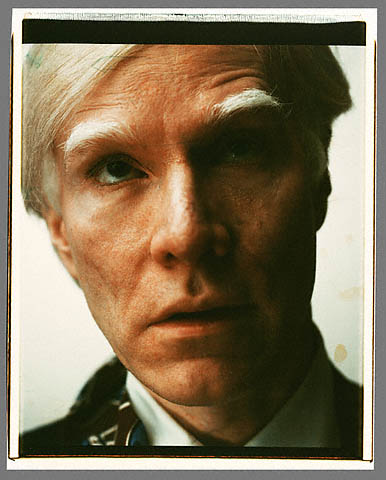
Andy Warhol, Self Portrait, 1979.
With Warhol we step from the art institution into the wide visual culture
Ross makes another point. Art as a calling, as a giving that invites us to respond to things and to care for them, to cherish them? Well I can get that:
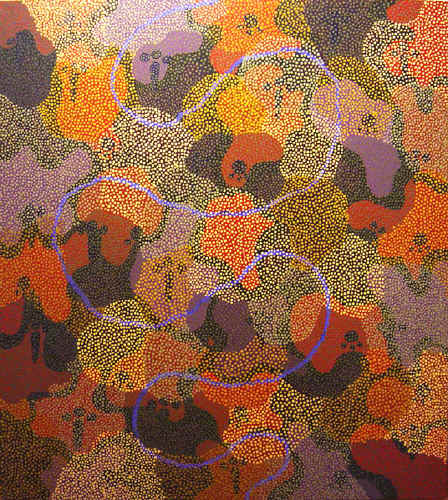
Malcolm Jagamarra,Lander River, 1999.
It is care for country.
What this kind of work does is reconnect artworks to the ethical (by which Ross means the good.) I accept that move because I accept that art in a society which harms people should help to ease their suffering.
That is the best I can do under the circumstances.
next previous start
|


Stephen Ross writes: '...Beauty appears at once as the apotheosis of the limit, the superlative of superlatives, and as beyond measure, beyond superlatives and achievements.'
Aesthetics, it seems to me, does far too much of this – eulogises a vague, ill-defined entity it calls ‘beauty’.
Try substituting ‘God’ for ‘beauty’ in the above. Works, doesn’t it? Try ‘perfection’. That works too. As does ‘excellence, ‘the superb’, 'my girlfriend', etc, etc.