|
April 18, 2007
The growing availability of access to the means of production of images, sounds or text means that there is a lot of digital self-activity in art and politics happening. Lots of people are making images, good ones. The images in postmodernity appear, are everywhere, and then vanish, leaving barely a trace. It's all about the flow.
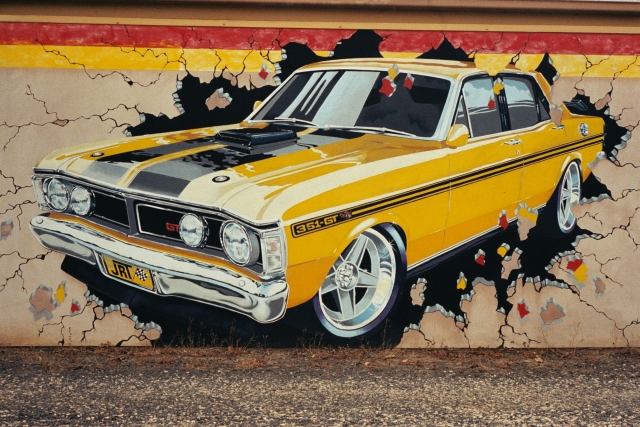
Gary Sauer-Thompson, mural, Goolwa, 2007
If self-publishing on the internet is a welcome development, then the buzz words, ‘user-generated content’ and ‘democratised media’, express a deep-seated unhappiness with the current media; an unhappiness expressed in blogging, photo-sharing sites and other forms of personal publishing. Self-publishing on the internet is less vanity publishing as claimed by some journalists, and more an expression of our desire to have more control of our representations.
Remember how Time magazine has voted us digital wannabes “The Person of the Year” for “seizing the reins of the global media, for founding and framing the new digital democracy, for working for nothing and beating the pros at their own game”? It is true that access to the media of visual representation has undergone a radical democratisation, one driven by the same digital technologies that are consolidating the ability of global capitalism to project its power across cultures. Hence we have a much welcomed pluralism and diversity of voices heard and their images visible.
I'm not sure what the connect is between self-publishing on the internet and the democratisation of art and media in the digital age? How does junk for code further the process of digital democracy? It has nothing to do with beating the ‘pros’ at their own game as I have no desire to be a photojournalist, a professional artist, an academic in cultural studies, or part of the corporate media. How does junk for code challenge the power of the media companies? Though a digital world has given people space to express themselves that is quite different to building forms of democratic governance that can listen and take account of what is being said by these voices and images.
|


