|
April 15, 2007
Web 1.0 is the internet network I've been familiar with in my experience of file-distribution methods in a digital world. I open a Web page and click a link on its structured database to download a file to my computer. If the file is both large and popular, the demands on the server are great, and the download will be slow. Usually the download is fast with ADSL2+broadband.
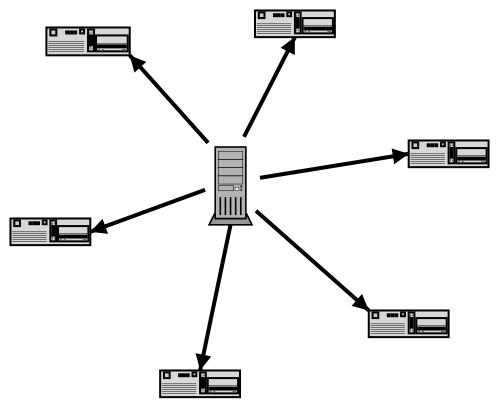
This business model has defined the technology road map and it enabled businesses and government departments to reach out to their customers and stakeholders online, but with limited feedback opportunity.
The internet continues to evolve. We have Web 2.0 where much of the content is generated not by the centre but by its user community. The examples that comes to mind are YouTube, MySpace, or Wikipedia, not your traditional business company or government department. The latter's digital platforms have little connection with user-generated data, other than as a coat of paint. In Web 2.0, the focus shifts from the computer to the internet, and to a more decentralized network.
When I was looking around for an online copy of the 5 CD of the Band's A Musical History over the internet, using the free BitTorrent software I've downloaded onto my PC I enter another kind of network. I pick the title from a list. I've stepped into a peer-to peer one network, which some commentators view as a giant bandwidth-suck.
P2P technology basically began with Napster in 1999 as a method for users to share MP3 files (digital music) over the Internet. P2P technology uses a system of end-user computers that facilitates the transfer of digital information. P2P used to fall into two models, Napster and Gnutella, which have many variations. Both models do not use the classic client-server configuration but a client-client configuration. The significant difference in the two models is the Napster model maintains a master list of files and users while the Gnutella model has no such list.
The new development was bit torrent: a technology that will probably change the landscape of broadcast media since people getting their TV online, will drastically change the nature of the medium.
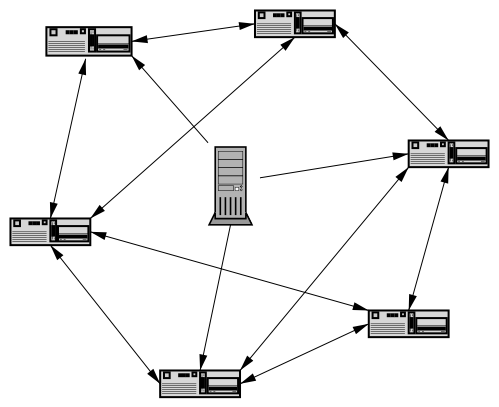
Leslie Ellis describes what happens next:
In the background, you get what’s called a “tracker,” which watches every other BitTorrent downloader of that title. In the BitTorrent lingo, the thing you want is the “torrent.” Those who have the whole thing are the “seeds.” They dole out chunks of the digital thing you want. Your tracker interacts with seeds and other BitTorrent trackers, to fetch the chunks you need. For a popular movie, it’s not unusual to see 30,000 downloaders pulling from each other, and from 200 seeds, the authors found. Once you get swarmed with the whole file, you, too, can become a seed. The more you share, the better download performance you get.
That's a simplified view of how swarming works in a peer-to-peer network. In my case I searched for an obscure or old file (the Band's A Musical History) that was probably available on only one or two hosts.

Apparently BitTorrent accounts for an astounding 35 percent of all the traffic on the Internet -- more than all other peer-to-peer programs combined -- and dwarfs mainstream traffic like Web pages. P2P has become one of the most prolific sources of viruses, worms, Trojans, spy-ware, and other undesirable software, and so represents the personal risk the user incurs from the use of P2P software.
I presume that those who desire music are pulling it on the Web. Like me they’re going out and finding it, but unlike me, most of them are they’re searching for great new stuff.You can hear music before buying it. Suddenly, the major the labels’ business model is in trouble as they no longer controlled exhibition and distribution. However, distribution is only one part of the music industries much larger business structure, as they are also in the business of A&R, the finding, filtering and amplification of new talent. The recording industry has lost everything on the cultural and artist side of things and so what they do is use their money and lawyers to bully the competition and consumers.
|


