|
April 26, 2007
I intend to post an image a day from the Kangaroo Island series for a while, as well as doing some other posts. The images can be seen as an exploration of a particular and special place (Kangaroo Island) in a globalised world, whilst the commentary makes a space for understanding art outside of the discourses of truth (value-neutral knowing) and morality (right action), which have dominated a positivist and utilitarian modernity.
We stayed a couple of nights in one of the lighthouse cottages:This particular image is of a little bay to the east of the Cape Willoughby lighthouse. It can be read as a representation of the beauty of wild nature as it has a degree of calmness about it:
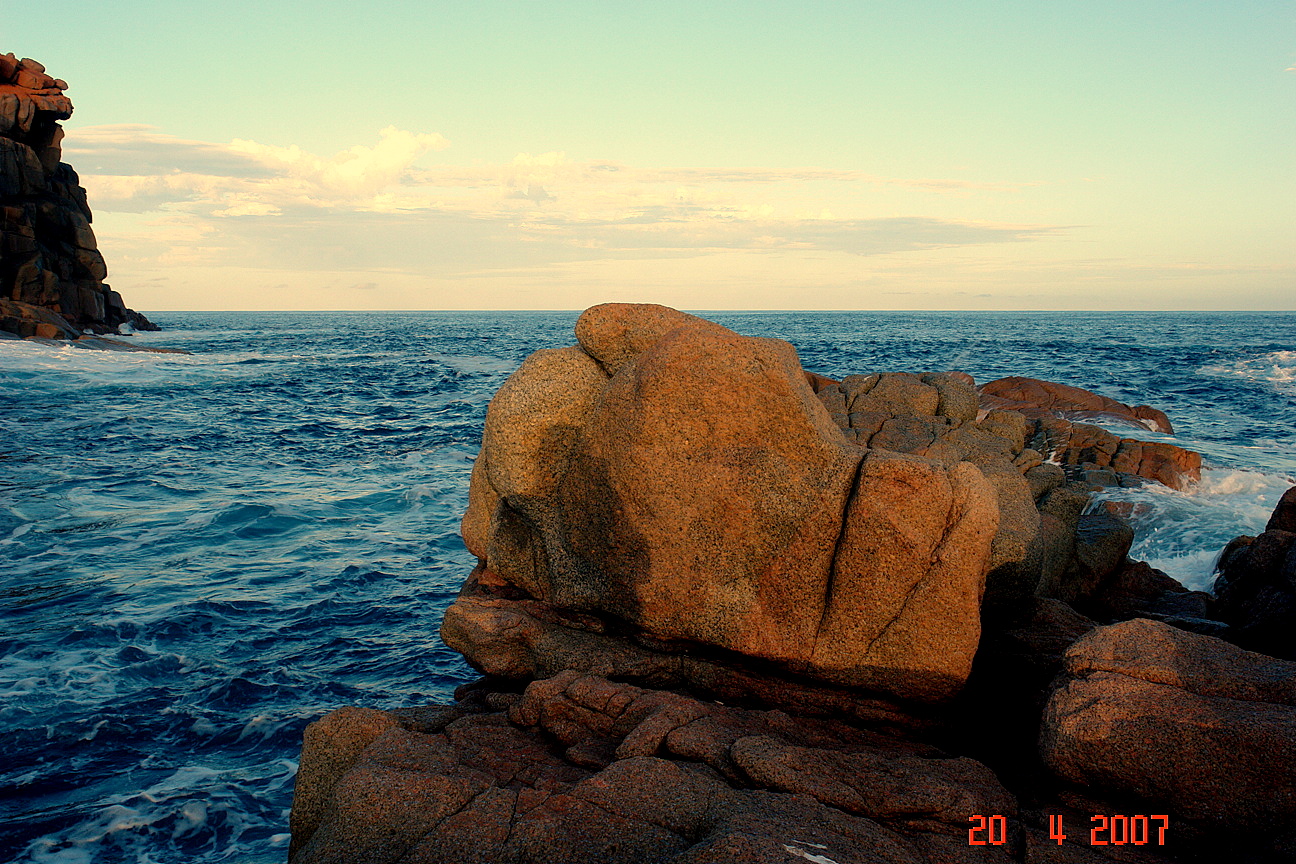
Gary Sauer-Thompson, Cape Willoughby, Kangaroo Island, 2007
This particular wild space was both beautiful and sublime. Whilst tin this space I kept on thinking of Eugene Von Guerard's Cape Shanck. In this case the spectator of natural sublimity experiences a situation of being overpowered by the size or energy of the sublime phenomenon: the power of a surging or raging ocean.
Could we argue that for around the last century, the arts---as opposed to tourist images--- have not had the beautiful as their main concern as some contend, but something which has to do with the sublime?
If we go back to Edmund Burke we find that his reconceptualization of the sublime consisted in adding the factor of fear or terror. The fear or terror in this instance is one of being swept away by the seas. It spells danger. Schiller contended that the sense of well-being that arises when one contemplates a stormy sea from the safety of the shore can never by itself become a source of the sublime. The sea needs to be sufficiently threatening to pose a danger to us.
For Kant in The Critique of Judgment (1790) the very idea of a sublime artwork is a contradiction in terms. The sublime does not designate the product of an artistic practice as such. Even when experienced the sublime is entirely contained in a subjective experience determined by a certain relation between the powers of reason and imagination. I would want to change the Kantian feeling of the sublime into the characteristic or a property of artworks themselves.
A well known European example of the sublime:
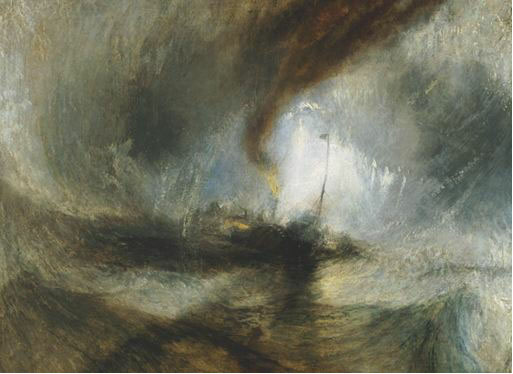
J. M. W. Turner, Snow Storm: Steamboat off a Harbour's Mouth, 1842, Oil on Canvas.
We can then begin to read the sublime and art historically and so grasp and understand a certain kind of history.
|


