|
May 26, 2008
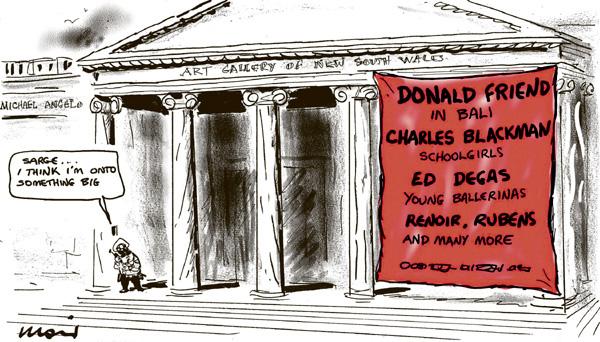
As those in the art institution continually point out there are lots of images of nude females in the world's art galleries and on the multitude of internet art sites. Art has gone online in a digital age. Moreover, there has been previous exhibitions of Bill Henson's work in Australia with little comment about the sexualised nature of kids. So Henson stands in a tradition consisting of Donatello, Caravaggio and Murillo and Balthus.
 Alan Moir
Why the fuss now? So why close down Bill Henson's exhibition? Why choose Benson's current work to make a stand? Why wage war against Benson and the art institution? Why run the crazy line that Henson is a pornographer who abused the trust of the young girls and exploited them with their parents collusion? Hetty Johnson's claims about Henson corrupting the young cannot be taken seriously, given that the models and their parents are saying the opposite. Moreover, if Henson's intent was to produce a work of art and solely a work of art, then I cannot see how Henson has committed a crime, despite Hetty's Johnson claims that he has.
More broadly, why do we this deep concern and anxiety about teenage innocence, young female bodies, nudity and sexual exploitation? Henson's work discloses the anxieties, fears and concerns. It's a catalyst as it were that discloses a culture of fear.
If we take this broader perspective, then what is disclosed is the link off naked teen girls to pornography, pedophilia and the extensive depiction and exploitation of young women in our society for commercial gain. There is a moral panic happening, and it is one based around the politics of fear and social deviance. The moral panic is specifically being framed in terms of morality by the mass media, as it is being expressed more as outrage, rather than fear per se. Behind the outrage lies the concern for social control over those who are defined as a threat to society's values, community standards, and interests’.
The issue is one of the sexualisation of adolescents – especially girls – in the media, by which is meant a thirteen-year-old model pouting from the Weekend Australian Magazine’s fashion page. Clive Hamilton, in todays Crikey Daily, states the case for those concerned about the sexualisation of children:
Over the last decade or so advertisers and the wider culture have increasingly eroticised children. They have been over-loaded with adult sexual material and have had attributed to them forms of adult sexual behaviour, including being dressed, posed and made up as if they were sexual practices at their age is fine. Children as young as eight and nine are now routinely treated in this way.
This has been a recent phenomenon ─ previously it was only teenagers of around 16 or more who were presented this way ─ yet it has occurred slowly enough for most Australians to be inured to it or to accept that that is just how the world is. After all, when even respectable retailers like David Jones eroticise 10 and 12-year-old girls in their advertisements, it is easy to dismiss any objections we may have as peculiar to ourselves.
The eroticisation of childhood means that we have been conditioned to see children differently, as having adult sexual characteristics, urges and desires. How else can we explain why we seem to accept mothers going shopping with 12-year-old daughters dressed like prostitutes? Why are we blasé about pre-teens watching video clips show anal sex is a "personal choice"
A line needs to be drawn in the sand. Yet there is little challenge to the way young children are being bombarded with sexual images from the broader media. From this perspective Henson's work is similar to that in the Weekend Australian Magazine's fashion page, but pushes the boundaries as it involves more nudity. Henson photographs naked adolescents--teen girls (the boys have been forgotten).
The reason for this kind of biopolitics is that Henson is being used by conservatives to take a stand, and help to ignite the moral panic about the sexualisation of kids in order to create public support for the need to "police the crisis. The media play a central role in the "social production of news" in order to reap the rewards of sex and crime (pornography and pedophilia ) stories.
Internet pornography and its accessibility to children has been perhaps the longest-running moral panic of the last decade, with its emotions of fear, loathing and outrage. The fear is justified. Why the fuss now, especially when the same industry that made the panic possible has produced the tools to filter out the tools to deal with it as concerned parents can now download software to block offending websites and protect their children?
Moral panics have a tendency to occur ‘at times when society has not been able to adapt to dramatic changes’ and when such change leads those concerned to express fear over what they see as a loss of control. The internet stands for loss of social control as images can circulate all over the world in a flash.
|


I am not a prude or ultra conservative. I grew up with great exposure to art & artists & am now a mother of two 8 year old daughters. Although I have not seen all of the images in question from what I have seen I do not believe they are pornographic. However I have no doubt that some of the images could be used by paedophiles for sexual excitement.
This issue is not about pornography it is all about the exploitation of children. While I agree with Andrea Wilson (SMH letters p. 12 26/5/08) that I would prefer to take my daughters to the uncensored exhibition than read a Dolly magazine there is no way I would give permission for my daughters to pose nude for anybody or anything & I wonder if she would. The Herald also quotes Zahava Elenberg who posed for Henson at age 12. She was positive of the experience & now as an adult & parent is supportive of Henson & his work. However she did not pose nude & therefore the comparison is not at all valid.
The fact that these images or some of them have been posted on the internet should be of great concern to the parents of the child & does of course change the nature of the issue as stated by Clive Hamilton.
As a parent I did not need to know that the UN Convention of the Rights of the Child makes it clear that parents do not have the right to give this sort of consent on their children's behalf. Quite frankly it seems obvious that it is completely inappropriate as no parent can be sure of how the child will feel about it when they are older.
In regards to the issue of exploitation I understand that Henson's work sells for six figure sums even if the girl received some monetary renumeration it is obvious that Henson has a lot more to gain (& not only money) from exhibiting & selling his work than the models he uses. If this is not exploitation then I'm not sure what is. It really doesn't matter if his intentions were noble if the result is somewhat less.