Mandy Martin, Puritjarra 2, 2005. For further information on MANDY MARTIN, refer here: http://www.mandy-martin.com/
If there are diverse kinds of knowledge and ways of knowing place, then we need to learn to value the different ways each of us sees a single place that is significant, but differently so, for each perspective.
adrift on a sea of information at a time when the world's night is a destitute time. In the age of the world's night, the abyss of the world must be endured.
--Adelaide is home. Relaxation is Victor Harbor. I'm a frustrated photographer who has lost his way in life.I have trouble coping in the technological mode of being of our complex digital world.
This interview with Bill Henson is courtesy of Nicholas Pickard at the Sydney Arts Journo blog. It is Leo Schofield interviewing Bill Henson on the Ovation; a digital cable tv channel l that I've never watched and know little about.
I introduce the interview because there is a common judgement that Henson's photographs are disturbing (repulsive and distasteful are the words often used), and that, consequently, his motivations in making these images are questionable. A contrary way of thinking about the issue can be found at both Pavlov's Cat and Sorrow at Stills Bend. Both are well worth reading.
I've juxtapositioned Henson's comments with an eloquent expression on this post at Audrey and the Bad Apples ----of the view that finds Henson's work very disturbing.
Clemintine Ford, an Adelaide journalist says that the Henson photographs that she saw:
placed the subjects in very vulnerable poses, downcast eyes and hesistancy in the way they held their bodies. It seemed to me that the poses were primarily a construction of Henson's visions of sexuality. This doesn't mean they're designed for sexual gratification, nor that he is intentionally pornifying them. However, in the same way I would find images of passive, unresponsive naked women cast in a dark metaphorical forest quite arrogant and offensive (as supposedly insightful art), I found the photographs released last Friday quite repulsive in terms not of the children's bodies but in terms of the photographer's eye.
This why there are legitimate reasons to question Henson's motivation here and his procedures. At this point we do need to listen to what Henson is saying about his work, as opposed to making things up or projecting.
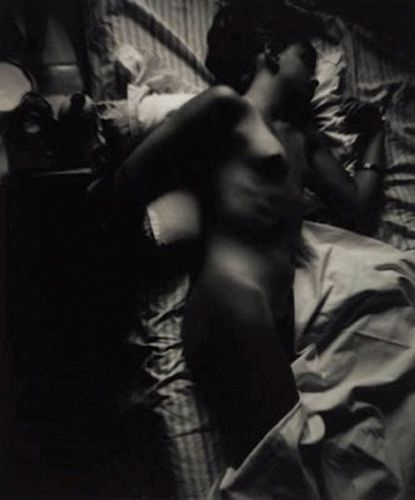
Bil Henson, Untitled, silver gelatin print,?
A critical examination of Henson's work is much more fruitful than assuming that these works are kiddie porn or that art should not be criticized from the perspective of mainstream values. If we do this then can begin to see that Henson's photographs explore loneliness and desire with states or moments of transition and metamorphosis in everyone’s lives. Adolescence as a growing towards adulthood, is an uncertain and ambiguous period as there is some knowledge and certainty as well as a tenuous grasp of adult life.
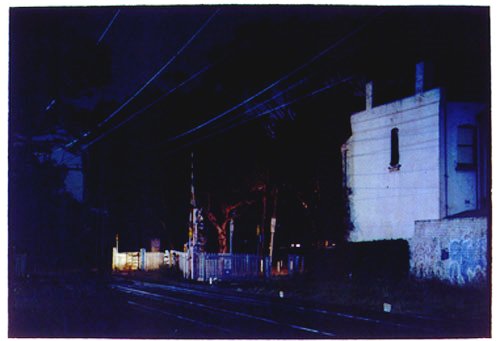
This in between state is also found in the landscapes --the wasteland, or the spaces between the shopping mall and the petrol station:
Bill Henson, untitled, 2005
The lonely suburban landscapes with the night light are both locally familiar (Melbourne) as Russell Dengnan points out and eerie. The eerie refers to solitude; intimacy; transitional, incommunicable states; desecration, melancholy and moments of self-mourning.
Update: 28 May
Sebastian Smee in The Australian gives a context for the darkness or the twilight world of Henson's photographs when he says:
We live in a society that has less and less time for ambiguity. It is a society of maximum visibility. And yet the values of brightness and transparency that are so emphasised in the media are often little more than a veneer for various kinds of bullying. Just look at the way advertising - always so nerve-rackingly upbeat - incessantly cajoles and manipulates children into an awareness of sexuality that is always attached to emotional blackmail and commercial gain.
with other work from the dark repressed space:
As an art critic, every month I see imagery that is revolting, cynical and exploitative in a way that puts Henson's work into perspective. I have been subjected to video footage from a probe inserted into the artist's anus (Mona Hatoum), I have seen mannequins of children with penises and vaginas attached to their face (the brothers Jake and Dinos Chapman) and, yes, I have seen images of naked pubescent and prepubescent children by the likes of Jock Sturges and Larry Clark that I find, for the most part, unredeemed by artistic merit.
Henson's work has artistic merit. We should also take seriously the fears and anxieties about the way sexual abuse of children has become rampant, as the evidence is undeniable and the damage inflicted by those in positions of trust and responsibility is very real.
| Posted by Gary Sauer-Thompson at 8:51 AM | Permalink
It has rightly been mentioned that childrens' lives and surroundings have been sexualized by our culture. I can't help thinking that Henson's recent pohtos do this too, but in a very explicit way, although artfully lit and without the mainstream media tackiness.
I just can't quite emotionally grasp Henson's psychological underpinnings. We are looking at lost and vulnerable souls, some looking frozen in a bluish light, all of them appearing passive.
I see nothing of a struggle with adolescence, there isn't any moment of struggle, just passivity.
These children look indeed like they could be manipulated and used, the fact that they are naked adds considerably to that unease. In fact, the nudity adds a strong sexual note, could the artist not have explored aforementioned issues with clothed models or portraits or children in their natural surroundings?
The fact remains that we are looking at naked, passive children who show considerable unease in their postures, expressions and by the way they are photographed, what is it that the artist finds intriguing about that?
Henson's models have always looked interchangable representing a type rather than individuals.
I just get a very strong feeling that these photos are very much about the artist's sexual and psychological preocupations and not about any given child shown, issues surrounding adolescence or what have you.
Barbara,
Yes there is a common feeling of unease about Henson's naked teens. You put it well in your comments on the Henson thread at the Melbourne Flickr site:
One thing that puts me off is that these kids are shown to look vulnerable, passive and helpless. Some of the photos have a bluish light that makes them look like they're freezing.The mood is such that the kids look like they are not really in charge, they seem somewhat lost and dazed. This does seem to invite a predatory gaze.
Why a predatory gaze rather than the male gaze? Isn't predatory a bit swift, even if the male gaze has a predatory dimension?
Re your comment above:
We are looking at lost and vulnerable souls, some looking frozen in a bluish light, all of them appearing passive.
I see nothing of a struggle with adolescence, there isn't any moment of struggle, just passivity.
Mostly, yes, but not all. There are some images of teens being being active in expressing their sexual desires.
Re your comment:
The fact remains that we are looking at naked, passive children who show considerable unease in their postures, expressions and by the way they are photographed, what is it that the artist finds intriguing about that?
Well, naked passive children with sexual desires trying to make sense of their desires alone in a twilight world? Their world is not that of the child nor the adults.
They only have themselves to deal with their sexual conflicts. I'm not sure that it is simply a case that it's all about what we want to phantasise into it, we are just looking at models in a studio who act out someone else's phantasies. That places Henson's art too much in a vaccuum.
Barbara,
your comment below strikes a chord with me:
Henson's models have always looked interchangable representing a type rather than individuals.I just get a very strong feeling that these photos are very much about the artist's sexual and psychological preocupations and not about any given child shown, issues surrounding adolescence or what have you.
Henson has been doing this kind of work for 20 years or more with girls and boys. The models get younger.His work doesn't change that much.
Maybe its both a case of his preoccupations---as an artist---and exploring issues around teen sexuality in our culture. The commentary is not really exploring what these issues might be. It is still caught up in the issue of an indecent image under the Crimes Act, folk devils and exploitation
There is no doubt of Henson's excellence as an artist, and his work does rub us where it itches, as good art should do at times. But what is he saying with these images from a netherworld of darkness? They are clearly not art about art. He is saying something about the world of teen sexuality in our society, but what?
Pam,
one of your links is to an article by a Melbourne psychologist in The Age. Steve Biddulph says:
Tens of thousands of parents now deal with the tensions in their daughters and sons as they struggle with self-image concerns they rarely had a generation ago, and teens themselves have to deal with the assumption that they will have sex long before they feel emotionally ready.
He then says:
This is a media-created problem, and art is just another media, though one that we might hope was more creative and less harmful.
Maybe its not just a media problem? Maybe, from Henson's perspective, it is an existential problem?
We need to beware of 'the prude' we harbour in ourselves which daren't contemplate that nudity in children or young persons should ever be 'signified' in any way shape or form let alone as 'High Photographic Art'.
Had Bill Henson sculpted his young models in 'stone' ala Michelangelo or Rodin or painted putti on ceilings re Renaissance palaces no doubt critics would have been all too blasé with their 'uninterested reviews' about passé style.
Clearly, 'The Photograph as Art' can be too honest for 'The Dishonest' to gaze upon.


It has rightly been mentioned that childrens' lives and surroundings have been sexualized by our culture. I can't help thinking that Henson's recent pohtos do this too, but in a very explicit way, although artfully lit and without the mainstream media tackiness.
I just can't quite emotionally grasp Henson's psychological underpinnings. We are looking at lost and vulnerable souls, some looking frozen in a bluish light, all of them appearing passive.
I see nothing of a struggle with adolescence, there isn't any moment of struggle, just passivity.
These children look indeed like they could be manipulated and used, the fact that they are naked adds considerably to that unease. In fact, the nudity adds a strong sexual note, could the artist not have explored aforementioned issues with clothed models or portraits or children in their natural surroundings?
The fact remains that we are looking at naked, passive children who show considerable unease in their postures, expressions and by the way they are photographed, what is it that the artist finds intriguing about that?
Henson's models have always looked interchangable representing a type rather than individuals.
I just get a very strong feeling that these photos are very much about the artist's sexual and psychological preocupations and not about any given child shown, issues surrounding adolescence or what have you.