Thought-Factory.net Philosophical Conversations Public Opinion philosophy.com Junk for code

Mandy Martin, Puritjarra 2, 2005. For further information on MANDY MARTIN, refer here: http://www.mandy-martin.com/
If there are diverse kinds of knowledge and ways of knowing place, then we need to learn to value the different ways each of us sees a single place that is significant, but differently so, for each perspective.
RECENT ENTRIES
SEARCH
ARCHIVES
Library
Thinkers/Critics/etc
WEBLOGS
Australian Weblogs
Critical commentary
Visual blogs
CULTURE
ART
PHOTOGRAPHY
DESIGN/STREET ART
ARCHITECTURE/CITY
Film
MUSIC
Sexuality
FOOD & WiNE
Other
www.thought-factory.net
looking for something firm in a world of chaotic flux

photography in a time of moral panic « Previous | |Next »
June 1, 2008

Christopher Deere makes some good points in an op-ed in The Age about the way that the prevalent public fear and moral panic about paedophiles in our culture impacts on photographers working today. This moral panic, for instance, has resulted in me, as a photographer, working in the inner city. It is here that I can find spaces and the freedom provided by big crowds to avoid the paranoia associated with the moral panic. This paranoia represents photographers as folk devils.
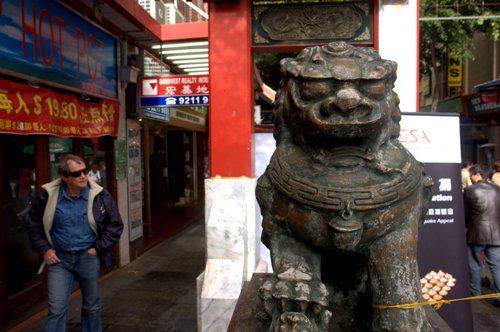
Chinatown.jpg Gary Sauer-Thompson, Chinatown, Sydney, 2008

In his op-ed Deere argues that Australians were fairly relaxed about the confluence of sexuality, young girls, ballet and photography in the 1970s, but now things are very different. He describes this change thus:

That was then, this is now. Now, as a balding and bespectacled nearly middle-aged man, I can hardly walk through a public park without looks of guarded alarm and gestures of defensiveness from the mothers of the children playing there. It probably doesn't help that I still carry a camera almost every time I step out of the house. That instrument immediately turns me into a figure of open suspicion in any public place. I can almost hear people thinking, and sometimes aloud: What is he doing here? Why is he carrying a camera? He looks a little odd; I'd better keep my eye on him.
I have sensed this public fear and suspicion in the suburbs of Adelaide around the 1990s when I lived in inner suburb of Parkside and walked the suburban streets with a camera. It was that experience that caused me to return to living in the inner city. This public fear is much worse now.

Deere describes his own reactions as follows:

I suppose that I should be accustomed to it by now, but I'm not. I can still feel a flash of offended realisation when a young woman gathers her children towards her as I pass nearby, or when a security guard in a supermarket follows my movement along the aisle towards the raw sugar. I'm innocent, I sometimes want to say; I'm really not here to cause you any harm. But that would be pointless, and might only make matters worse. Better to simply go about my own business and leave everyone else in peace.

Behind the current moral panic, he says, are real concerns about the safety of children and young women in this technology-heavy age of the internet. He adds that the apprehension is about who has the right to possess a person's image (and, by implication, his identity), and that this has spread to the point where, not so long ago, a suburban council tried to prevent parents from taking photographs of their children at the local pool.

Update: June 2
Frank Furedi is quoted in Lesley Sands' Moral Panics as observing that reaction to events such as the Henson event:

‘reflect far wider concerns about the nature of society today, in circumstances where people sense that things are out of control’. It is when the ‘traditional norms and values no longer appear to have much relevance to people’s lives’, yet there is the belief that there is little with which to replace them, that a very real sense of loss can occur. And set against this background; people’s awareness of this loss of control over their lives, makes them all the more susceptible to moral panics, and perhaps those that would orchestrate them

If we have the politics of fear, then moral panics are usually expressed as expressions of outrage rather than unadulterated fear, and they are framed in terms of a dominant morality threatened by the activities of a stereotyped group. This group, it now seems, now includes photographers. Photography is now being framed as deviant behaviour within todays conservatism of fear.

| Posted by Gary Sauer-Thompson at 11:08 PM | | Comments (17)
Comments

Comments

Dear Gary: Hello; I am Christopher Deere, and I am very surprised to see a response to my essay appear so quickly in the wider culture. (But I do wish that you had paid a little more attention to the spelling of my name). I wrote the piece more than a month ago, long before the kerfuffle over Bill Henson's photographs had blown in on the wind, and the opinion editor of The Age accepted it immediately (in the middle of April) but needed to wait until enough space was available for its publication. (And, as it now happens, a timely issue with which to associate it.) So thanks for the airplay, although I think that you could have been a little more expansive in your own expression of the issue. I'll be in touch again soon. With my regards, Christopher

Christopher,
my apologies for mispelling your name. I have corrected the mistakes.

We're becoming like the 'primitives' we've laughed at for so long, who are supposedly afraid of losing their souls if photographed. Yet at the same time we're plastering ourselves all over the place at MySpace and Facebook, putting ourselves under permanent public surveillance at the Big Brother house.

Gary,
male photographer friends of mine have mentioned this feeling of suspicion against them. they see it as irrational and are upset by it even though they agree with the need for child protection, and agree that the rights of children to be protected and free from sexual exploitation.

Lyn,
In yesterdays Crikey Daiiy Hetty Johnston from Bravehearts Inc. says that:

As we see it, this debate is fundamentally around two major issues. It is a contest between those defending As we see it, this debate is fundamentally around two major issues. It is a contest between those defending the historical rights and freedoms of the Arts and those defending today’s rights and freedoms of our young. One can not be achieved without the sacrifice of the other. Too, it is about the law itself – particularly the understood meaning and definitions of the language under the law such as ‘child p-rnography’, ‘sexual context’, ‘intent’, ‘consent’, ‘artistic…public benefit purpose’, ‘dissemination’, ‘possession’. What do these definitions mean in today’s ever changing technologically charged world? We know that art is no longer confined to the walls of the gallery, exclusively accessible by only its visitors. Today’s technology means Art is shared or ‘disseminated’ globally within minutes. The content of these images then attracts a wider audience and also comes under the scrutiny of various jurisdictions and statutes.

For Johnston the historical rights and freedoms of the Arts need to be sacrificed to defend the rights and freedoms of our young. She adds that:
We do not believe that any adult should be free to usurp child protection laws for their own personal satisfaction -- be it artistic, monetary or sexual. This comes at the expense of the rights and freedoms of children and plays directly into the hands of those who want to liberate children and young people from the laws which protect them.


Christopher
you write:

So thanks for the airplay, although I think that you could have been a little more expansive in your own expression of the issue.

The post situated my photography within your comments; and by implication the work of other photographers. I used me to illustrate and confirm your point about photographers being seen as perceived threats. There were links back to earlier post on moral panic, which in turn, linked to this article on moral panic by Lesley Sands that built on the groundbreaking work of Stanley Cohen. The Sands article talks in terms of the:
... ‘folk devil’ is a ‘deviant’: someone engaged in wrongdoing and whose actions are considered harmful to society. They are deemed selfish and evil and thus substantial steps must be taken to ‘neutralize’ their actions, in order to allow a return to ‘normality’

Linking photographers to folk devils and deviancy can be interpreted as expanding on the issue. The update has a link to a number of books on moral panics.

From the perspective of the Sands article we can see that the media in the Henson event has been involved in an orchestration of a panic within society; a campaign that implies that paedophiles are everywhere and could be anyone.

Lyn,
Betty Johnston and her mass media friends are engaged in an old ritual that succeeds in tapping into something that has been an integral public humiliation that generates solidarity-through-exclusion.

This also provides a way to indulge in the sexuality of children without admitting to any actual interest in that sexuality.It also direct attention away from real, likely, sources of harm that are hard to face----most child sexual assault is perpetrated by someone the child and family know and trust---and instead focus on those “bad guys”--- the pedophiles who are downloading all the images of sexualised children disseminated on the internet by art galleries.

Dear Gary (and others): Good grief - what a busy conversation I seem to have started (or perhaps simply butted into). I'm certainly glad that I'm not the only person (and especially not the only man) who feels this way; in only the past day since the publication of the essay have I had three distinct discussions with men (and one woman) who have been through much the same experience as photographers in public places.

So I entirely agree with the view (no pun intended) of Frank Furedi: that something much more unsettling is taking place in the wider culture and perhaps even in the wider existence of humanity, so that a psycho-social over-reaction is provoked in people and communities who would otherwise never feel any real alarm at the state of the world. Witness the disturbing escalation of random and irrational public violence in recent times: I take this to be an unconscious defensiveness against a range of economic and environmental factors, such as the niggling awareness of climate change and the passing of the production of peak oil (not to mention a looming global shortage of food and the probable collapse of the world financial system).

At such an unstable and potentially terrifying time, it is almost no small wonder that a total stranger will snap at me for pointing a camera in his general direction. I don't want to blame him, because it isn't entirely his fault. And it certainly isn't mine. The heart of the matter comes down to this: that people are afraid of losing any control over their own sense of recognition, towards themselves as well as towards others. So as long as we have birth certificates and passports and motoring licences and e-mail addresses and telephone numbers and wedding rings - in short, as long as we're always prepared to allow someone else, in some measure, to determine who we are before we are willing to take on that version of recognition as some part of our own self-determination (i.e., some part of our own individual identity), we will all always feel a little unsettled, even uneasy, about who we are or who anyone else might be.

A photograph makes a permanent statement about this uneasiness, which is why it means so much for us to be in control of how and when and why our images are created and made available. The picture of Dorian Gray is a portrait of any one of us, now and forever.

Christopher,
you say

the past day since the publication of the essay have I had three distinct discussions with men (and one woman) who have been through much the same experience as photographers in public places.

A woman? Our accounts were gender specific. It was the mal photographers who were causing the anxiety in public places.

How are women causing that anxiety about folk devils?

Gary,
Long ago when I was in the magazine industry a Sydney newspaper published a front page photo of a couple passionately kissing in a public park on Valentine's Day. Unfortunately it turned out they were both married to other people.

The debate then (1990 or thereabouts) was not about adultery or what's appropriate behaviour in public, but about photography of the public without their consent.

You say that fear of kiddy fiddlers has spread to include photographers, which appears to be true in the Henson case. But what about more generally?

Christopher's point about uncertain identity is a good one I think. In a way, people seem to think that when they're in public they're still private, or still have privacy, or something like that. The camera somehow violates that privacy in a way that the gaze of others doesn't. Yet they'll go home and upload all sorts of stuff onto YouTube, in some cases (kids in the park for example) exactly the same stuff a photographer might have shot.

Hey Gary, excellent topic to look at at this point in time. Fascinating. I think it is no mere coincidence of timing that Christopher Deere's op-ed piece in The Age was actually written by him more than a month ago - he certainly was picking up on something that has just exploded, with some of the unfortunate Bill Henson's artwork as an incredibly powerful catalyst.

I'd imagine that most people reading Deere's piece would assume it has been written during the last few days as a reflection on the whole furore over Henson's controversial recent photographs. And yet it was written well before then.

Henson's intense, dark photographs of adolescents were a "train crash waiting to happen" as I read on a post on a blog recently (sorry I can't recall exactly where, I have been reading so many on the Henson matter.) And I guess the climate we are in at the moment, together with a very frank, undisguised photograph of a naked girl in the midsts of puberty, has resulted in a huge train crash. (Also stirred up into an even bigger storm by elements in the main stream media.)

I am glad that Christopher Deere made reference to Frank Ferudi, I visited his website and it is very interesting, thank you Christopher, I had not heard of Ferudi before.

Dear Emma (and others): I would like to make it clear that the first reference to the work of Frank Furedi in this weblog discussion was not made by me, but rather (I assume) by Gary in one of his updates to the original posting. I was aware of Furedi's work at the time of the writing of my essay, but certainly not in such great detail that I had it in mind in my exploration and expression of the issue. So I, too, have since hived off to chase up some more of that background for my own understanding.
My thanks to all of you for your ongoing involvement in what has surely become a much-needed and vital public discussion about a serious moral issue. I have been surprised and heartened by the level and volume of the response; I definitely did not expect that so many people would pay so much attention to what I had to say. I do feel reassured by the fact that I wrote and submitted the essay well before the present fuss about the brilliant artwork of Bill Henson. But then the issue had been niggling away at me for quite a while, so I could have been even more clairvoyant if only I had put myself to the bother some time ago.
So, keep talking; and keep carrying a camera, because that's the only way that other people will eventually realise what photography is for: memory and history, in public as well as in personal terms.

I have just read a new article on the SMH website, "Child porn web broken by 70 arrests"

"Dozens of men have been arrested for child pornography and abuse offences - including community leaders, a police officer, a teacher and a youth worker - after the nation's biggest anti-pedophile investigation." It is a really horrendous article to read, and is quite a long, detailed article, well worth reading. It explains some of the ways investigators can catch those they are investigating, using computers and the internet back against them. The problem seems so horribly vast - "Perhaps most disconcerting is the scale of the internet child exploitation. As many as 3.5 million child abuse images are on the internet and cannot readily be removed."

One of the investigators said - "There are kids that international police around the world have seen grow up through these images. We can't identify them and that is very frustrating." What a heart-breaking thing to read, just foul.

And I couldn't help thinking what awful timing for defenders of Bill Henson's work, and for Henson himself, that this particular massive investigation has just been announced in the media, given how much it resonates with some of the issues Henson's recent photographs have ignited. I can easily imagine many people linking the two stories together, following so closely on the heels of one another as they do.

Emma
nude isn't pornography. It's a simple defence but one that needs to be made when conservative Australia goes into a panic about teenage sexuality and nudity.

I agree with you Pam, that nudity doesn't then automatically equate to pornography, not at all. I was just thinking about how sad it is that the recent investigation, which has exposed such a dark glimpse into the existence of people who want to access child pornography, has been announced so closely after Bill Henson's work was heavily criticised by some for itself constituting child pornography (an accusation I don't agree with at all.) It is a confluence of two separate events that are not in themselves connected to each other - and yet I think people could choose to connect them simply because they happened so close to each other. As in it could give people a crude reason to be more prejudiced against Henson's photographs than if they were just thinking about his photos on their own merits. (I hope that helps explains a bit more what I was trying to say.)

Well, Henson is out of the woods, thank goodness, what a crazy few weeks this must have been for him.

Emma,
you are right. People in the conservative movement did want to connect the two events through creating a climate of panic and fear.