|
June 26, 2008
Are we going to see the Internet remain a uniquely open space in which people can create and borrow and learn? Will it break down the elitism in the arts? Or will it become just like television and be all carved up with advertising, where everybody’s directed here or there based on the presence of some advertiser’s investment?
My gut feeling--reinforced by these comments---- is that the digital divide has morphed into a cultural divide, which involves not only access to technology, but also access to the money, training, and time that it takes to be a full participant in online work.
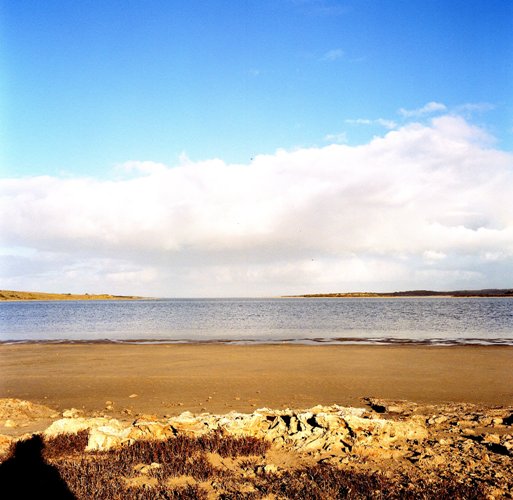 Gary Sauer-Thompson, Murray Mouth, circa 2007
The internet has fostered the amateur in opposition to those people who are held to have special talent, and are separated, given special attention, and are seen as professional artists who "serve" society.The obverse is the tendency to denigrate the amateur.
The Arts Council fosters this denigration by concentrating much of its supportive work on professionals: using the term 'excellence' as a kind of euphemism for professional art-making, concentrating on elevating the top pros and the organizations that they work with, and pretty much leaving the amateur unincorporated art-making piece of the Australian scene off to the side. The amateur's form is the internet---YouTube or Flickr---and this form is largely ignored by the various art councils even though these are very vigorous and very much alive
The aim of the official arts bodies appears to be one of bringing more fine art to the Australian people” without encouraging more people to actually create. Amateurs who might like to dabble in photography, for instance, aren’t empowered by our society (or our schools) to do so.
|


I see that the Australia Council for the Arts has been required to deliver an enforced efficiency dividend. 28 people are leaving the Australia Council through a combination of voluntary and non-voluntary redundancies, to help save $1.8 billion across the entire public service. The Council is making the shift to peer assessment panels through online assessment and other processes.