|
July 12, 2008
Bill Henson gave a speech to open the Picture Paradise: Asia-Pacific Photography1840s-1940s at the National Gallery of Australia.
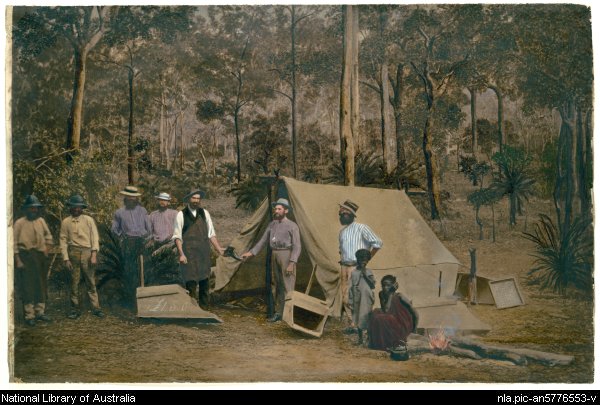 Richard Daintree, Gold diggers, Queensland, circa 1864-1870 albumen photograph overpainted in oil on canvas
Henson says that the Picture Paradise exhibition gives us a encyclopedia catalogue of a vanished world as it was first caught and envisioned by photographers, from the beginnings of photography to the eve of World War II.
And whatever history has revealed, we should never presume to see this vanished world as those who lived in it saw it. Of course, the past is another country and they not only do things differently there; we can only guess at the nature of that difference. And just as we should never presume to fully grasp what for us would be the strangeness of the world-view held by those who lived long ago and far away, so we should be absolutely clear that we cannot know, or fully grasp, the experience that others have, when they are alone -- staring quietly and intently into this strange little mirror on the world -- when they bring life's experiences to bear in each encounter with a photograph. We cannot know what the long-ago subject knew and you and I cannot know precisely what the other sees when she looks at a picture.
He highlights the uniqueness of photography, which he says comes from its profound contradictions: the evidential authority of being a window on a world that can only be reached by the imagination.
Henson's argument is that there the lesson of photography is that there are many truths, not one:
[August] Sander thought he wanted his Spenglerian types, like the Nazis, but instead he gave us a world of subtleties and half-tones. What this exhibition gives us, with great richness and subtlety, is the ambiguity and mystery of a thousand lost worlds what are brought back to us by the power of the imagination and the capacity to wonder. There are signs and there are contradictions of signs.
The use of the word 'signs' opens to another way of talking about the images of photography than Henson's many truths Daintree's image, for instance, creates social meanings, which are then interpreted by differently by diverse viewers in different situations. The black seated female figure produces a multiple of meaning in the colonial context of the destruction of indigenous society. What is the indigenous family on the right doing there?
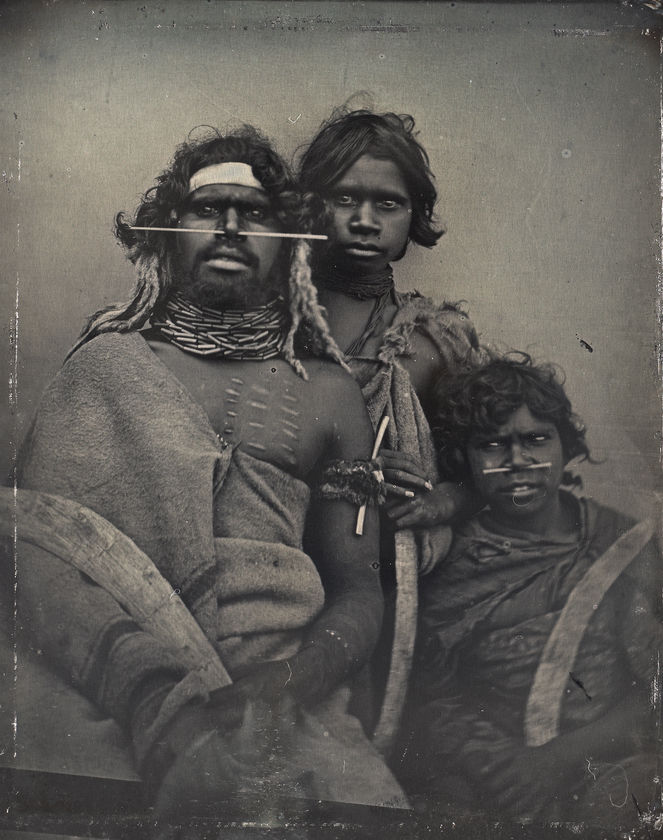 Douglas T Kilburn, daguerreotype of a south-east Australian Aboriginal and two companions, 1847
The daguerreotype was popular for about 20 years before the revolution of photography on paper. Once the latter happened from the late 1850s, photography really took off and had a much bigger public life. Kilburn's ethnographic 'portraiture cvn be interpreted as part of ‘anthropological gaze’, which is one way of describing the dominant character of modernity’s encounter with Indigenous Australia.
|


