|
July 27, 2008
I have made a few steps in learning how to use the Apple Macbook and so I am basically functional.
It is often disconcerting to see the way visual images are reused and transformed. This one cleverly reworks images of Jerry Garcia, the Grateful Dead's song 'Trucking', and the Grateful Dead's Europe '72 album cover design:
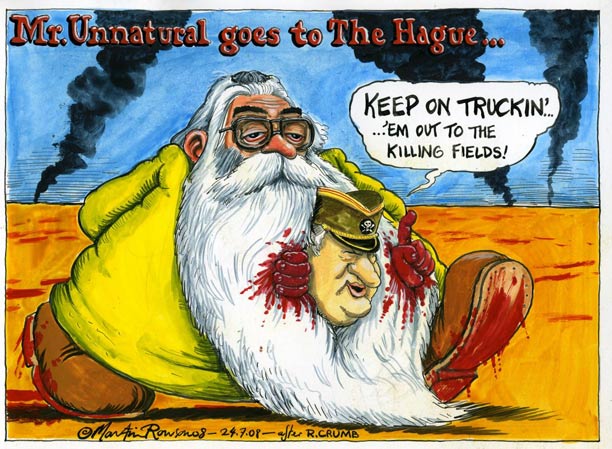 Martin Rowson
It is disconcerting, as we go from an image that is part of an alternative or hippie culture to that of a mass murderer. The rebellions of the ‘counter-culture’ and May ’68 involved a challenge to established cultural hierarchies and this post-1960s popular culture, with its transgressions, enthusiasms, rebellions and anti-structures, was a along way from a blood and soil Serbian fascism based around ethno-nationalism.
The Grateful Dead in turn reworked the work of underground cartoonist R. Crumb. In 1965.Crumb, whose work was (and still is) beloved by college students and hippies, introduced a character called Mr. Natural. His famous slogan, Keep on truckin’, used the word in the first sense of “keep trying” or “keep moving along .”he Grateful Dead were undoubtedly familiar with Crumb’s work. Their song uses the expression in a similar way, to mean “traveling.” Truckin’, first recorded in 1970, tells the story of a journey around the United States and contains one of the most often repeated catchphrases of that era: “What a long strange trip it’s been.”
|


