|
May 4, 2012
As noted in an earlier post Paul Foelsche joined the South Australian Police Force in 1856; in December 1869 he was officer-in-charge of the first police detachment posted to the Northern Territory. He was promoted to inspector in 1873. He succeeded Captain Samuel Sweet as leading photographer of the Northern Territory where his work became the main pictorial record of Aborigines (the Larrakia people).
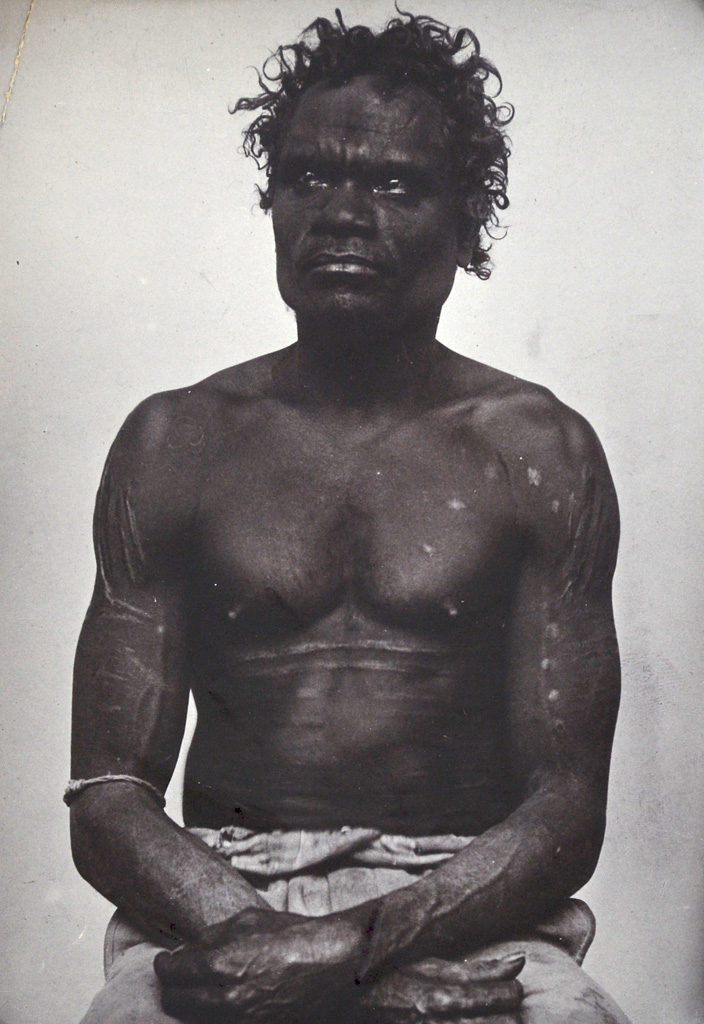 Paul Foelsche, studio portrait, aboriginal man, Darwin
In the late 19th and early 20th century photographs of Australian Aborigines came to be of great interest to European scholars. Aborigines formed the outstanding example of so-called 'primitive society'. The idea of a people still living in the Stone Age (in popular parlance) made information about these 'contemporary ancestors' of utmost importance to the scientific community. Museums played a major role in the dissemination of the evolutionary hypotheses to the general public. To illustrate the earliest stages of human life and culture, the 'primitive' artefacts, skulls and photographs of Aborigines were in demand.
Foelsche's portraits in the late 1870s often took the form of the Aborigines sitting in a chair (a Thonet chair?) next to a graduated ruler. Humiliated and expressionless they are objects of study and they have been given numbers and measurements.
 Paul Foelsche, Studio portrait if Aboriginal man, hand chained at right c.1875, Northern Territory
|


