|
April 30, 2012
Beat Streuli shoots images for his large-scale photographs, videos and photographic installations in dense urban spaces. Often focusing on single people in amidst the constant flow of the street, his works captures both the daily drama of individuals and the rhythm of the multitude.
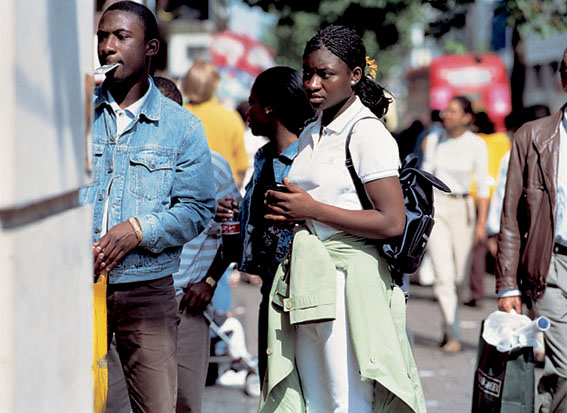 Beat Streuli, Oxford St, England, 1997
He is included in this I Spy: Photography 1938-201 and the Theatre of the Street, 1938-2010 exhibition at the National Gallery of Art in Washington --along with Walker Evans, Harry Callahan, Robert Frank, Bruce Davidson and Philip-Lorca diCorcia. The text by Sarah Greenough, senior curator and head, department of photographs, says:
All these photographs and videos court happenstance, and all these artists view the city as an endless spectacle. In this age of cell phone and security cameras, YouTube and Google Earth, the photographs also make us aware of our uneasy relationship to the camera, suggesting both our fascination and discomfort with its intrusion into our daily lives.
But there are no photographs from security cameras on the street, Google Earth, or the Google's Street View in the exhibition. So it is reduced to the 'theatre of life' on the street and to the personal expression of the artist photographer.
Greenough ought to have been a little more critical of "I Spy" as there are surveillance issues with respect to Google's street view camera on top of a car --ie., the Street View's intentional Wi-Fi data collection program which it processed to see what the "favourite" sites appeared to be.
The Street View project was an ambitious plan to photograph and map the world’s streets that also involved gathering information about local wireless networks to improve location-based searches. It also included code to collect unencrypted data sent from homes by computers — e-mails and Internet searches — as specially equipped cars drove by. That data collection occurred from 2007 to 2010 and Google knew about it.
If we limit ourselves to the frame of the art institution, then we can see that Streuli is part of the "I Spy" world because his ongoing series depicts individuals and crowds caught and framed unawares by the imperious gaze of the camera’s telephoto lens. The photographer remains visibly ‘invisible’ in the sea of pedestrians on the shopping streets of the world’s big cities: London, Tokyo, New York, Sydney.
Streuli, who is sometimes ensconced inside a cafe, then presses the shutter release when the people on the street are in an unguarded state--- when they let the mask of their public persona slip in order to be alone with themselves for a moment in a public place.
 Beat Streuli, Bruxelles Midi, 2006
Bruxelles Midi (2006), a series of photographic portraits made in Brussels at the Bruxelles-Midi railway station and a nearby market, both of which are situated in proximity to the largely Muslim immigrant neighborhood where the artist lived at that time. These are excellent images and Streuli captures the grace and elegance of people often reinforced by the way that he frames them and the way that he balances formal and perceptual concerns.
My problem is with the curator's text. Greebough ought to have been critical of her "theatre of life" concept. Streuli presents a fragmented collage of portraits utterly disassociated from the complexity of the urban high shopping street, because these streets are framed by the signs of conspicuous consumption that seduce potential consumers into buying goods they do not need. The consumer context has been cut out.
|


