|
April 17, 2012
Suzanne flies out to France tomorrow to walk part of the Santiago de Compostela pilgrim walk. She asked me to find out where she could see the photographs of Eugène Atget in Paris.
One reason is that Agtet, our grey standard poodle whom we recently lost at the end of our Tasmanian trip, was named after Eugène Atget.
I'm dammed if I can find any of Atget's work on show in Paris at the moment. I did come across the digital collection of the Bibliothèque nationale de France called Gallica, which has a collection of Atget's images.
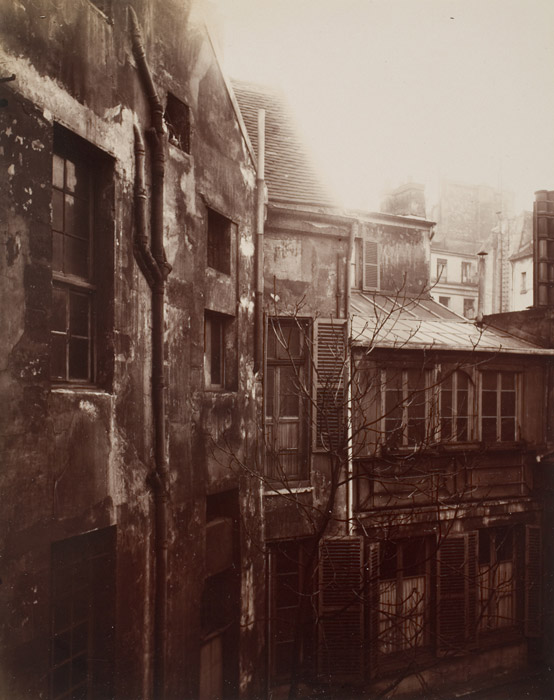
Eugène Atget, Cour du Rouen, 1922
In his early views of Paris, Atget the documentarian sought to illuminate his subject with an even clarity, the best to convey information. He usually made such images in the middle of the day, when shadows were minimal.
Atget's late photographs, however, are frequently marked by light and deep shadows. The ones of the parks and gardens in and around Paris were often made early in the morning. These pictures use light and shadow to create a mood rather than to describe a place:
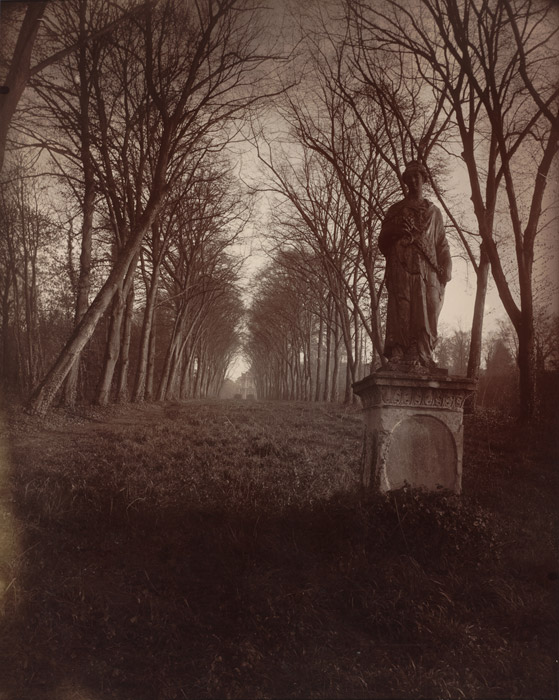 Eugène Atget, Parc de Sceaux, 1925
According to the National Gallery of Art in Washington, Atget made a series of 66 photographs at the Parc de Sceaux between March and June 1925.
Like the other grandiose estates near Paris to which Atget was drawn, Sceaux was saturated with history. Built in the 17th century for Jean Baptiste Colbert (1619–1683), finance minister to Louis XIV (1638–1715), the Versailles-like property was badly damaged in the French Revolution and then partly reconstructed and renovated in the mid-19th century. The regional government acquired the estate, which had fallen into disrepair, in 1923, and Sceaux's buildings and outdoor sculptures were classified as historic monuments in 1925, the year in which Atget made his photographs.
Atget worked at Sceaux just before renovations were undertaken to transform it into a public park. The images that Atget made in the overgrown and partly ruined grounds are suffused with melancholy.
|


