|
December 29, 2007
After Cubism Picasso devised and explored one new experiment in style after another, shifting back and forth between many different modes of representation. I've always had trouble making sense of them, and never taken much interest.
The Dance, a work Picasso made to commemorate the death of his old friend Ramon Pichot in 1925, is frequently cited as a turning point in Picasso's career almost as radical as that of Les Demoiselles d'Avignon in 1907. From this point on, he invented fantastic mutations of the human body with ever greater freedom and expressive power.
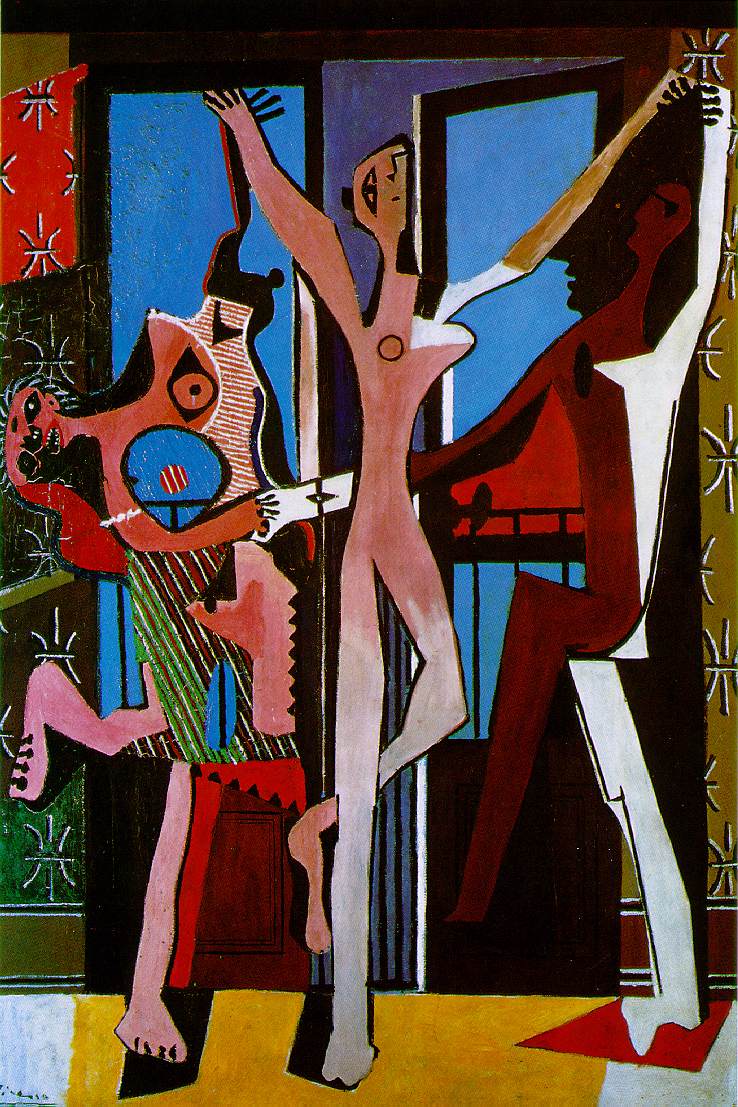 Picasso,The Dance, 1925, Oil on canvas
The shapes are distorted and deformed in the manner of Surrealism, even though Picasso was never a part of surrealism. Picasso's art was always rooted in some concrete reality, no matter how unreal the imagery may seem; even his most hallucinatory pictures are representations of the people in his life and of his emotions for them.
The twinned themes of his new works after The Dance were his erotic rapture for his mistress (Marie-Thérèse Walter) and his anger and loathing for his wife (Olga Khokhlova).
 Picasso, Girl before a Mirror, 1932,Oil on canvas
A love poem painting; but one in which the image of a woman confronts her mortality in a mirror, which reflects her as a death's head.
|


Gary,
Picasso made some demonic images of Olga--she appears as a kind of tortured and murderous monster, all teeth and claws and octopus limbs.