Thought-Factory.net Philosophical Conversations Public Opinion philosophy.com Junk for code

Mandy Martin, Puritjarra 2, 2005. For further information on MANDY MARTIN, refer here: http://www.mandy-martin.com/
If there are diverse kinds of knowledge and ways of knowing place, then we need to learn to value the different ways each of us sees a single place that is significant, but differently so, for each perspective.
RECENT ENTRIES
SEARCH
ARCHIVES
Library
Thinkers/Critics/etc
WEBLOGS
Australian Weblogs
Critical commentary
Visual blogs
CULTURE
ART
PHOTOGRAPHY
DESIGN/STREET ART
ARCHITECTURE/CITY
Film
MUSIC
Sexuality
FOOD & WiNE
Other
www.thought-factory.net
looking for something firm in a world of chaotic flux

DYI street culture « Previous | |Next »
November 2, 2007

Not quite Art part 3 is about art and money. Derelict spaces taken over by artists and turned into studios and DYI bars have led the revitalization of Melbourne's laneways and the development of the local urban culture. The money earned from the bar funds the art projects.

This DYI street culture has led to Three Thousand, which filters the local art happenings and resources on a weekly basis.
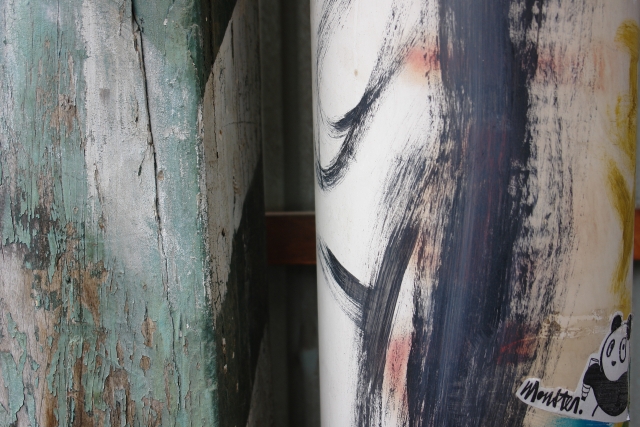
wood.jpg
Gary Sauer-Thompson, monster, Adelaide, 2007

This kind of street culture been picked up by advertisers, marketing executives and designers and it provides the support for magazines such as Unseen Magazine.

| Posted by Gary Sauer-Thompson at 12:03 AM | | Comments (5)
Comments

Comments

Meaningless trivia: my cats name is monster.

Cam,
he must be some cat! I see from your photos that the cats travel with you. Is that right?

Gary,
the third episode was a disappointing one. Marcus Westbury showed how how street culture in Melbourne was dependant on, intertwined with business, in a positive sense. The sense was created of a flourishing cultural scene.

But Westbury didn't really show how the street culture gave rise to the new digital media --the fashion, web designers, photographers, film makers etc.

readers might also be interested in the Is Not Magazine:

"Is Not Magazine is a magazine in the form of a 1.5m x 2m bill poster. It is the work of five young Melburnians, and from April 9, 2005, it has been on display at 50 outdoor poster sites in inner-city Melbourne.. Is Not is independently published, carries no advertisements and is, among other things, an experiment in publishing real content where people expect to find advertising."

copies are also for sale through the website.

Kez,
wasn't Is Not Magazine a magazine in the form of a 1.5m x 2m bill poster that was mentioned about half-way through Westbury's Not Quite Art?

An interesting idea as an example of self-publishing. How does it relate to art and business? The arts and economics nexus was unclear in this part of Not Quite Art. How is Is Not Magazine a creative industry?