|
November 6, 2007
The idea of a city wide Wi-Fi that would be be free, or near-free, because it is seen as public infrastructure is an alluring dream in an information society. What we actually have forming in Australian cities are a few free wireless hotspots plus, in some cases, "private/public" partnerships. That means giving a private company---eg. Internode in Adelaide --- the right to build a wireless network and to try to make money off of it.
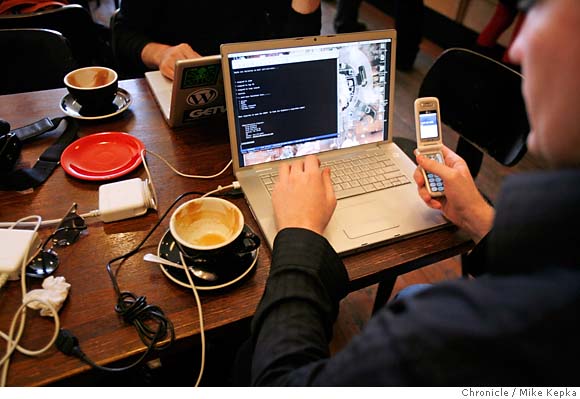
Mike Kepka, office workers, Ritual Roasters, San Francisco.
This has given rise to a new breed of office worker armed with laptop and mobile phone working from independent coffee shops with Wi-Fi -- wireless Internet access.
Tim Wu in Where's My Free Wi-Fi? Why municipal wireless networks have been such a flop in Slate says that:
Setting up a large wireless network isn't as expensive as installing wires into people's homes, but it still costs a lot of money. Not billions, but still millions. To recover costs, the private "partner" has to charge for service. But if the customer already has a cable or telephone connection to his home, why switch to wireless unless it is dramatically cheaper or better? In typical configurations, municipal wireless connections are slower, not dramatically cheaper, and by their nature less reliable than existing Internet services. Those facts have put muni Wi-Fi in the same deathtrap that drowned every other company that peddled a new Net access scheme.
The limited success stories come from towns that have actually treated Wi-Fi as public infrastructure. Real public infrastructure costs real public money, and if you're not willing to invest in infrastructure, you get what we have: crumbling airports, collapsing bridges, and degraded roads.
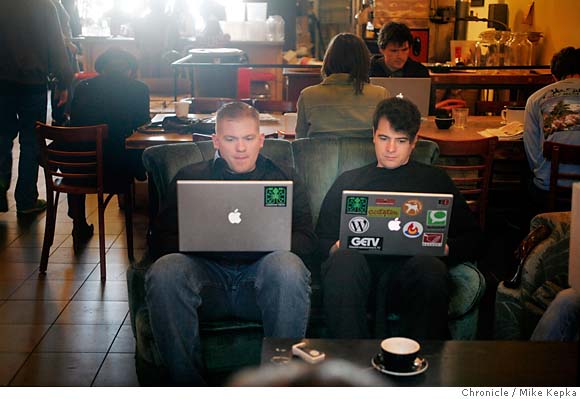
Mike Kepka, office workers, Ritual Roasters, San Francisco.
Adelaide is moving to build comprehensive wireless networks in its central business district by meshing the hotspots.Though I have a telephone connection to my home with ADSL2+ but it would be nice to move around different cities in Australia accessing WiFi hotspots as part of the ADSL2+ account.
From what I can gather a national chains of hotspots, ie., in all major locations across Australia and New Zealand, or a global roaming facility, barely exists--you have to be a geek who loves coffee-- or if it does, it is still outrageously expensive.
What is needed is affordable mass market wireless broadband services across the nation. The global village is not yet.
|


Gary,
I have seen nothing like this down Victor Harbor way.