|
November 13, 2007
I've been tracing my roots as a photographic flaneur concerned with street art to Lettrism a French avant-garde movement, established in Paris in the mid-1940s. It had its theoretical roots in Dada and Surrealism and formed in reaction to Breton's surrealism. It builds on the surrealist idea of urban wandering and the longstanding concept of the flâneur.
Lettrism was a visual poetry movement that aimed to get poetry back into people's lives, and it was named from the fact that many of their early works centred around letters and other visual or spoken symbols.They incorporated letters, numerals and non-Western calligraphy into painting and fused art with poetry to create a music of letters.
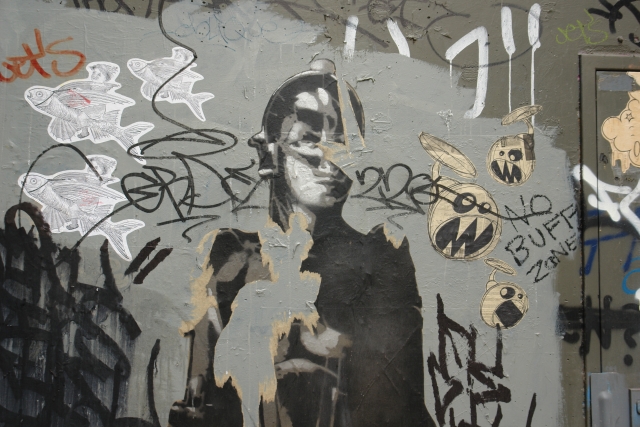
Gary Sauer-Thompson, flying fish, CBD Adelaide, 2007
My interest is in both the movement of Lettrist activities toward the visual manifestations of expression in the later years, as a great deal of activity was in painting and film; and the Lettrist movement's evolution into the Situationists.
The latter aimed reawaken the radical political potential of surrealism: ie., to supersede art, abolishing the notion of art as a separate, specialized activity and transforming it so it became part of the fabric of everyday life.
The bridge between Lettrism and the Situationists is the Lettrist International and its ideas of dérive (or drift) and psychogeography. Dérive refers to an aimless walk through city streets that follows the whim of the moment for hours on end. This urban wandering or exploring is a technique to help us revisit the way we look at urban spaces by stepping outside of our daily route and routine.
If we follow our emotions and look at our urban situations in a radical new way, then we realize that most of our car dominated cities such as Adelaide, Canberra or Brisbane are thoroughly unpleasant because they have been designed in a way that either ignores their emotional impact on people, or indeed tried to control people through their very design.
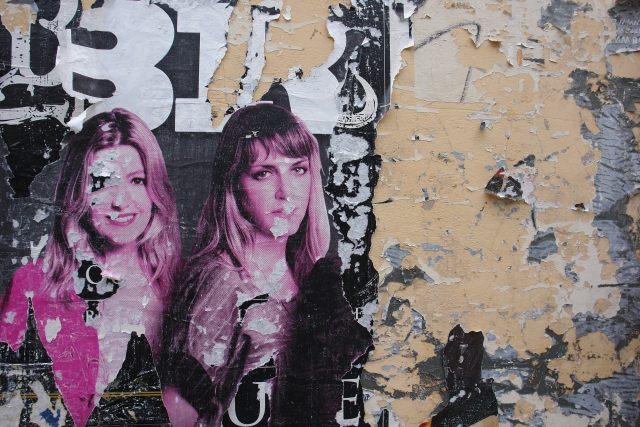
Gary Sauer-Thompson, two girls, CBD Adelaide, 2007
Psychogeography refers whole toy box full of playful, inventive strategies(eg. derive or drift) for exploring cities, and it includes just about anything that takes pedestrians off their predictable paths and jolts them into a new awareness of the urban landscape. and to become aware of a pattern of emotive force-fields that permeates a city.
|


Gary,
It's not linked to the European avant garde, but it lightens one's day. A Nicholson rubbery figures political animation entitled 'Yesterday', with big apologies to Paul McCartney. It's a lament, sort of; and the form and content work well.
Urban exploring is venturing into abandoned structures and sites that are generally entered first by locals, and often sport large amounts of graffiti and acts of vandalism. In terms of genealogy --establishing identity by providing an inventory of historical links in the form of resemblances between that which is unique and that which is general--- the art graffitists can be linked back to the European avant garde through a punk culture. The Situationists are connected to Punk through Malcolm MacLaren's support of situ-inspired activities dating from the Paris uprising.
MacLaren's later creation of the Sex Pistols, the rock band to destroy rock 'n roll, is seen as a translation of the Situationist point of view, as well as their slogans and iconography into a pop music venue.
Another link is Sadie Plant, The most radical gesture: the Situationist International in a postmodern age (Routledge, 1992). A review. The key texts are Debord's Society of the Spectacle; The Revolution of Everyday Life by Raoul Vaneigem; the Situationist International Anthology.