|
November 12, 2007
Sven Lutticken in Secrecy and Publicity: Reactivating the Avant-Garde in New Left Review says that, if the historical avant-garde had failed in its attempt to dissolve art as an autonomous sphere as Peter Burger claimed, then the culture industry had become an alternative cultural force, in the form of the mass media, fashion, music etc. Andy Warhol is the often mentioned example of the postwar or neo avant garde who engaged with the culure industry.
In the 1970's Andy Warhol did portrait commissions of the predominately wealthy and famous--- actors, models, royalty, and society figures. Having their image glorified by Warhol was one way of seeking affirmation of their status as a celebrity.The 'Warhol treatment' blurred their image into a uniformed mass of brightly-coloured 'pop' faces.
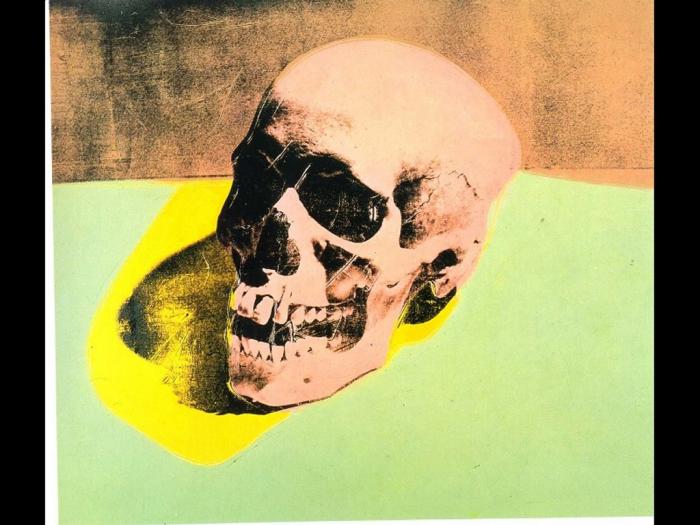
Any Warhol, Skull, 1976, Synthetic polymer paint and silkscreen on canvas.
Warhol's Skull series, produced during this same period, acted as a counter-image to these glamorous portraits. What Warhol signifies is the neo-avant-garde of the sixties and seventies taking the commercial media as a conscious focus for his practice.
Lutticken says:
Andy Warhol, for instance, broke out of the gallery’s white cube by integrating his art into the spectacular economy. His magazine Interview started as an underground film journal, became progressively slicker and ended up as the yuppie-lifestyle magazine of the 1980s. Warhol made the step from the avant-garde to its Doppelgänger, the culture industry. Openings became society events; cameos in soap operas and the labours of the paparazzi put universal recognizability within the artist’s reach. Warholian practice has had perhaps more than its fair share of repetition among contemporary artists: a desire for integration into the worlds of fashion, advertising and pop culture is widespread .... contemporary artists have not abandoned the art world. If anything, they are now able to combine their activities across different spheres with greater ease . ... Now that that world itself has definitively become part of the media, artists who work as veejays or fashion photographers are as welcome in museums and galleries as they are in the glossy art magazines where they might do fashion spreads. Scarcely anyone now makes a distinction between their work appearing in the ‘artist’s pages’, under the editorial control of the magazine, or in an ‘experimental’ ad by some fashion designer targeting an art-magazines audience.
Such phenomena turn Warhol into a prophet, and have undoubtedly contributed to stimulating a wider critical approach to his work that has shed the traditional art-historical focus on his paintings.
In their attempt to escape art’s isolated, autonomous sphere todays neo-Warholian avant-garde often end up as fodder for a perverted avant-garde that they cannot control, or even influence to any significant degree.
Is the culture industry a perverted avant garde? Didn't the avant garde have something to do with utopia? Isn't the theme of utopia tied to utopia being a site in which possible non-capitalist scenarios are worked out, worked through, or otherwise proven not to work at all. Isn't the desire called utopia an imagining of life after capitalism?
|


