Thought-Factory.net Philosophical Conversations Public Opinion philosophy.com Junk for code

Mandy Martin, Puritjarra 2, 2005. For further information on MANDY MARTIN, refer here: http://www.mandy-martin.com/
If there are diverse kinds of knowledge and ways of knowing place, then we need to learn to value the different ways each of us sees a single place that is significant, but differently so, for each perspective.
RECENT ENTRIES
SEARCH
ARCHIVES
Library
Thinkers/Critics/etc
WEBLOGS
Australian Weblogs
Critical commentary
Visual blogs
CULTURE
ART
PHOTOGRAPHY
DESIGN/STREET ART
ARCHITECTURE/CITY
Film
MUSIC
Sexuality
FOOD & WiNE
Other
www.thought-factory.net
looking for something firm in a world of chaotic flux

on the road « Previous | |Next »
October 15, 2007

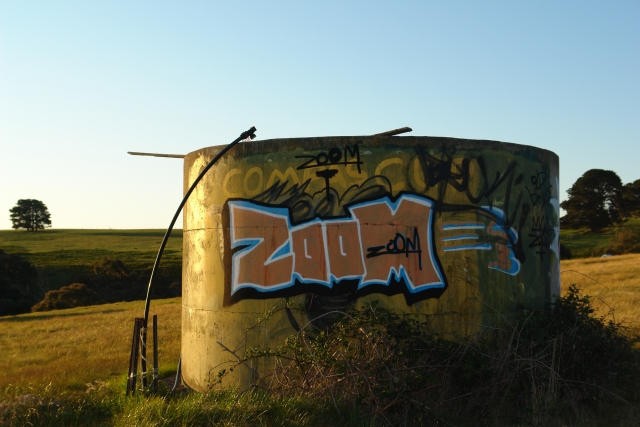
I was traveling back to Adelaide from Victor Harbor in the late afternoon, as I had to catch the early morning flight to Canberra. The sun was going down as we were coming into Mt Compass and this scene caught my eye:
VictorharborRd.jpg
Gary Sauer-Thompson, on the Victor Harbor Rd, South Australia, 2007

I'd been thinking about it still rains regularly in the southern part of the Fleurieu Peninsula and so the land will become prime agricultural land. The dairy farmers will eventually go as the price of water goes up. Will they be replaced by vineyards exporting quality wine?

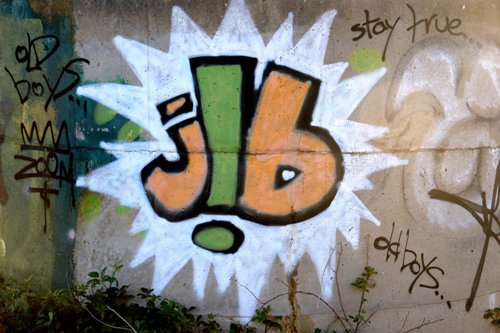
There is more graffiti appearing on the Victor Harbor Road:
graffitiVictorHarborRd.jpg
Gary Sauer-Thompson, on the Victor Harbor Rd, South Australia, 2007

Though it was a quick shot I realized that I'm really struggling with making the transition to digital photography. I'm really glad that I'm no working in the chemical darkroom. However, digital cameras nowadays resemble computers more than anything. They have all the features you may like, they can be tweaked infinitely, and they are more flexible than ever before and you can tweak the image in a darkroom or in Photoshop. So the photographer becomes an image builder rather than a image taker.

My reaction is to all the complexity is to restrict myself and forget about the tweaking.

| Posted by Gary Sauer-Thompson at 5:41 AM | | Comments (3)
Comments

Comments

Gary
Photography and the darkroom are going digital.The economics of professional photography demand this, if nothing else. Resolution in digital imaging technology already matches or exceeds that of film.

The siren call of bigger and better in digital photography is causing otherwise rational people to lose sight of financial reality. Does it makes sense for a non-professional photographer to buy a $US5,000 DSLR?

Pam,
It was only a few short years ago that if one wanted to have a photographic print one either went to a lab or did it oneself. Doing it oneself meant investing in the space to build a darkroom as well as the time and effort to master the traditional art of film processing and print making. Going to a lab meant anything from the corner chemist for snapshots or a pro lab for expensive high quality (sometimes) prints.

Today anyone with a computer (and that means 70%+ of affluent consumers in many countries) can purchase a photo quality inkjet printer, and with a bit of a learning curve make very high quality prints — either snapshots of the kids on vacation, or fine art prints up to 13X19" on their desktop. Print making has been democratized. Computers and inkjets allows more and more people to master the art of print making. Today the skills lie in knowing how to use Layers in Photoshop rather than how to mix alternate developer formulas.

Gary,
Photoshop is arguably the 800 pound gorilla of the digital photography world, and these days digital means photography. Now in its 18th year, the brainchild of Thomas and John Knoll has gone from being a tool primarily for graphic artists and pre-press people, to the dominant program used by photographers around the world.

It is not without its problems though. Now on Version #9 (dubbed Photoshop CS2), the program has been described by pundits as something of a Frankenstein. No, not because its evil, but because it has grown with a part from here, and a part from there – with a feature designed for this constituency, and another for that one. In trying to become all things to all people (at least those in the imaging arena), it has become a heavyweight product, but also one encumbered by a lot of baggage.