Mandy Martin, Puritjarra 2, 2005. For further information on MANDY MARTIN, refer here: http://www.mandy-martin.com/
If there are diverse kinds of knowledge and ways of knowing place, then we need to learn to value the different ways each of us sees a single place that is significant, but differently so, for each perspective.
adrift on a sea of information at a time when the world's night is a destitute time. In the age of the world's night, the abyss of the world must be endured.
--Adelaide is home. Relaxation is Victor Harbor. I'm a frustrated photographer who has lost his way in life.I have trouble coping in the technological mode of being of our complex digital world.
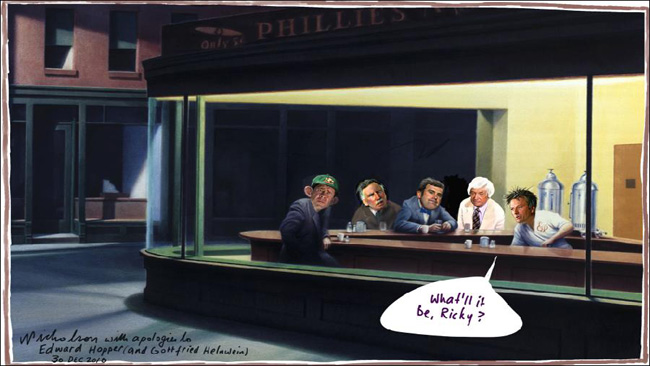
Often the intertextuality is forced and unconvincing. But this works:
Edward Hopper's 1942 Nighthawks captures three customers seated at the counter of a brightly lit all-night diner, all seemingly lost in their own thoughts. It is a dark, evocative painting of, what once was, a New York City diner. The viewer's eye is drawn first to the bright, cold fluorescent light of the interior, but quickly refocuses on the three customers. The three counter patrons are set against the dark background of the nighttime street.
The darkness is not just from the night. There is a psychological darkness here. The customers seem frozen, lost in their own thoughts. Physically close, but emotionally detached, they are separate from one another. it suggests that the pulse of the city as desolate and dangerous with predators lurking.
What we have with the cricket tragics is the feeling of desolation and despair rather than with loneliness or alienation. Australian cricket has lost is shine and glamour. It looks tawdry.
Many artists have produced works that allude or respond to Nighthawks---eg., Tom Waits Nighthawk Postcards:
This is from his third album, Nighthawks at the Diner, in which Tom Waits set up a nightclub in the studio, invited an audience, and cut a 70-minute, two-LP set of new songs.
| Posted by Gary Sauer-Thompson at 5:58 AM | Permalink