Thought-Factory.net Philosophical Conversations Public Opinion philosophy.com Junk for code

Mandy Martin, Puritjarra 2, 2005. For further information on MANDY MARTIN, refer here: http://www.mandy-martin.com/
If there are diverse kinds of knowledge and ways of knowing place, then we need to learn to value the different ways each of us sees a single place that is significant, but differently so, for each perspective.
RECENT ENTRIES
SEARCH
ARCHIVES
Library
Thinkers/Critics/etc
WEBLOGS
Australian Weblogs
Critical commentary
Visual blogs
CULTURE
ART
PHOTOGRAPHY
DESIGN/STREET ART
ARCHITECTURE/CITY
Film
MUSIC
Sexuality
FOOD & WiNE
Other
www.thought-factory.net
looking for something firm in a world of chaotic flux

in Sydney « Previous | |Next »
March 2, 2008

The traffic in the streets in Sydney may be in gridlock but it is possible to get around by rail fairly easily. I was able to go from Mascot to Central to Strathfield and back again with ease and in quick time. It was moving around Strathfield in a car that was the problem. It was a traffic jam. Urban congestion in Sydney is worse on the weekends than the weekday. Hence the Saturday morning mashup.
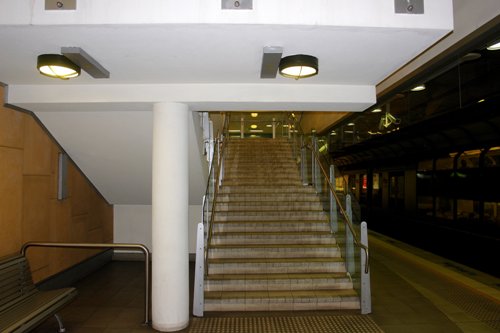
SydneyMascotStation1.jpg Gary Sauer-Thompson, Mascot Station, 2008

Why more money is not spent on improving the rail infrastructure so that people can move around quickly and easily around Sydney is beyond me. From what I can make out, the Lemma Government is wanting lots of money from Infrastructure Australia for motorways: the M4 and the F3-M7 connection are mentioned, along with the Moorebank freight terminals and southern Sydney freight lines.
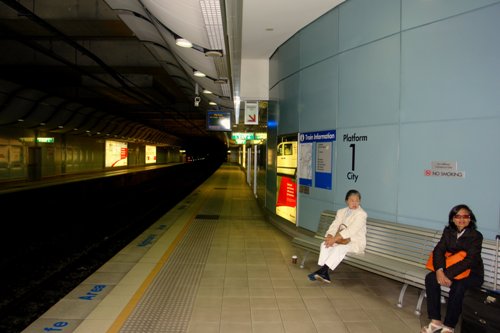
Sydneymascotstation2.jpg Gary Sauer-Thompson, Mascot Station Sydney, 2008

It is now very expensive to avoid the gridlock and travel around Sydney by car on all the tollways. The gridlock is on the suburban roads that are near to, or access, the various motorways. The people who catch the trains to work take their cars out on the weekend and so clog the roads. Leisure time is fighting gridlock.
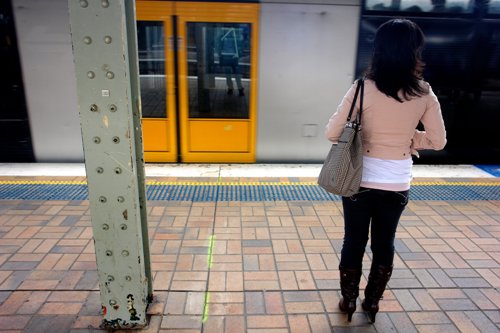
SydneyCentralStation.jpg Gary Sauer-Thompson, Central Station, 2008

The car is not the solution if you want to improve the liveability of the metropolis. It is better rail transport.

| Posted by Gary Sauer-Thompson at 5:14 AM | | Comments (3)
Comments

Comments

Interesting the way people don't talk at railways stations.That is where they come together, yet they avoid talking to one another.

Pam,
people seem to engage more in airports--well, at the Qantas club. The same sense of alienation and wariness is not there as there is in railway stations --there is eye contact. Maybe it is the booze in the Qantas club!

On another note people in Sydney must be so sick of traffic and the high cost of housing. I guess you address the former by living in the inner city, catching the train and walking. Dunno what you do about the latter. It's $500, 000 plus to buy a run down something and another $250,000 to do it up. That's a big mortgage.And its only starters. My guess would be that the inner-city homes tare probably unaffordable even to a professional couple.

There are job opportunities elsewhere now--eg., Brisbane or Melbourne.

Gary,
most Australians feeling the most “mortgage stress” live on the suburban fringe not professionals in the inner city. These outer suburban areas usually have limited public transport, making residents car dependent and more vulnerable to fuel price rises too. They are also experiencing increasing grocery bills and a slump in the price of their over-valued and over-mortgaged properties.

It is expected that between 250,000 and 300,000 will suffer from severe mortgage stress, where they begin defaulting and risk having their homes repossessed.