|
March 15, 2008
The Bidydanga artists are currently being heralded as one of the most exciting art movements to emerge in the Australian and International Indigenous world of art. That gives it the flavour of avant-garde--innovators at the "cutting edge" of art and politics.
This is a questionable framing in a postcolonial culture increasingly shaped by globalization, since avant-gardism, which was founded on an historical consciousness, on its sense of difference from the past, is no longer critical or emancipatory. However, this modernist frame is an improvement on the stigma of negativity inherited by the notion of otherness from the old and never abandoned Western prejudices on primitivity, barbarity and a timeless culture.
Bidyadanga is a coastal town situated 250km south of Broome composed of 4 different Indigenous tribes plus the traditional owners plus the saltwater Karrajarri people. One of them is the extended Yulparija tribe, who came from an area around the Percival Lakes in the Great Sandy Desert (Wirnpa country), in the 1960s.
One of the artists in the Yulparija community is Sally (Liki) Nanii, whos work is grounded on an indigenous sense of place:
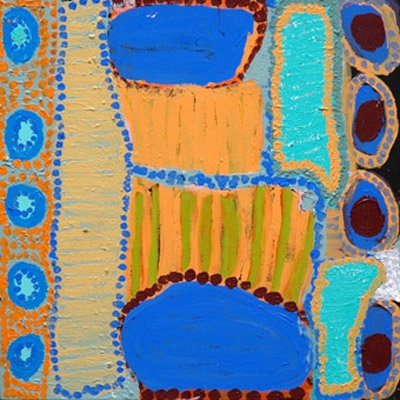 Sally (Liki) Nanii, Untitled, (?), Acrylic on Canvas
When Anglophone philosophers talk about music or film or literature or art it is usually a pretty narrow band of works that are taken as paradigmatic—inevitably these are the works that the writers know, more often than not canonical works in the western tradition. Rarely do these writers venture out of their safe harbour--- ie., of using English words drawn from Western European artistic traditions---to discuss contemporary indigenous art.
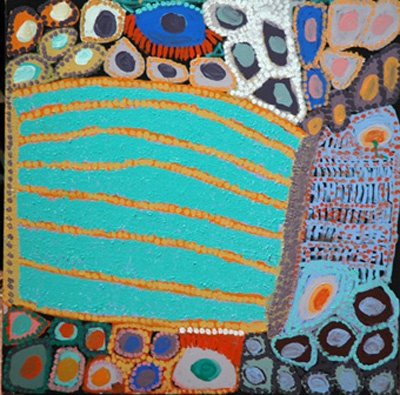 Sally (Liki) Nanii, Untitled, (?) Acrylic on Canvas
This kind of work demands that we do discuss indigenous art. Aboriginal art has been enormously important in enabling white Australia to come to an understanding of the integrity of Aboriginal culture. All those issues of the connectedness of Aboriginal people to the land and the violence of their being displaced from it, for instance, are given a new level of intelligibility through the art.
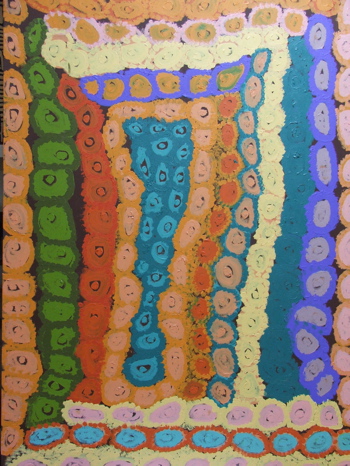 Sally (Liki) Nanii, Untitled, 2005, acrylic on canvas
The growing world market for Aboriginal art has resulted in works that are intentionally transcultural in nature: produced in one culture for use in another. As Aboriginal paintings move from Aboriginal communities to the Western art world, they assume "meanings" and significances, which are unknown or unimportant to their (Ab)original creators. Yet transcultural aesthetics has not yet been appreciated by philosophers.Will post-colonialism provide the opening?
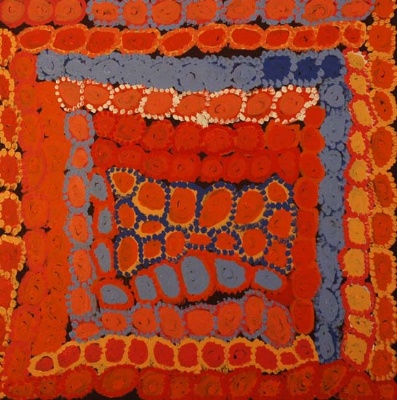 Sally (Liki) Nanii, All the Jila, (?), Acrylic on Canvas
In the meantime we swing between the idea that Aboriginal art originates in a world locked in an ideal pre-industrial past, and that Aboriginal artists offer a passport to this lost garden of Eden; or viewing Aboriginal art through the lens of western modernism; eg., interpreting the later work of Turkey Tolson, Mick Namarari and (especially) Emily Kngwarreye as gradually evolving a high abstract expressionism originating in New York.
|


Gary,
there are still people who deny that indigenous arts are art.In doing so they are imposing an ideology which establishes a hierarchy of what is valuable that allows other groups of people to be seen as less cultured, and that reproduces colonial domination. This maintain a hierarchy of value that makes the artistic achievements of the indigenous people ‘invisible’.
This view is breaking down, thank goodness.