Thought-Factory.net Philosophical Conversations Public Opinion philosophy.com Junk for code

Mandy Martin, Puritjarra 2, 2005. For further information on MANDY MARTIN, refer here: http://www.mandy-martin.com/
If there are diverse kinds of knowledge and ways of knowing place, then we need to learn to value the different ways each of us sees a single place that is significant, but differently so, for each perspective.
RECENT ENTRIES
SEARCH
ARCHIVES
Library
Thinkers/Critics/etc
WEBLOGS
Australian Weblogs
Critical commentary
Visual blogs
CULTURE
ART
PHOTOGRAPHY
DESIGN/STREET ART
ARCHITECTURE/CITY
Film
MUSIC
Sexuality
FOOD & WiNE
Other
www.thought-factory.net
looking for something firm in a world of chaotic flux

Newtown: architecture « Previous | |Next »
March 3, 2008

There is another side to the glossy cosmopolitan image of Australia's global city--- Sydney, Australia's number one, and only global, city. And it's not the One Nation battler suburbs in the redneck western Sydney either.

The image of 'Global Sydney' is that from the perspective of those with jobs in the financial markets, media, advertising, movies, sport and recreation. If you are a globe trotter, returning expatriate, visiting business professional, or even a high-flying rust-belt refugee from Victoria or South Australia, who can therefore afford to live by the beach or the harbour, then Sydney offers an attractive climate, lifestyle and fun people.

The glossy image is that of a big cosmopolitan city and a resort:
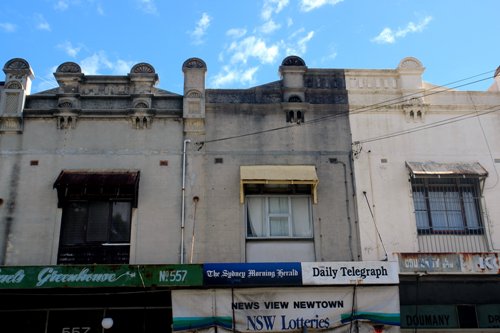
SydneyNewtownshops.jpg Gary Sauer-Thompson, shop facades, Newton, Sydney, 2008

Behind this grunge and decay in Australia's global city we have an inner city urban culture, which provides another reason why people think Sydney is hot, even if they cannot afford Sydney mortgages. An insurgent inner city culture that has broken away from the modernist emphasis on newness and innovation.

This transgressive Grunge culture complicates the narrative tropes of neoliberalism as a healthy, growing, flexible economy delivering prosperity with a conservative humanistic culture providing the means for civilising global capitalism. What is disclosed in the Newton part of the global city is pollution from cars and waste (rubbish); drugs and disease; figures of abjection and melancholy and pornography. It's a sleazy world full of international students using wirelessed internet cafes.
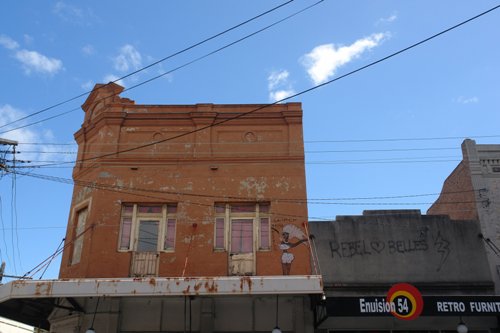
SydneyNewtownrebel.jpg Gary Sauer-Thompson, King Street, Newtown, Sydney, 2008

One effect of a neo-liberal rationality and governance of the global political economy on this inner city culture is that the conservative civilising culture of an Arnoldian-Leavisite project based on the reading of a traditional canon and felt experience has been dumped by many as waste into the council rubbish bins lining the back streets.

SydneyNewton222KingSt.jpg Gary Sauer-Thompson, 222 King Street, Newton, Sydney, 2008

The anglocentric, monocultural heritage, which has been embodied in academic English, the traditional humanities and literary culture, has been displaced by an embrace of cultural studies.

| Posted by Gary Sauer-Thompson at 11:17 PM | | Comments (6)
Comments

Comments

Gary,
have you read the Australian grunge literature of the 1990s and after? I have in mind Andrew McGahan’s Praise, Christos Tsiolkas’ Loaded, Elliot Perlman’s Three dollars and Andrew McCann’s Subtopia. This literature is about lives deformed by the neoliberal governance of the 1980s and 1990s

This is an expression of Adorno's damaged lives in Minima Moralia.

Gary,
great photos of (South?) King Street, especially of the 1st stories which seem to be sitting at ground level with the strip-shops underground.

I like the idea of cultural studies being the only sort of knowledge able to be practised in these streets.

I'll have to read Minima Moralia, Pam.

Michael,
what do you mean by:

'the idea of cultural studies being the only sort of knowledge able to be practised in these streets.'

My photography has its roots in Lettrism and the situationists and so it is about coming to know the city as an artist exploring the city. It's a kind of visual street knowledge. Do you mean something like what Mark Davies argues in this text
Literature, now, looks less like a central canonical cultural form and more like a sub-cultural pursuit. Since the mid-1950s television, cinema, popular music, and design have all staked a claim as sites of cultural knowledge, and have produced social meanings that many find no less compelling than those produced by literature.

Pam,
no I haven't. Grunge culture for me is more visual---1980s tacky street fashion, dirty streets, tacky housing, decrepit shops, wasted lives; post industrial. In music it is Nirvana's Nevermind. It is definitely post punk. It is the fringe festival in Adelaide.

My only exposure to Grunge Lit. was reading Elliot Perlman’s Three dollars in the 1990s. I found that it was too caught up in the Arnoldian-Leavisite cultural formation, for which I little sympathy. I notice that Michael Christie has a good article on grunge literature and neo-liberalism at his Eurhythmania weblog. I like his idea of Grunge Lit as a culture of subversion and critique of neo-liberalism or economic rationalism.

I must read Mark Davis’ argument for a genuinely popular critique of neoliberal marketisation. In this paper Davis talks about the decline of a literary culture:

The decline of the literary paradigm can be understood in terms of broader social and governmental shifts related to globalisation, such as the decline of postwar consensus (‘welfare state’) politics and their supplanting by a new consensus based around free-market notions of deregulation, privatisation and trade liberalisation, and the rise of the global information economy. Seen in these terms the decline of the literary paradigm isn’t simply to do with literature; it’s to do with a broader reconceptualisation of the public sphere itself.

It's the 'broader reconceptualisation of the public sphere' that interests me. Davies goes on to say that:
Literary journals such as ABR and Meanjin and the books pages of broadsheet newspapers have set themselves up as nostalgic guardians of a (mid-list) literary culture at odds with both the ‘postmodernist’ academy and the new commercial imperatives. Their valorisation of old-fashioned notions of aesthetics and artistic autonomy can be understood as part of an attempt to recover art as a space sealed off from market forces.

A more critical ethos in the public sphere depends on dumping the cultural conservative's attempt to recover art as a space sealed off from market forces and politics.

Gary,
I'm glad you're finding something of interest in the posts on grunge lit at my blog.

The Davis quote is something like what I was trying to get at in responding to your image of the literary paradigm's texts dumped in Newtown's back lane bins, and displaced by cultural studies.

I don't know how well the type of critical analysis of grunge literature & music I'm attempting links up with the visual Situationist methods your photos practice, but I feel there is a grunge structure of feeling shared.


Michael,
your posts are very helpful to me. They reconnect me with the concerns of academia, outline ideas that express what I feeling, and point to writings that address the shift in culture that I discern as I explore the urban streets with a camera.