|
March 4, 2008
One of the situationist's techniques is détournement, which involves a displacement of the modernist emphasis on creating the new. It involves the reuse of preexisting artistic elements in a new ensemble through the capturing of various spectacular images and turning them around in a new presentation in order to subvert the authority of the sign and the significations it sets in order.
 Gary Sauer-Thompson poster, Newtown, Sydney, 2008
John Moore in his The insubordination of words: Poetry, insurgency and the situationists says that Debord and Wolman understand détournement as both negation and prelude – not, it should be noted, as negation and affirmation. Negation means that existing structures of meaning are to be dismantled, and through the collision, juxtaposition and collocation of the liberated autonomous elements, a new ensemble of meanings is assembled which confers fresh significance on the new images.
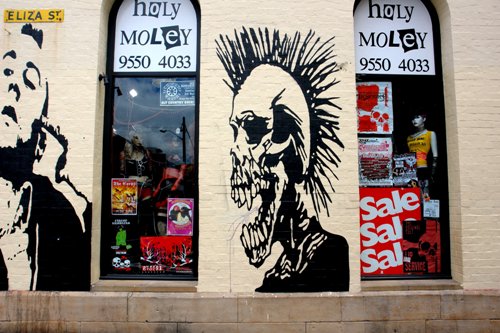 Gary Sauer-Thompson, shop front Newtown, 2008
Détournement provides a way to rethink the work of history in the present to open time that appears to stand still in the conservative hegemony that we have experienced for the last decade. It's also a way to counter the market view of historical time that renders the present in terms of unfolding laws of history. It is a also a way to tear the present out of neo-liberals conception of the continuum of history as the naturally evolving and civilizing free market.
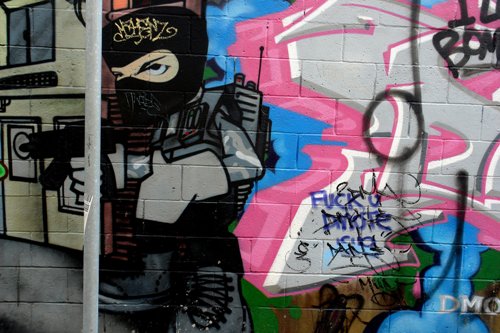 Gary Sauer-Thompson, street art, Newtown, 2008
If the aim is to fracture a seamless present and to lift that present from seamless time, then untimely critique insists on alternative possibilities and perspectives in a seemingly closed political and cultural world.
|


Gary,
your recent Newton photographs can be seen as part of the nostalgia and yearning of Australian critical and imaginative writing towards the authentic, the local, the vernacular and the insular.You pitch the local (Newtown) against the global market flows transforming Sydney into a global city, and then hunt around for a critical edge in the local using a Situationist aesthetic.
What has gone is the old culturally cringing colonial ghostliness which haunted
Anglo-Australians with a deep nostalgia for Mother England and the crude essentialist cultural nationalism based on national character etc etc But this 20th century cultural formation appears to have been replaced by post-colonial and diasporic hauntings that continue to provoke questions about Australian culture’s relationships to a globalised world.
The Humanities are still attached to the local as an authentic expression of ‘homeliness’ in Newtown Australia in opposition to the transnational/industrial/cultural flows.