|
March 23, 2008
Edmund Burke's notion of the sublime referred to romantic notions of ‘terror’ and ‘awe’ in landscape. Burke talked about the sublime in terms of infinity, vastness and intensity of feeling, especially terror and awe, and drew a clear distinction between the sublime and the concept of beauty, which he linked to feelings of pleasure, tenderness and harmony and with things of delicacy and elegance.These emotions of terror and awe could be triggered by steep mountains, or gloomy grottoes.
In the Australian context, with Marcus Clarke, the emotions of terror and awe associated with the natural sublime could also be triggered by the 'weird and melancholic forests'. The Australian landscape was primitive and frightening, the untamed opposite of the English pastoral ideal.
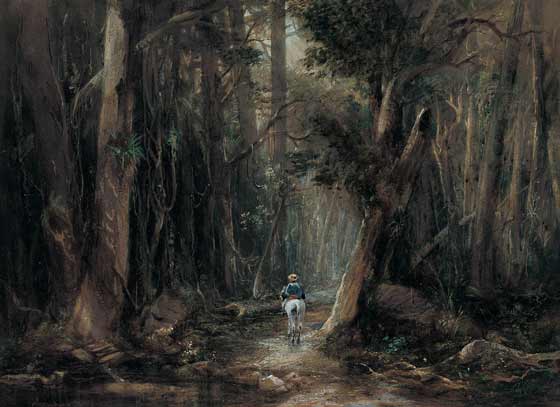 Conrad Martens, Forest, Cunningham's Gap, 1856, Watercolour on paper
The conventional art historical view is that the Australian landscape was seen in settler Australia as very boring and dull and monotonous, and that the artists complained that they couldn't really construct sublime or picturesque kind of pictures out of what Australia presents. Some traditionalists even thought that landscape painting couldn't be done in Australia. They were referring to neo-classical Georgian Claude Lorrain-type landscape.
What was created by Conrad Martens and others is the visual language of the romantic sublime.
|


Gary
This image is quite different from the standard work of Conrad Martens.
He began as one of those professional painters who accompanied voyages to the strange and the new lands. He was a friend of Charles Darwin, Martens replaced Augustus Earle on the Beagle's expedition to South America, then worked on ships across the Pacific, before arriving in Sydney in 1835.
He stayed on painting those luminous, Turneresque watercolours of settled country (eg., Sydney) rather than natural wilderness.