|
March 10, 2008
Deyan Sudjic, director of the Design Museum, has an op-ed in The Observer on cities entitled Cities on the edge of chaos in which he explores the kind of lives we are creating in our cities and asks will citizens - and cities - cope with the fierce pressures of this new urban age.
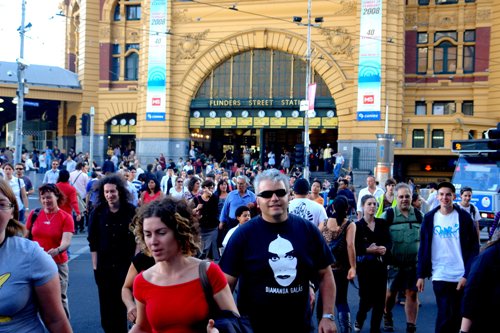 Gary Sauer-Thompson, Flinders/Swanston St, Melbourne, 2008
Sudjic says that we do not belong to a generation that has the shared faith that the pioneer architectural modernists had when they chartered a liner to cruise the Mediterranean and drew up their vision of what the modern city ought to be, the 1933 Charter of Athens written by Le Corbusier.
Its ideas are well known. It's main purpose was to erase pedestrian urban life as defined on vibrant city streets in prewar European capitals. We were offered seductive images of skyscrapers sitting in vast parks long with the strict segregation of uses.
Sudjic adds:
They divided their ideal city into functional zones, shaped by slabs arranged to maximise the sunlight falling on the ground between them.Theirs was a generation that was freed from the luxury of self-doubt. Ours is not and that is why we struggle now when we try to think what cities should be. We have seen too many soured urban utopias that were invented by the architects on that liner, and propagated by a political system that measured success in the number of new buildings that it could deliver each month.
Politicians love cranes; they need solutions within the time frames of elections and cranes deliver them. But there are only a limited number of problems that are susceptible to this kind of time scale. He says that:
The result is a constant cycle of demolition and reconstruction that is seen as the substitute for thinking about how to address the deeper issues of the city.Visions for cities tend to be the creation of the boosters rather than the theorists or the policy-makers. City builders have always had to be pathological optimists, if not out-and-out fantasists. They belong to a tradition that connects the map-makers who parcel up packages of swamp land to sell to gullible purchasers...Cities are made by an extraordinary mixture of do-gooders and bloody-minded obsessives, of cynical political operators and speculators. They are shaped by the unintended consequences of the greedy and the self-interested, the dedicated and the occasional visionary.
The cities that work best are those that keep their options open, that allow the possibility of change. The cities that work best are those that keep their options open, that allow the possibility of change. Successful cities are the ones that allow people to be what they want; unsuccessful ones try to force them to be what others want them to be.
|


Gary,
In this paper by Nikos A. Salingaros it is stated that:
Modernist urbanism, Salingaros says, is easily recognizable once you know what signs to look for. Some of its principal characteristics are: monolithic buildings and vast open spaces; geometrical alignment to arbitrary rectangular axes; elimination of the intermediate and smaller scales; insistence on industrial materials; insistence on the "purity" of form and surfaces.
This goes hand in hand with an intolerance of whatever helps to reinforce the urban fabric, such as pedestrian spaces, semi-enclosed urban spaces, permeable interfaces, folded urban boundaries, remnants of the past, modestly-sized structures, street furniture, and anything that "clutters" an empty minimalist geometry.