|
February 22, 2011
Only five months after being hit by a 7.1 magnitude quake, Christchurch--my hometown--- was again hit by a large, 6.3 magnitude tremor. The latter earthquake was related to the 7.1 magnitude quake that struck the city last September.
The port suburb of Lyttelton, the epicentre of the earthquake, was destroyed. This time round there have been fatalities--- 75 confirmed dead-- as the earthquake happened around midday and hit the CBD hard. At least 100 people remain trapped in the ruins. 300 are still missing.
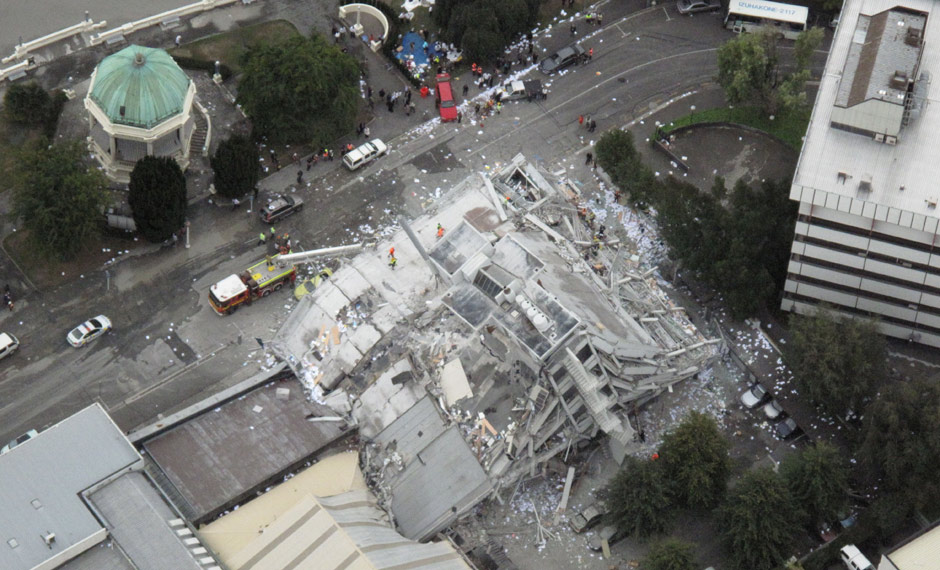 destroyed building, Christchurch, New Zealand, 2011
Many more deaths are expected. The water mains and sewer lines, still under repair after last September, have ruptured. Roads has been buckled up. \The streets are littered with dead bodies. The aftershocks keep coming. The earthquake was at shallow depth and Christchurch is built on silt and this amplifies the seismic effect and causes the process of liquefaction.
My mother is okay. She only lost the chimneys of her house. All I wanted to do growing up in Christchurch was get out. I I watched the raw footage coming through from a live feed when I was at Melbourne airport waiting to fly back to Adelaide.
The strong 6.3 magnitude shake--the main aftershock of the earlier 7.1--- dislodged the soft land around central Christchurch. This means properties around the Avon and Heathcote rivers face further damage, as the soil begins to slip towards the river, taking properties with it.
Update
New Zealand is in a region of extraordinary geological activity called the Ring of Fire, which stretches from Indonesia to the coast of Chile. For every 10 earthquakes on the planet, nine are in this region. New Zealand itself straddles the boundary between the Pacific and Australasian tectonic plates, which slowly grind into one another. In the south island the Pacific and Australasian plates slip past each other horizontally, producing the enormous Alpine fault that runs down the western flank of the island.
Christchurch sits on what is historically a tectonically active area where the Alpine fault runs right across New Zealand's South Island. Associated with this are many fault segments. What seems to have happened is that the pressure has built up on a particular fault segment with the epicentre much closer to the city itself.
|


