
Mandy Martin, Puritjarra 2, 2005. For further information on MANDY MARTIN, refer here: http://www.mandy-martin.com/
If there are diverse kinds of knowledge and ways of knowing place, then we need to learn to value the different ways each of us sees a single place that is significant, but differently so, for each perspective.
|
|
looking for something firm in a world of chaotic flux
|
|
|
British Photography: Herbert Ponting
« Previous |
|Next »
|
|
|
February 19, 2011
Herbert Ponting, the official "camera artist" of the 1910-12 Scott Expedition, struggled to address the relative lack of classical perspective of horizon and scale.
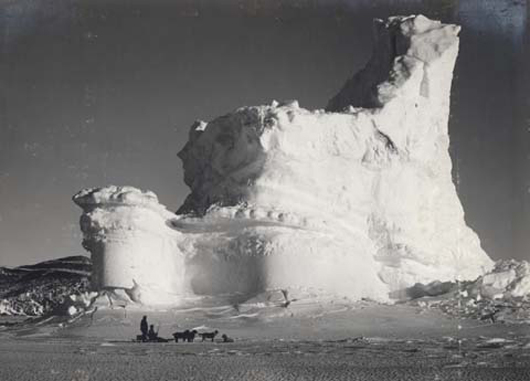 Herbert Ponting, The Castle Berg, 1911
The human-scale figures and the "sublime" icescapes only become meaningful in relation to one another. Elena Glasberg says in the Blankness in the Antarctic Landscape of An-My Lê:
Without human figures, the unfamiliar environment would escape the particularity of place. This paradox of encounter, which fueled the Heroic Age, between an indifferent ice and humans intent on colonizing the uninhabitable, recurs throughout Antarctic photographic representation. It has left deep traces of style, object choice, and perspective on Antarctic representational history, not the least of which is the powerful imperial imaginary of Antarctica as a tabula rasa, or a pristine, untouched, terrain that, as the translation "blank slate" would suggest, invited marking.
The kind of blankness produced by juxtaposing human figures on the ice or staging perspective with the lens is a "filled in" kind of blankness. It is not unlike the blankness of early European maps that designated the southern continent as terra incognita, in words written boldly across the map vellum.
Glasberg says that:
For Ponting, the inviting blankness of Antarctica seemed almost formalist, an aesthetic challenge to create a recognizable scape from such impoverished materials. That his photos were part of an imperial expedition to claim Antarctica and the South Pole underscores the role of cultural concepts in the construction of empire. Ponting's landscapes were more than attempts to fill in the blank of Antarctica with familiar gestures to romantic sublimity: they were claims on the territory created by the camera's eye as much as by the juridical intentions of the British.
Ponting's black and white juxtapositions of ice and human figures created a powerful aesthetic characterized by the trace of the body: the footprint, the track in ice, and the human figure itself. The Heroic aesthetic sees men, ice, materials, and animals all within a range of objects and relations that coordinate towards an inhabitation, a claim. Despite and against their own fragility or marginality to the ice, these marks march toward a future of increased levels of habitation: more marks and more men.
|
|
|
| | Posted by Gary Sauer-Thompson at 8:48 PM | Permalink |
|
|
|
|
|
|
|


